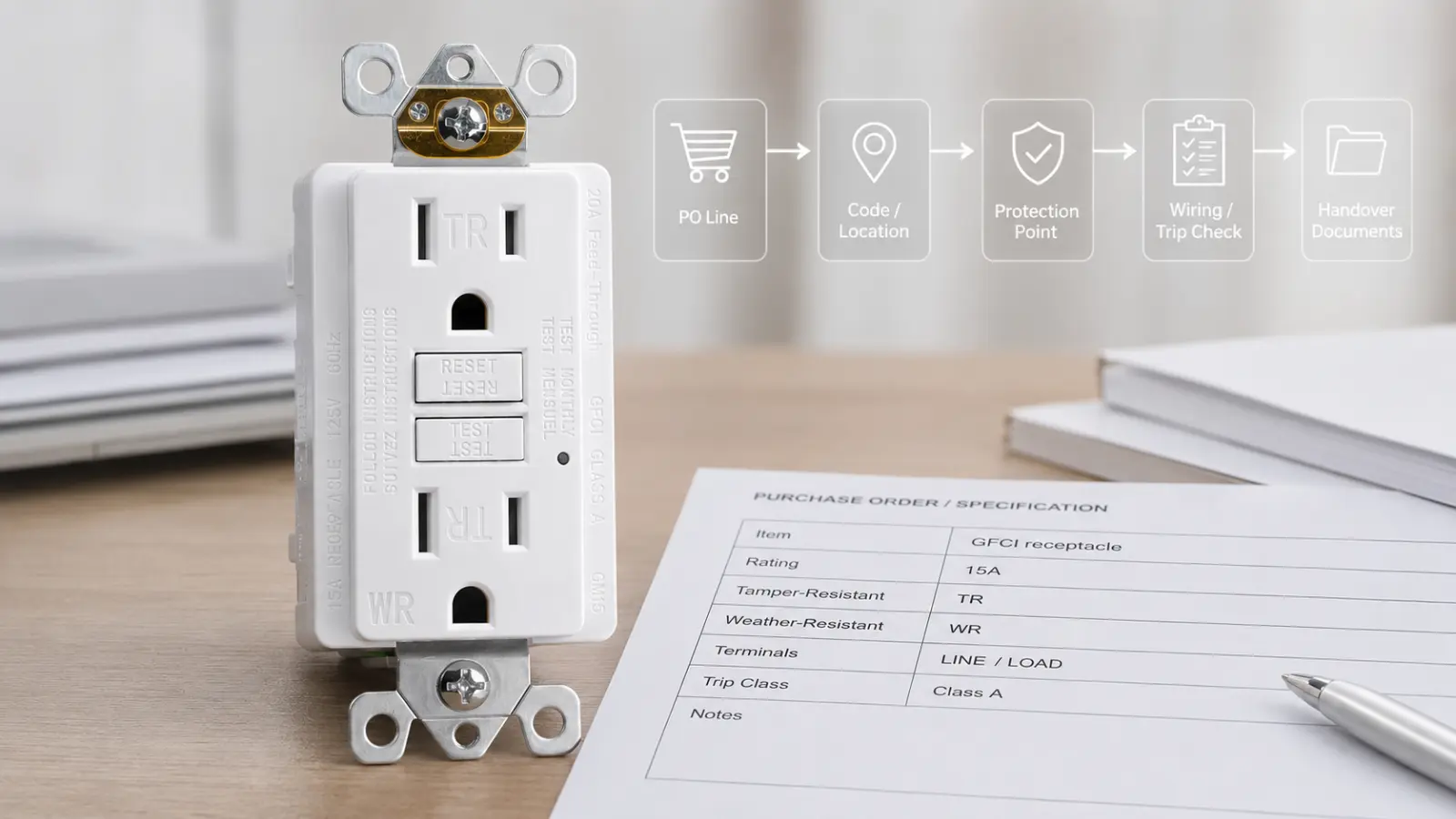
A buyer sends a line that reads “GFCI receptacle, 15A, TR.” It looks finished. Three fields, a rating, a marking — the kind of line a purchasing system accepts without a second glance. It is not a spec yet. It hasn’t said where the ground-fault protection sits on the circuit, whether the reset has to be reachable by the person who trips it, whether the location forces weather-resistant construction, or what the device does when its own protection wears out years later. Every one of those is a decision, and the line skipped all of them while looking complete.
That gap is most of what reaches us from the sourcing side. Not “is this GFCI good,” but a phrase that carried fewer decisions than the project needed and nobody caught until submittal review or a service call.
There’s a second pattern, running the other way. When a GFCI shows up as a problem — won’t reset, keeps tripping, “the whole batch is dead” — the device is the last thing to rule out, not the first to suspect. The circuit, the wiring, a modern appliance’s leakage, a label nobody verified: each of those gets checked ahead of it.
This guide is the map between those two facts. It does not re-explain how a GFCI senses an imbalance — the linked pieces do that. It lays out the order a buyer or specifier actually decides in: where protection sits, which device that implies, what to write down, and what a trip is really telling you. We sell these devices into multi-unit North American projects, so the angle is the part that happens before anyone picks up a screwdriver, and the part that happens long after.
In September 2021 a contractor flew in from Toronto with a folder of drawings for five apartment buildings and one instruction: work out how many of each device the layout needs, using the fewest parts possible. He didn’t hand us a parts list — he handed us the problem that comes before a parts list.
Where the Code Forces Your Hand First
Before any device gets chosen, one question outranks the rest: which NEC edition the AHJ is actually enforcing. The 2026 NEC raised the outdoor-outlet threshold in 210.8(F) from 50 to 60 amps and set the listed-HVAC exception to expire September 1, 2026 — but adoption runs on state and local clocks, and large markets can sit a cycle or more behind the newest edition. A protection path that is correct under one edition can be the wrong submittal under the one enforced next door. The 60A line alone pulls more outdoor disconnect work into the GFCI review than the old 50A threshold did, and which quote-level lines each 2026 change moves is itemized in our 2026 NEC sourcing breakdown.
Two locations carry their own traps. A kitchen island stopped being a “does it need power” question and became “where is a receptacle even allowed, and is the countertop assembly listed for a fixed installation” — which is why we wrote out the island placement rules under 210.52(C) location by location, since that call has to land before the stone is cut. Outdoor HVAC is the other: after the September deadline a one-line “60A GFCI disconnect for outdoor AC” stops saying enough, because the answer might be a standard Class A device, an HF-marked Class A device, or a listed Class C SPGFCI with its own disconnect warning — three paths told apart in HF GFCIs, Class C SPGFCIs, and the 210.8(F) deadline.
The Decision That Comes Before the Device: Where Protection Sits
This is the part most spec lines skip, and the one that drives cost for the life of the building. A properly listed Class A GFCI breaker and a properly listed Class A GFCI receptacle both satisfy 210.8. The code rarely asks “which device.” The real question is where the sensing and the reset belong, set by who has to reach that reset after the room is finished — the tradeoff we lay out in GFCI breaker versus GFCI outlet.
For a hotel bathroom, a rental unit, a commercial kitchen, or any circuit crossing several separate wet zones, I lean toward a device at each location, each fed from LINE. A guest who trips a hair dryer presses a reset they can see; the same trip on a panel breaker becomes a front-desk call. For a straightforward residential branch where the head device sits somewhere reachable, one upstream GFCI feeding standard receptacles downstream covers everything past it for the price of one device — that lever pulled the Toronto job from roughly 8,000 GFCIs to just over 4,500 across the five buildings. The protected points in his design didn’t change; the part count did. The arrangements, and the troubleshooting cost of wiring a GFCI behind another GFCI, are worked through in running multiple GFCIs on one circuit.
Only once the protection point is settled does the device variant matter. A 15A or 20A face. Tamper-resistant where the dwelling-unit rule applies; weather-resistant added where the location is damp or wet — and on an outdoor point the protection can sit upstream while the WR and TR ratings still have to live on the device, which is the SKU split people get backwards in outdoor GFCI outlets with covers. Auto-monitoring, the self-test function, has been a UL 943 requirement for new Class A GFCIs since 2015; how a given model signals end of life, and whether it also carries the optional HF rating added under Supplement SB, are separate fields you confirm on the sheet rather than assume from the word “self-test.” We pulled those fields apart in the self-test TR datasheet checklist.
Combination devices add one more node. On a GFCI-USB combo, the USB module can be fed from the line side or the load side of the GFCI, and that internal choice decides whether the USB ports keep charging after the AC face goes dead — behavior that reads as a defect in the wrong room. Asking which side the USB is fed on belongs in the RFQ, not at the return desk; the architecture is in why USB ports stay powered after a GFCI trip.
When the Install Fights Back
A device that will not reset on a new install is a wiring question until proven otherwise. In November 2024 a Florida distributor forwarded a contractor’s complaint that none of our 15A units worked out of the box — thirty seconds of his install video showed LINE and LOAD reversed, and the lockout refusing to latch was the device behaving as a lockout should, not failing. Supply voltage at LINE, a downstream fault on LOAD, a shared neutral carrying current the device never sent out: that is where the first look goes, and the full check sits in GFCI wiring mistakes — line/load, downstream protection, shared neutrals.
Downstream protection has its own quiet failure: an outlet wired through a GFCI’s LOAD side looks identical to one with no protection at all, and without a “GFCI Protected” label nobody five years on can tell which is which. That difference — a device versus a protected condition — is what we draw out in GFCI protected outlet versus GFCI receptacle, and it decides whether the next service call starts at the right wall.
When a Trip Is a Diagnosis, Not a Verdict
The first useful question on a repeat trip is not what to replace. It is when the device trips. A unit that drops only when two appliances run together is reading cumulative leakage, not a fault in any one of them. In 2022 a Tampa contractor had a self-test GFCI quietly burn out behind a cover plate after weeks of trip-reset cycling on a circuit with a refrigerator and a variable-speed appliance — the housing held, nothing spread. The leakage on that circuit was the kind any standard Class A device reads as a fault; a different standard Class A unit would have met the same condition. That timing-first approach is the spine of why a GFCI keeps tripping with modern appliances.
Modern inverter-driven equipment leaks current at frequencies a 60 Hz Class A device can read at face value. I haven’t confirmed how widely HF-marked receptacles, as opposed to breakers, have reached active listings — the HF rating itself only arrived with UL 943’s Supplement SB, the Optional High Frequency rating, in August 2025. A reset that won’t hold, separately, has four common causes ahead of “the device is bad,” and on a self-test model the refusal to reset can be the lockout doing its job; we sort those apart in do GFCI outlets go bad. One terminology note sits under all of this: a complaint reported as a “GFI” problem is the same protection category as GFCI in the field, even where the documentation term matters, which is the point of keeping GFI versus GFCI straight.
The Documentation That Closes the Order
A correct device with the wrong paperwork still gets a submittal package rejected. When a supplier offers a UL file number, that is a search key, not an approval — the file points to a company and a product category, and one supplier can hold separate lines for GFCI, USB, receptacle, and switch that no single blanket claim covers. What to confirm past the number is laid out in UL file number verification before approving a supplier.
On the device itself, the fields that close an order are the ones the short phrase left out: amperage and NEMA face, UL/cUL listing to the right standards, the named end-of-life behavior, reset lockout stated rather than assumed, indicator logic read off the specific model sheet, and LINE/LOAD marking so the downstream protection is documented at the outlet.
What We Build, and Where We Stop
We are a B2B manufacturer. We do not sell into the individual DIY market, we do not wire devices on a wall, we do not visit job sites, and we do not make the AHJ’s call on what a location requires. What we speak to is the production and the parts — which device, how many, marked how, packed how. Our GFCI receptacles ship as self-test models in non-TR, TR, and TR/WR, 15A and 20A, with LINE and LOAD marked on the body, the LOAD terminals covered until protection is deliberately extended, an instruction sheet for the feed-through wiring, and “GFCI Protected” labels in the box. On the Toronto job we did the device take-off from the contractor’s own layout; the electrical design and the inspection submittal stayed his, and so did the call on what each circuit had to cover.
Common Questions
Should the protection sit at the breaker or the receptacle?
Decide by who resets it. If the person who trips the device should be the one to reset it, a visible point-of-use receptacle wins unless the layout blocks access. Centralized, hard-to-reach, or hardwired loads lean toward a breaker.
Does one GFCI protect the others on a circuit?
Only the ones wired to its LOAD side, and only if each is labeled.
What should a GFCI PO line include?
Eight things, and the short phrase usually carries three: protection class, device form (receptacle, breaker, or protected-downstream), amperage and NEMA face, TR and WR as the location requires, the intended reset point, LINE/LOAD marking, the labels that ship in the box, and the end-of-life behavior named rather than assumed. A line with those eight is one a reviewer can approve without a follow-up email.
Does an outdoor GFCI outlet need WR if the GFCI protection is upstream?
Yes. Keep two things apart: the protection path and the device construction. An upstream GFCI breaker or receptacle can satisfy the protection requirement, but it does nothing to the plastics and contacts sitting out in the weather — the outdoor point still has to be a weather-resistant (and, at a dwelling, tamper-resistant) device, and the in-use cover is its own line with its own source.
Will a GFCI receptacle work on a circuit with no ground wire?
Yes — the ground conductor takes no part in how it senses a fault. The replacement marking rules under 406.4(D)(2) are a separate matter, handled in the protected-outlet article.
Why won’t a new GFCI reset?
On a fresh install, check LINE/LOAD position, supply voltage at LINE, and any downstream fault before suspecting the device. A reverse-wired modern unit refuses to latch by design.
Is “GFCI required” enough on a PO?
No. It doesn’t say where protection sits, who needs reset access, the amperage, the TR/WR variant, or the documentation.
How This Article Connects to the Rest of the ShengYu Library
The linked pieces aren’t a checklist of topics. Each one is a branch of the same decision. The protection-point choice in the breaker-versus-outlet and multiple-GFCI articles is the same choice that decides the outdoor SKU split and the USB combo architecture. The trip-diagnosis pieces share one rule with the wiring article: check the device last, after the circuit, the wiring, and the documentation. And the datasheet, UL-file, and protected-outlet labeling pieces all carry the load this guide opened on — a word on the line is not a settled spec.
Sources
- NFPA — 2026 NEC key changes, including the Class C SPGFCI path for listed HVAC equipment:
Key Changes in the 2026 NEC - NFPA — NEC enforcement and adoption status should be checked by jurisdiction:
NEC Enforcement Maps - UL Solutions — UL 943 / CSA C22.2 No. 144.1 applies to Class A GFCIs used for personnel protection:
GFCI Personal Protection Devices Testing and Certification - UL Solutions — Supplement SB introduced the Optional High Frequency / HF Rating path in UL 943:
High-Frequency Ground-Fault Circuit Interrupters - UL Solutions / IAEI Question Corner — self-test / auto-monitoring requirements for GFCI receptacles and circuit breakers took effect June 29, 2015:
Self-testing GFCI Requirements
NEC adoption status varies by state and local jurisdiction and should be confirmed with the AHJ. Time-sensitive facts in this article were checked against current NFPA and UL-published materials before publication.
Project Sourcing Starting Point
For projects sourcing UL/cUL-listed devices across multiple rooms or buildings, the GFCI outlet category is the starting point for the device schedule.