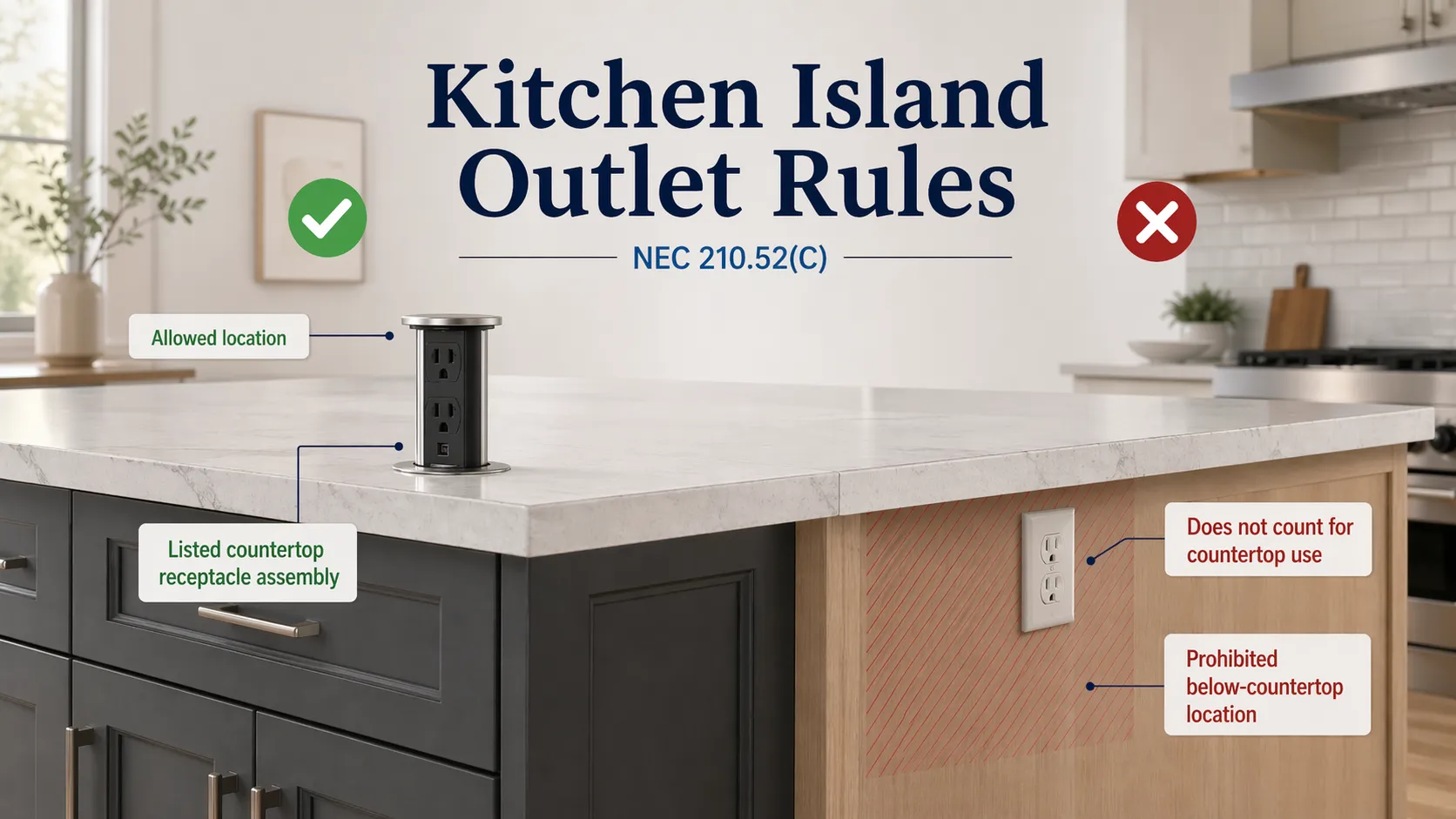
A common assumption is that the 2026 NEC first removed side-mounted or below-countertop island receptacles. The actual sequence is narrower: the 2023 NEC removed below-countertop locations as a permitted way to provide a receptacle serving an island or peninsula countertop or work surface. The 2026 NEC then added prohibited-location rules that close much of the nearby side-outlet workaround. For builders and buyers, the decision now has to be settled before stone fabrication and before the PO is released.
Short Answers, First
Does a kitchen island need an outlet under the 2026 NEC?
No. A receptacle serving an island or peninsula countertop or work surface is optional under both the 2023 and 2026 NEC. Under the 2026 wording, if no such receptacle is provided, electrical provisions must be provided for future addition.
Can I still put an outlet on the side of a kitchen island?
For a project under the 2026 NEC, receptacles on cabinet sides or wall surfaces below countertops and work surfaces are prohibited within 24 in. of cabinets, countertop or work surface by new 210.52(C)(4). The section also restricts specified adjacent-wall locations extending from base cabinets within the 24-inch zone. A receptacle installed inside a drawer is the express below-countertop exception.
What changed between the 2023 and 2026 NEC?
The 2023 NEC made island and peninsula countertop receptacles optional and limited the locations of receptacles provided to serve those surfaces. The 2026 NEC revises the wording from “if installed” to “if provided,” changes “provisions” to “electrical provisions,” points directly to new 210.52(C)(4), and adds prohibited-location language and a drawer exception.
Do kitchen island countertop receptacles need GFCI protection?
For covered dwelling-unit kitchen receptacles, yes. NEC 210.8(A)(6) covers 125V through 250V receptacles in dwelling-unit kitchens on the applicable single-phase branch circuits; the rule is no longer limited to receptacles serving countertop surfaces.
What does “electrical provisions” mean if no island receptacle is installed?
The 2026 NEC requires a future installation path but does not prescribe one universal rough-in method in this section. An accessible junction box, a conduit pathway, or another AHJ-accepted method may be used depending on the project. Confirm the method before rough-in and before cabinetry is finalized.
The Answer Depends on Which NEC Edition the AHJ Has Adopted
Before selecting an outlet assembly or approving a countertop cut-out, confirm the locally adopted code cycle. A project inspected under the 2020 NEC does not carry the same island-outlet assumptions as a project inspected under the 2023 or 2026 NEC. Local amendments may narrow or expand the accepted path again.
The adopted edition determines which locations remain available, which below-countertop or nearby wall locations are prohibited, and what future-installation provision must be planned. It does not automatically mean every island requires a pop-up assembly.
| Edition | Island / Peninsula Receptacle Required? | Permitted Path for a Receptacle Serving the Surface | If No Serving Receptacle Is Provided |
|---|---|---|---|
| 2020 NEC | Yes, based on countertop area. | A below-countertop location could qualify only when installed no more than 12 in. below the surface and where the countertop or work surface extended no more than 6 in. beyond its support base. | Not applicable to the required island receptacle framework. |
| 2023 NEC | No. Optional. | On or above the countertop within the permitted height, in the countertop using a listed assembly, or in the work surface using an assembly listed for that application. A below-countertop location no longer serves as the permitted countertop-serving path. | Provisions must be provided for future addition. |
| 2026 NEC | No. Optional. | The permitted serving locations remain, while new 210.52(C)(4) identifies prohibited locations on cabinet sides, below work surfaces, and in specified adjacent-wall relationships. A drawer exception is added. | Electrical provisions must be provided for future addition. |
The change from “provisions” to “electrical provisions” does not create a single nationwide rough-in method. It does make the purchasing sequence clearer: do not assume the island can be left unresolved until trim-out. Ask the AHJ what future-installation provision will be accepted before cabinetry and stone fabrication lock the design in place.
What the 2026 NEC Closes That the 2023 Language Left Debated
The 2023 NEC changed the island and peninsula framework by making the countertop-serving receptacle optional and restricting where a receptacle provided to serve that surface could be located. The disputed point was the phrase “to serve.” Some installers read the language as leaving room for a low side-mounted receptacle if it was described as a convenience outlet rather than a receptacle serving the countertop. Others rejected that reading.
That disagreement is not theoretical. Electricians and inspectors discussed this exact interpretation problem in professional forum threads after the 2023 cycle.
The 2026 NEC addresses much of that uncertainty through new Section 210.52(C)(4). Receptacle outlets are not permitted within 14 in. of cabinet sides or wall surfaces below countertops and work surfaces. Receptacles are also restricted on applicable adjacent walls extending from base cabinets within the specified 24-inch zone. One exception permits a receptacle installed inside a drawer below a countertop or work surface.
The 24-inch boundary addresses a physical hazard: a small-appliance cord routed over a countertop edge can be pulled by a child or caught by someone passing the island. The separation reduces the likelihood that a countertop appliance will be powered through an exposed draped cord. It does not eliminate every misuse scenario; it removes a familiar layout that created that hazard.
There is another important wording change. In 210.52(C)(2), the 2026 NEC replaces “if installed” with “if provided” and changes “provisions” to “electrical provisions.” The section still applies to receptacles provided to serve an island or peninsular countertop or work surface. The stronger practical change is the addition of the prohibited-location rule, together with the coordinated 24-inch restriction in 210.52(A)(5) for certain wall-space receptacles installed below countertops or work surfaces.
Where a Receptacle Provided to Serve the Island Surface Can Go
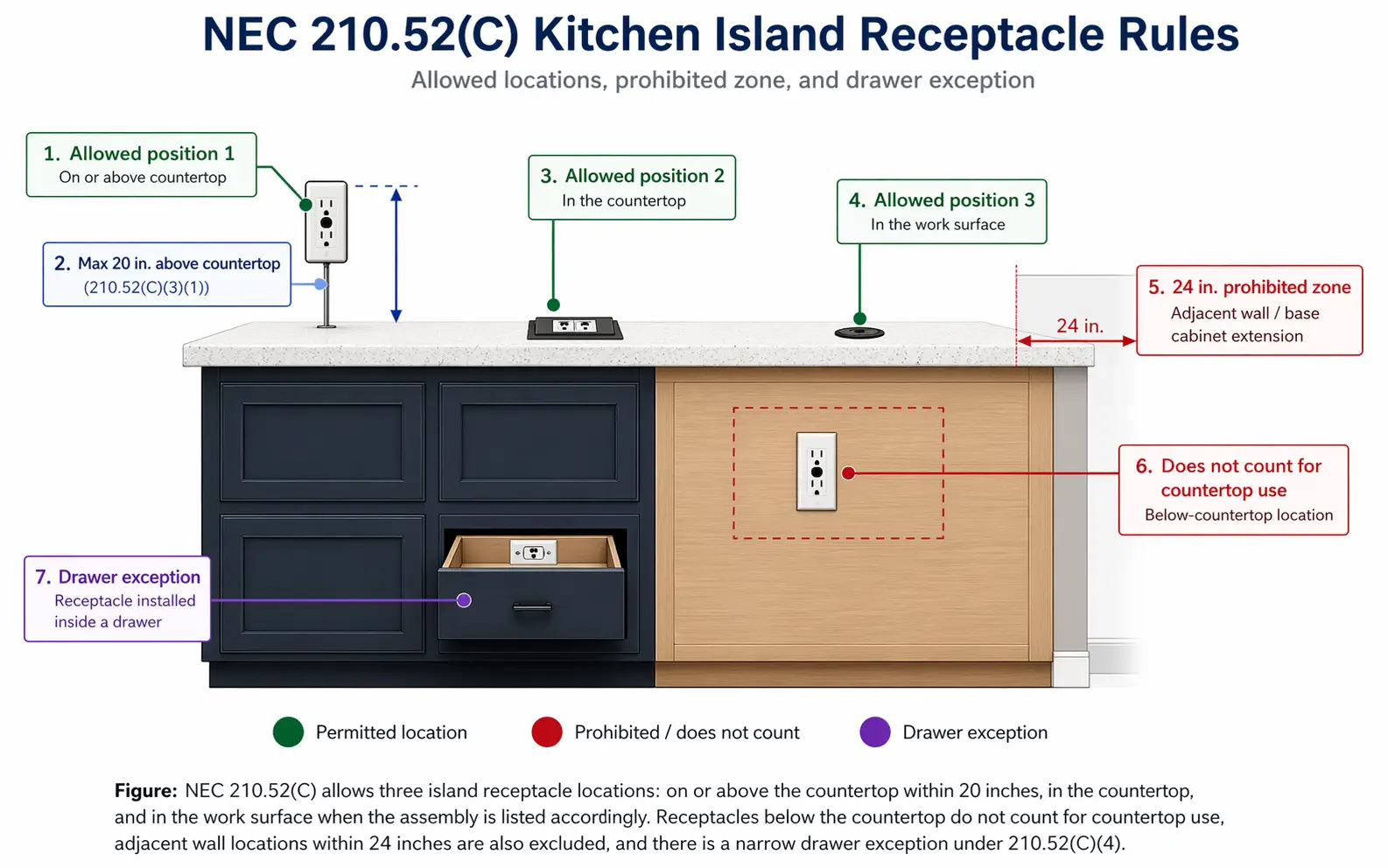
1) On or above the countertop, not more than 20 inches above it
This is often the simplest path when the design includes a raised ledge, a short backsplash, or another suitable above-surface mounting location. The receptacle must remain within the permitted height and accessible for the intended use. A countertop pop-up is not required merely because the island receives power.
2) In the countertop, using a listed countertop receptacle assembly
This is the pop-up or recessed-assembly path. Here the complete assembly matters. A quotation that states only “UL Listed outlet” does not establish that the assembly is listed for installation in a fixed kitchen countertop.
3) In the work surface, using an assembly listed for the application
A work-surface assembly must be listed for that installation environment or for countertop use where the listing permits it. Similar appearance is not enough; the listed installation scope controls the purchase decision.
A below-countertop cabinet-side receptacle is not a permitted location for a receptacle provided to serve the countertop under the current framework. For a project inspected under the 2026 NEC, new prohibited-location rules also have to be checked before any separate convenience outlet is shown near the island surface.
What “Electrical Provisions” Means When No Island Outlet Is Installed
If no receptacle is provided to serve an island or peninsula countertop or work surface, the 2026 NEC requires electrical provisions for future addition. The section does not prescribe one universal solution for every cabinet configuration, slab condition, or local inspection practice.
Common project approaches include an accessible junction box inside the island cabinet, a conduit pathway terminating at an accessible location, or a floor-fed pathway arranged before the cabinet and countertop are installed. Those are practical examples, not a substitute for local approval.
The buying consequence is straightforward: “no island outlet” is not the same as “no electrical decision.” The cabinet package, rough-in path, and inspection expectation still need to be settled before the island is closed up.
UL 498 vs. UL 962A: Why the Listing Scope Matters More Than the Label
This is where a visually acceptable product can still fail a submittal review.
UL Solutions identifies hard-wired receptacle assemblies intended for permanent installation in a kitchen or bathroom countertop physically attached to the building structure under the product category RTRT, investigated to ANSI/UL 498. Where a countertop assembly incorporates a self-contained GFCI receptacle, UL Solutions identifies the certification path under category KCXS and ANSI/UL 943.
For hard-wired countertop assemblies, UL Solutions describes additional evaluation including mechanical endurance, mechanical loading, temperature, dielectric voltage withstand, and spill testing. The countertop spill sequence uses one-half gallon — 64 oz. — of saline solution directed toward the assembly in its extended and most unfavorable cover position, followed immediately by a dielectric voltage withstand test.
A cord-and-plug connected assembly belongs to a different listing path. UL Solutions identifies these products under ANSI/UL 962A, product category IYNC, when they are intended for portable kitchen or bathroom roll-around islands or stationary furniture countertops. They are not identified for installation in a countertop physically attached to the building structure.
The distinction is not simply whether a product has been exposed to a spill test. UL Solutions states that IYNC assemblies intended for permitted kitchen or bathroom countertop furniture applications may also undergo a one-half gallon saline spill test, followed by leakage-current and dielectric-withstand testing. The decisive boundary is the intended installation scope: a hard-wired assembly for a fixed building countertop follows the RTRT or KCXS listing path; an IYNC cord-and-plug assembly is limited to portable or stationary furnishings.
If a vendor quotation says only “UL Listed,” ask for more before approving the SKU. Request the UL file number and verify the complete assembly category on UL Product iQ®. If the category returns IYNC, UL Solutions does not identify that assembly as listed for installation in a fixed kitchen countertop physically attached to the building structure. Do not release it for that application without a listing path that matches the installation and confirmation from the AHJ.
A Compliant Location Is Only the First Check: GFCI, TR and Countertop Listing Still Apply
GFCI protection — NEC 210.8(A)(6)
Under the applicable NEC language, covered 125V through 250V receptacles in a dwelling-unit kitchen, supplied by single-phase branch circuits rated 150V or less to ground, require GFCI protection. The 2023 change removed the former limitation to receptacles installed to serve countertop surfaces. An island receptacle does not sit outside that rule.
If a countertop assembly does not include integral GFCI protection, protection must be addressed upstream through a compliant circuit design. For related device planning, see our GFCI outlet range.
Tamper-resistant receptacles — 406.12 in the 2023 NEC / 406.26 in the 2026 NEC
The tamper-resistant requirement appears in Section 406.12 under the 2023 NEC and in reorganized Section 406.26 under the 2026 NEC. For dwelling-unit applications, covered 15A and 20A, 125V and 250V nonlocking-type receptacles must be listed tamper-resistant receptacles. That includes applicable receptacle openings in a countertop assembly.
A TR marking is not a cosmetic detail. A countertop assembly with non-TR receptacle openings can create a compliance gap even if the assembly location and listing scope are otherwise correct. Our TR and WR receptacle selection guide explains how marking categories should be separated during specification review.
Listed for countertop applications — 406.5(E) in the 2023 NEC / 406.14(E) in the 2026 NEC
UL Solutions identifies Section 406.5(E) in the 2023 NEC and Section 406.14(E) in the 2026 NEC as the countertop-assembly references. If the receptacle is installed in the countertop, the complete assembly must be listed for that application. This is why a component listing or a furniture-unit listing cannot be treated as a substitute for a fixed-countertop assembly listing.
Before the Stone Is Cut: What Buyers Should Confirm First
The outlet decision belongs before stone fabrication, not after electrical trim-out. Once quartz or granite fabrication is released, a late outlet-location change can affect the cut-out, cabinet clearance, branch-circuit path, inspection timing, and occupancy schedule. On multi-home projects, one repeated layout error multiplies quickly.
| Check Before Release | What to Verify | What Goes Wrong If It Is Missed |
|---|---|---|
| Adopted NEC edition | Confirm whether the permit is being reviewed under the 2020, 2023 or 2026 NEC, plus local amendments. | An outlet layout carried forward from an older project may fail inspection under the adopted edition. |
| Outlet or future provision | Decide whether a receptacle serving the island surface will be installed now or whether electrical provisions will be provided for future installation. | Cabinetry may close off the pathway needed for a future installation. |
| Permitted location | Confirm on/above-countertop, in-countertop or in-work-surface location against the adopted edition and AHJ interpretation. | A side-mounted device may require redesign after the stone and cabinet layout are fixed. |
| Assembly listing | For a fixed countertop assembly, verify the UL file number and complete-assembly category, such as RTRT or KCXS where applicable. | A furniture-type or component-only listing may be rejected for the fixed-countertop installation. |
| GFCI and TR strategy | Confirm whether GFCI is integral or upstream and whether covered openings are listed tamper-resistant receptacles. | A compliant assembly location can still fail the device-level compliance check. |
| Cut-out and cabinet clearance | Use the exact assembly specification sheet to confirm cut-out dimensions, under-counter depth, drawer clearance, plumbing clearance and appliance movement. | A listed assembly may still be impossible to fit after fabrication is complete. |
Do not release a countertop assembly from a catalog image alone. The listing path, protection strategy and physical installation envelope all belong in the pre-PO review.
What ShengYu Can Review When the Countertop Assembly Comes from Another Manufacturer
ShengYu does not manufacture countertop pop-up assemblies. That boundary matters. We cannot provide the listing documentation for another manufacturer’s complete assembly, and we do not replace AHJ review of the installed layout.
What we can review is the surrounding wiring-device package that is often ordered at the same time:
- Whether the surrounding kitchen receptacle plan requires upstream GFCI protection when the countertop assembly has no integral GFCI;
- Whether the specified receptacle openings need TR marking under the adopted NEC edition;
- Whether standard receptacles elsewhere in the kitchen are correctly specified as 15A or 20A for the project use and branch-circuit design;
- Whether an above-countertop USB charging position is being confused with a prohibited side-mounted cord path;
- Whether the documentation package for ShengYu-supplied GFCI, USB, receptacle, switch or wallplate items matches the quoted scope.
For the separate amperage-selection question, see our guide to 15 amp vs 20 amp receptacle ordering. A 20A branch-circuit plan and a fixed countertop assembly decision are related review items, but they are not the same decision.
Frequently Asked Questions About Kitchen Island Outlet Rules
Does the 2026 NEC require a receptacle on a kitchen island or peninsula?
No. Under 210.52(C)(2), a receptacle provided to serve an island or peninsular countertop or work surface is optional. If none is provided, the 2026 NEC requires electrical provisions at the island or peninsula for future addition of such a receptacle. The AHJ should confirm the accepted rough-in method for the project.
Can a receptacle be installed on the side of a kitchen island cabinet under the countertop?
For a project under the 2026 NEC, new 210.52(C)(4) prohibits receptacle outlets within 24 in. of cabinet sides or wall surfaces below countertops and work surfaces. It also restricts specified adjacent-wall locations extending from base cabinets within the 24-inch zone. A receptacle installed inside a drawer is the stated below-countertop exception. Confirm any separate convenience-outlet proposal with the AHJ before approving the island layout.
What changed between the 2023 and 2026 NEC for kitchen island outlets?
The 2023 NEC made receptacles serving island and peninsula work surfaces optional and removed below-countertop placement as the permitted serving path. The 2026 NEC revises “if installed” to “if provided,” changes “provisions” to “electrical provisions,” adds direct reference to new 210.52(C)(4), creates prohibited-location language for cabinet-side and specified nearby wall locations, and includes a drawer exception.
What counts as electrical provisions if no island receptacle is installed?
Section 210.52(C)(2) requires electrical provisions for future addition but does not set out one universal construction method in the subsection. Depending on the cabinet layout, slab condition and local practice, an AHJ may accept an accessible junction box, a conduit pathway or another approved rough-in method. Confirm this before rough-in rather than after cabinets are installed.
Is a cord-connected UL 962A pop-up suitable for a fixed kitchen countertop?
UL Solutions identifies IYNC / UL 962A cord-and-plug assemblies for portable kitchen or bathroom roll-around islands or stationary furniture countertops. It does not identify that listing path for countertops physically attached to the building structure. For a fixed kitchen countertop, verify the complete assembly listing path, such as RTRT or KCXS where applicable, before specification and AHJ review.
Does the 2026 NEC permit a receptacle inside a drawer below a kitchen island countertop?
Yes. New 210.52(C)(4) includes an exception allowing receptacle outlets installed inside a drawer below countertops and work surfaces. That exception addresses the prohibited-location rule. If the design relies on an in-drawer device as part of the countertop power plan, obtain AHJ confirmation before cabinetry and countertop fabrication are released.
Do kitchen island countertop receptacles need GFCI protection?
For covered dwelling-unit kitchen receptacles, yes. NEC 210.8(A)(6) applies to covered 125V through 250V receptacles in dwelling-unit kitchens on the applicable single-phase branch circuits. Protection may be integral to the countertop assembly or provided upstream through a compliant circuit design.
Do kitchen island countertop receptacles have to be tamper-resistant?
For covered dwelling-unit receptacle openings, yes. The applicable requirement appears in NEC 406.12 under the 2023 edition and in reorganized Section 406.26 under the 2026 edition. Covered 15A and 20A, 125V and 250V nonlocking-type receptacles must be listed tamper-resistant receptacles unless an applicable exception applies.
Author & Review
Prepared by the ShengYu Engineering Team — the product and compliance group supporting ShengYu’s UL- and cUL-listed wiring-device line for North American projects. This revision was reviewed against the NEC code-change record for 210.52(C), UL Solutions guidance on countertop receptacle assemblies, dwelling-unit kitchen GFCI guidance, and the 2026 tamper-resistant receptacle reorganization.
Related Articles on This Site
- 2026 NEC Code Changes: Critical Updates for GFCI and Receptacle Installations
- TR and WR Receptacle Selection Guide: A Spec Review Memo Under NEC 406.12 and 406.9
- UL 498 Changes Taking Effect June 20, 2026: A Buyer’s 8-Point Pre-Shipment Checklist for Receptacle Orders
- 15 Amp vs 20 Amp Receptacle: What Project Buyers Should Check Before Ordering
- 2026 CPSC Recalls & Safety Warnings: Why UL/cUL Certification Matters in Electrical Sourcing
Related Product Links
Sources and References
- NFPA 70, National Electrical Code — official code source and standard-development record.
- NFPA CMP-2 First Revision record for the 2026 NEC cycle — official revision record for 210.52(C)(2), (C)(3) and new (C)(4).
- ElectricalLicenseRenewal.com: 210.52(C)(2) 2026 NEC comparison — readable comparison of 2023 and 2026 wording.
- ElectricalLicenseRenewal.com: 210.52(C)(4) Receptacle Outlet Locations Prohibited — readable summary of the new prohibited-location framework.
- UL Solutions: Pop-Up Receptacle Assemblies for Kitchen Countertops — RTRT, KCXS and IYNC listing paths and testing scope.
- Minnesota Department of Labor and Industry: 2023 NEC FAQ — dwelling-unit kitchen GFCI expansion under 210.8(A)(6).
- ElectricalLicenseRenewal.com: 406.26 Tamper-Resistant Receptacles — 2026 reorganization from former Section 406.12.
- Mike Holt Forum: NEC 2023 island outlet interpretation discussion — field debate around the 2023 “to serve” language.
- UL Product iQ® — verification database for listing categories and file numbers.
Need help checking the surrounding device mix before the PO is released?
If the countertop assembly comes from another manufacturer, send the branch-circuit plan, the assembly listing category, and the receptacle line items you are pairing with it. ShengYu can review the GFCI, TR, 15A / 20A and supporting wiring-device scope supplied from our own line before the order is finalized.