Last updated: May 2026 · By the Sales Manager Bowen in ShengYu Engineering Team
In April 2024, when our GaN 65W USB-C wall outlet first went to market, I went back through our contact list and reached out — by email and WhatsApp — to one client in particular: a construction company that handles renovation and maintenance for mid-to-high-end serviced apartments. They had been buying our standard non-PD USB outlets for several years across multiple property cycles. The 65W model was new, but the underlying use case was not. Their tenants charged phones and tablets, and by 2024 most of them carried a 13″ or 14″ USB-C laptop as their primary computer. The old non-PD outlets handled phones fine and tablets passably, but laptops still needed the original charger.
That conversation is roughly where the rest of this article comes from. The question of what 65W actually covers — and what it does not — turns out to matter more than the question of whether GaN is “better.”
What 65W actually covers
This model is built around a specific output band. The USB Power Delivery profile on this 65W USB-C wall outlet is:
| Voltage | Current | Power | Typical device match |
|---|---|---|---|
| 5 V | 3 A | 15 W | Phones, earbuds, small accessories |
| 9 V | 3 A | 27 W | Phones, tablets, mid-range USB-C devices |
| 15 V | 3 A | 45 W | Tablets, light notebooks, lower-power laptops |
| 20 V | 3.25 A | 65 W | Mainstream 13″ and 14″ USB-C laptops |
The single-port case is simple: either USB-C port can negotiate up to 65 W when only one device is plugged in. The dual-port case is the one to understand carefully. When both USB-C ports are active simultaneously, total output stays at 65 W and the split depends on what each device requests. A common pattern — laptop on one port, phone or tablet on the other — runs around 45 W + 18 W. When both devices request more than 30 W (for instance, two USB-C laptops plugged in together), the receptacle distributes output more evenly between them.
On the phone side, the headroom is generous. Apple’s published guidance pairs the iPhone 17, 17 Pro, and 17 Pro Max with 40 W USB-C PD adapters for fast charging, and pairs iPhone Air and iPhone 17e with 20 W adapters. The 65 W ceiling sits above every current iPhone with margin to spare, and PD ensures the phone only draws what it requests. The outlet’s headline number exists primarily for the laptop case, not the phone case.
What 65W is not built for
Two categories sit outside what 65 W can deliver cleanly.
High-wattage laptops. 16″ workstation laptops, gaming laptops, and machines that ship with a 100 W or 140 W brick will not charge at full speed from a 65 W outlet. Most will still charge through standard PD negotiation, just slower than the original adapter would deliver, see the difference between USB wall outlet vs wall charger. For users actively gaming or compiling, the gap is noticeable. For users charging overnight or during a meeting, it usually is not. We tell project buyers to assume their gaming-laptop guests will continue to use their original chargers, and to design wall-outlet placement around the much more common 13″-14″ laptop case.
Android phones with proprietary fast-charging. Brands like OPPO, OnePlus, Xiaomi, and Samsung run their own proprietary protocols (VOOC, HyperCharge, Super Fast Charging). On a USB PD wall outlet, these phones fall back to their USB PD-compatible speed, which sits well below the headline number printed on their original adapter. The outlet still charges them — just not at the brand’s marketed maximum.
Both categories are part of why we did not build a 100 W version of this outlet. Heat is the harder limit. A wall box gives the power stage very little room to shed heat, and a 100 W design would push the device toward a larger profile or a thermal margin we do not want to ship. The market case is weaker too. In hotel rooms, serviced apartments, hot desks, conference rooms, and student housing, 65 W covers the devices we are designing around: phones, tablets, and mainstream 13″-14″ laptops. The 100 W case belongs to heavier laptops and original adapters.
Why GaN, not silicon
GaN (gallium nitride) began appearing in mainstream high-output phone chargers around 2019 and 2020. The reason is thermal: GaN-based power-conversion stages dissipate less heat than equivalent silicon designs at the same output. In an external desktop charger sitting on a table with air around it, that thermal advantage is nice but not decisive. In a wall outlet sitting inside a junction box with no airflow at all, the thermal advantage is what makes 65 W output at this device size practical.
The cost difference between GaN and silicon is real — GaN power stages cost more — but it was the trade-off we accepted to keep the receptacle within the dimensions of a standard 15 amp duplex device. A silicon-based 65 W power stage would either run hotter inside the wall box or require a larger physical form factor that would no longer fit a standard wall plate.
We do not manufacture the GaN chips themselves. What we control is the integration — how the power-conversion stage sits inside the receptacle housing, how heat is moved away from sensitive components, and how each unit is tested at the line before shipment. Every receptacle goes through full-function testing on the production line before it leaves the factory.
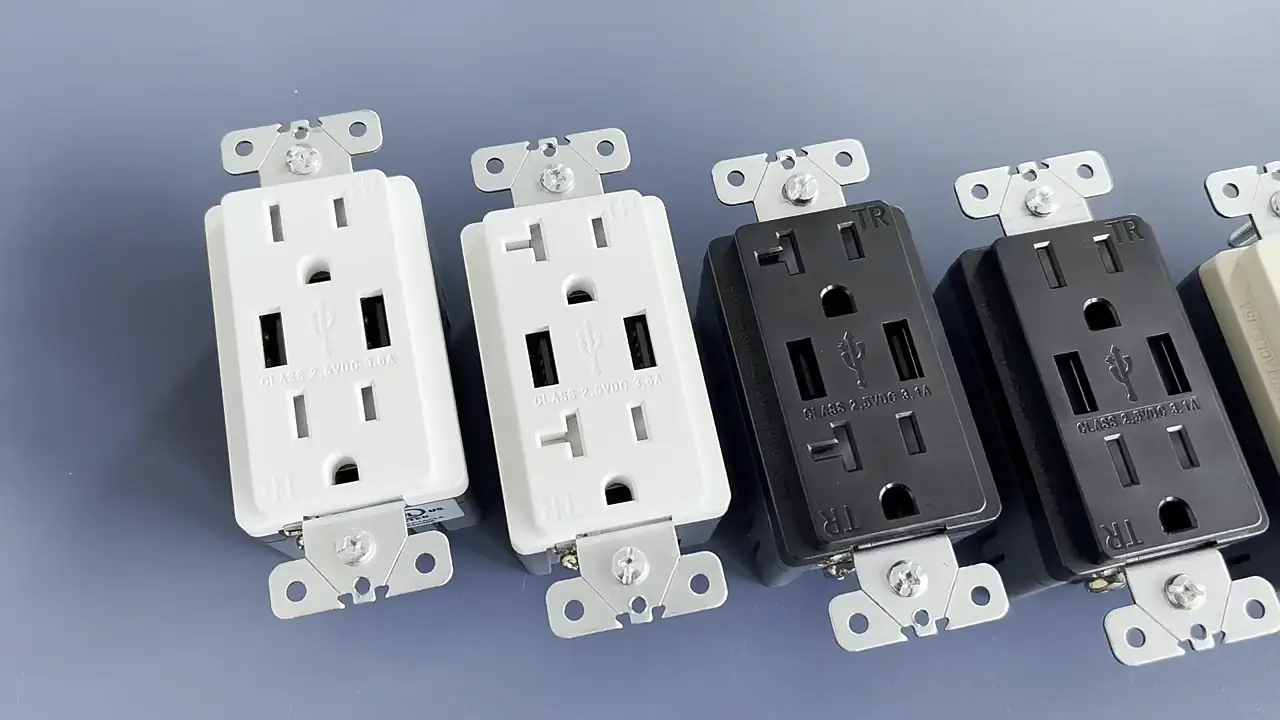
65W GaN dual USB-C receptacle video
This short product video shows the 15 A 65 W GaN dual USB-C receptacle itself. It is not a full certification review or an installation guide; it is mainly useful for checking the product format, face layout, and visible receptacle details before asking for the full spec sheet.
Feedback from one serviced-apartment renovation
The construction client I mentioned earlier rolled out the 65 W outlets across renovation work in the months after the launch. Their property management group collects tenant service feedback periodically, and the form has a separate line specifically for USB charging facilities. The PD USB-C feedback came back positive — though I do not have the exact response percentages, since that data is internal to their operation.
The reasons they shared with us, paraphrased from the feedback they collected: tenants only need to carry a USB-C cable rather than a separate adapter brick; the same outlet covers phone, tablet, and laptop; and the two standard NEMA 5-15R receptacles on the same device stay available for whatever else needs to be plugged in. That last point matters more than it appears. A USB outlet that consumes an AC slot trades one capability for another. A duplex receptacle with USB that adds USB-C without losing AC capacity adds capability without subtracting it.
Spec items to check before release
A few items worth checking when a 65 W USB-C receptacle enters a project specification:
The AC side is rated 15 A, 125 V AC, 60 Hz, with NEMA 5-15R configuration and 20 A feed-through capacity. The face is tamper-resistant for covered receptacle locations under NEC 406.12 where the code has been adopted, including dwelling units and guest rooms or guest suites in hotels and motels. The device is UL certified to the applicable UL 498 requirements, including Supplement SE for receptacles with integral Class 2 power-supply output connectors. Color options are white, ivory, light almond, black, and gray.
Wall box fit is the install-side variable that we cannot confirm from our end. Box compatibility depends on box volume, conductor count, conductor size, grounding conductors, internal clamps, device depth, and the NEC 314.16 box-fill calculation. We do not visit job sites, so the box volume confirmation has to happen at the install end. The marked volume on the box itself is the starting point.
For project sourcing, stock color SKUs typically start at 500 units per shipment with a 7-15 day lead time to FOB. OEM orders with private-label packaging or custom colors generally start at 1,000 units per SKU with a 30-45 day lead time from PO confirmation.
A note on the broader USB outlet line
The 65 W GaN model is one of four USB output tiers in our line: a standard non-PD model around 12 W, a 20 W PD model, a 36 W PD model, and this 65 W GaN unit. The 65 W tier is where we have spent the most engineering time because it sits at the laptop-charging boundary, where the design constraints are tightest.
One pattern worth knowing for project teams: even with everything wired and specified correctly, USB-C laptop charging can sometimes run slower than expected — for reasons that have nothing to do with the outlet itself. We covered that separately in Why Your 65W USB-C Wall Outlet Charges a MacBook, iPad, or Phone Slower Than Expected.
Our 65W GaN dual USB-C receptacle is here for spec sheets, sample requests, and project pricing.