Two of the three ways to wire a receptacle enter from the back, and only one of them belongs on a spec-grade line. We build receptacles and switches across the grade range for North America — side-wire, screw-pressure-plate, and push-in. A buyer who writes “back-wire” on a PO and assumes it pins the terminal can get either of two very different mechanisms.
So the question on a spec isn’t back versus side. It’s whether that back terminal is a screw-clamp or a push-in spring, because a PO that leaves it blank can buy either.
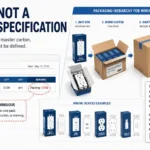
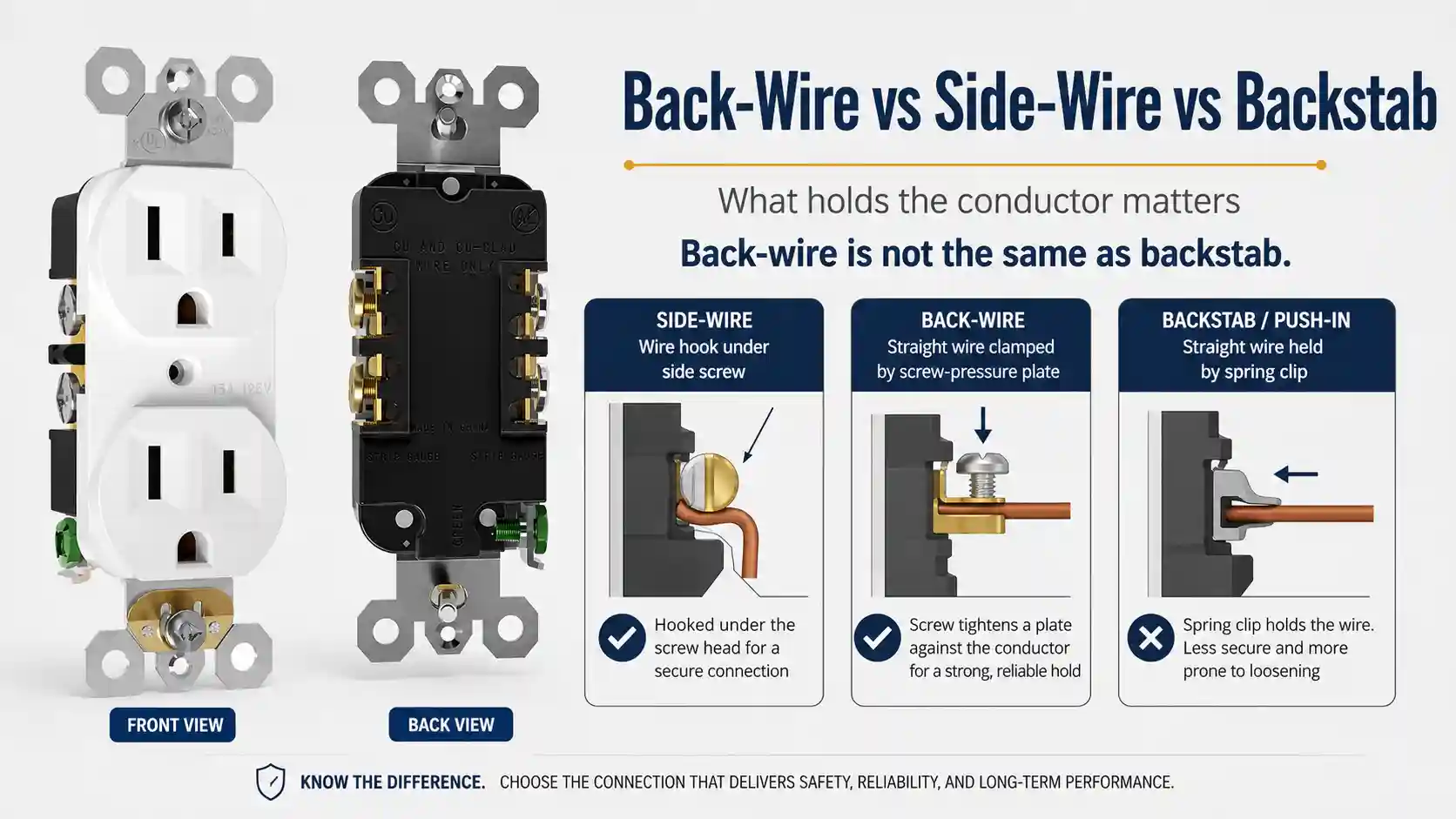
| Terminal | How the wire is held | Where it lands |
|---|---|---|
| Side-wire | hook wrapped under the side screw | every grade |
| Back-wire (screw-pressure-plate) | straight wire clamped by a plate under a screw | commercial / spec / heavy-duty |
| Backstab / push-in / quick-wire | straight wire gripped by a spring clip, 14 AWG solid only | residential / quick-install |
Most of what ships into projects sits in the first two rows.
Two of these enter from the back. Only one is a backstab
Side-wire is the one everyone pictures: strip the wire, hook it, wrap it clockwise under the side screw, tighten. It is on every grade we make, from budget to heavy-duty.
Back-wire and backstab both take a straight wire into the back of the device, and that is where the confusion starts. The mechanism is the opposite. A back-wire terminal — UL calls it a screw-actuated clamp — presses a metal plate down onto the wire when the screw is tightened. A backstab holds the wire with a thin internal spring and no screw at all.
One word covers both in casual use, and that is the root of the PO problem. “Back-wire” on a purchase order can mean the screw-clamp a spec job wants, or the spring-clip hole a budget SKU carries. That is the real back-wire vs side-wire vs backstab question for a buyer — not which is best in the abstract, but which one the PO actually pulls.
So are backstab outlets actually bad?
Ask the trade and you get a fight. One camp backstabbed receptacles for decades and points to forty-year-old installs that never failed. The other camp is still finding the failures, and notes that push-in was pushed off heavier wire after enough of them turned up.
The mechanism explains the split. A spring clip meets the wire at a small edge. Thermal cycling and the push-pull of plugs over the years work that edge loose, and a loose contact runs hot. A screw-clamp holds the wire flat against a plate with mechanical force that does not relax the same way. One building-inspection reference estimates the screw-clamp’s long-term reliability at 150 to 200 times the push-in’s.
A single home replacement can run on a push-in for years without trouble. A project buyer signing off hundreds of devices that will see daily plug cycling is making a different bet, and the small contact patch is the wrong side of it. Push-in is legal and UL-listed. Legal isn’t the same bar as spec-grade.
Why the screw-clamp is what ships on spec grade
Terminal type tracks grade. On a spec, commercial, or heavy-duty receptacle, the back terminal is the screw-pressure-plate, and the contacts are triple-wipe rather than the double-wipe on a budget device. The heavier contact holds a plug longer and resists the wear that loosens a cheap one.
We build all three terminal types. Our project orders run almost entirely on standard wiring — side-wire and screw-pressure-plate. Push-in ships in small volume, mostly to the budget end; I’d have to pull the order history to put a real number on it. So a spec landing on our line defaults to the screw-clamp — not because we turn down the alternative, but because project buyers don’t ask for it.
The screw-clamp also takes the conductor a project actually uses. UL lets a screw-actuated clamp hold solid or stranded copper across the standard range, commonly #14 through #10. A push-in hole takes 14 AWG solid and nothing else, which keeps it off the 12 AWG that 20A circuits run on. On our spec-grade line the triple-wipe contacts get the same scrutiny described in our receptacle plug retention test, and the terminals are sample-checked by the batch.
Receptacles pick one terminal; switches carry two
The terminal story is not identical across devices, and a buyer specifying both on one project should know the difference.
Our receptacles come as one or the other: a screw-pressure-plate back-wire SKU, or a push-in SKU. A buyer picks the line. Our switches are built the other way — side-wire and push-in on the same body, so the choice happens at install, not at order.
Code treats the two differently as well. A snap switch wired through its push-in terminal is held to a 15A branch circuit under NEC 404.14(D). And UL lets a receptacle’s screw-clamp take solid or stranded copper, while a switch has to be marked for stranded before stranded is allowed on it. So “back-wire switch” and “back-wire receptacle” do not point at the same terminal, and a PO that reuses one phrase across both lines is quietly specifying two different things.
Writing terminals onto a PO line that holds up
The fix is not a longer argument about which terminal wins. It is a few words on the PO that pin it.
Grade is the part a buyer can actually enforce. “Commercial grade” or “spec grade” pulls the screw-clamp, the triple-wipe contact, and the wider conductor range along with it, without anyone policing each spec by hand. A line that ships right tends to carry:
- the grade — spec, commercial, or heavy-duty, or residential where budget rules the job
- the terminal in plain words — side-wire and screw-pressure-plate back-wire, or push-in if that is the intent
- the conductor — copper, solid or stranded, and the AWG range
- amperage and TR, kept on their own line, the way the 15A vs 20A receptacle spec is handled
Two phrases look complete and are not: “back-wire” standing alone, and “quick-wire” used as if it meant the screw clamp. Both leave the mechanism open.
Same spec, different terminal by market
The right terminal follows the job.
Retail replacement and budget multi-family runs are where push-in shows up. Install speed wins on volume, and the devices see light cycling over their life. The trade-off is acceptable there because nobody is loading those outlets all day.
Hospitality, office, and spec-grade projects run the screw-clamp. Daily plug cycling and a long service life turn the small spring contact into a liability, and the grade already chosen for the face — the same call behind the decorator vs standard receptacle decision — carries the terminal with it. Switches on a standardized project follow the same path; on our line, a three-way body standardized across a job still ships side-wire plus push-in, with the push-in held to 15A.
What we build, and what we don’t
We build receptacles and switches across the grade range, sample-test the terminals at the batch level, and can tell a buyer which terminal and grade a given spec line will actually pull off our shelf.
We don’t wire the device into the wall, choose the branch circuit, or decide what an inspector will accept. When a job calls for pigtailing every device, or follows a terminal rule local to one jurisdiction, that is the installer’s and the AHJ’s call. We point to the listing rather than rule on it.
FAQ
Is back-wire the same as backstab?
No. A backstab, or push-in, holds the wire with a spring clip and no screw. A back-wire terminal on a commercial-grade device clamps the wire under a plate tightened by a screw. Same entry point at the back of the device, opposite grip — and the screw-clamp is the one that belongs on a spec-grade line.
Are backstab outlets bad?
They are legal and UL-listed, but the spring clip’s small contact patch can loosen over years of plug cycling, and a loose contact runs hot. For a project, the screw-clamp is the safer spec.
Is back wire better than side wire?
On a spec-grade device they are close — both use screw force on a large contact area. The method to keep off a project line is push-in, not either of these two.
Why do electricians avoid backstab?
Small contact area, a spring that relaxes with thermal cycling, and a wire that works loose as plugs go in and out. Push-in is also rated for 14 AWG solid only, which rules it out on the 12 AWG of a 20A circuit.
Can I specify push-in to save cost?
Yes — for budget residential runs on 15A circuits with 14 AWG solid wire. Keep it off spec-grade work and 20A lines, where the screw-clamp earns its place.
Sources
- Leviton, Back vs Side Wiring — official explanation that back wiring slides the conductor under the terminal clamp, while side wiring wraps the conductor around the screw:
Leviton Back vs Side Wiring - Leviton, How to Wire a Device Using the Quickwire Method — official Quickwire / push-in instruction noting that the Quickwire hole accepts 14 gauge solid wire only:
Leviton Quickwire Method - Leviton T5320-W product page — public product data showing terminal screws accept #10, #12 and #14 AWG copper, while Quickwire push-in terminals accept #14 AWG solid copper only:
Leviton T5320-W Product Data - UL Code Authorities, Receptacles and Stranded Conductors — UL-authored discussion of receptacle terminal categories, stranded conductor suitability, and push-in terminal restrictions:
UL Code Authorities PDF - IAEI, Are receptacles and switches Listed for use with stranded conductors? — explanation of receptacle listing categories and conductor-use differences between receptacles and switches:
IAEI Receptacles and Stranded Conductors - Leviton Captain Code 2023, Switches and Receptacles with Push-In Terminals & Wire Types — public code summary for NEC 404.14(D) and 406.3(D) push-in terminal conditions:
Leviton Captain Code 2023 - Legrand Pass & Seymour PS5362W — spec-grade receptacle product page showing internal screw-pressure-plate back and side wire terminal language and #14–#10 AWG conductor range:
Legrand PS5362W Spec-Grade Receptacle - Home Depot, Legrand Pass & Seymour 20 Amp Commercial Grade Backwire Duplex Outlet — public listing noting 8-hole internal screw-pressure-plates and #10–14 AWG solid or stranded copper / copper-clad wire:
Home Depot Legrand Commercial Backwire Listing - Mike Holt Forum, Receptacle connections loop or backwire — trade discussion showing the split between side-wire, pressure-plate back-wire, and push-in opinions:
Mike Holt Receptacle Connections Discussion - Mike Holt Forum, terminal/conductor discussion — trade discussion separating screw-clamp back-wired receptacles from back-stabbed devices:
Mike Holt Terminal Discussion - Inspectapedia, Back-wired electrical receptacle & switch connectors: safe or unsafe? — field-inspection reference discussing push-in spring terminals versus screw-actuated clamp terminals and long-term reliability concerns:
Inspectapedia Backwired Connector Reference - HandymanHowTo, Side Wire vs Back Wire — supporting visual explanation of side-wire, screw-and-clamp back-wire, Quickwire / push-in, and contact-grade differences:
HandymanHowTo Side Wire vs Back Wire
Related reading
- 15 Amp vs 20 Amp Receptacle: What Project Buyers Should Check Before Ordering
- Receptacle Plug Retention Test: What UL 498 Evaluates and What We Check in Production
- Decorator Receptacle vs Standard Receptacle: Why the Wallplate Opening Comes Before the Face
- 3-Way Switch vs Single Pole: When a Contractor Buys Three-Way for Single-Location Points on Purpose
Before the spec is sent
Browse the duplex receptacle category.
Questions on which terminal a spec line will pull? Talk to us.