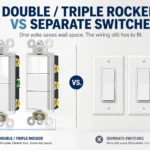
On a Toronto multi-building take-off, we’d already split the schedule room by room — single-pole here, three-way at the stair and double-entry rooms. At sign-off the contractor went down the device list and struck the single-pole line out, all of it, and wrote three-way across every point. We asked. He said the unit-cost gap was small enough on this job that he’d rather stock one switch body than two, and keep the option to add a second control location in a room without sending someone back to change the device. He was buying for a few hundred rooms that might still move, not one room that was finished.
That call is the question this article is about, and the common answer skips past it.
The DIY Answer Is Right and Answers the Wrong Question
Search “can a 3-way switch be used as a single pole” and the pages we found all say yes: land the hot on the common, use one traveler, leave the other unused. That is correct. It is also written for someone who bought the wrong switch and wants to make it work once.
A take-off asks a different thing. Not “can this one device fill in,” but “should the schedule carry single-pole at all, or standardize on the three-way body and drop a SKU.” The terminal trick is the same; the decision is not. One is salvage. The other is a stocking and labeling call across a few hundred devices, and it carries consequences the wiring diagram never shows.
Where Standardizing on Three-Way Pays, and Where It Just Costs
The contractor’s logic holds on a specific kind of job. It does not hold everywhere, and buying three-way for every single-location point is a real way to spend money on flexibility a project will never use.
| Project shape | Single-pole on the schedule | Standardize on three-way body |
|---|---|---|
| Retail order, fixed layout, few devices | Right call — lower unit cost, ON/OFF marking, no spare terminal to miswire | Pays for flexibility nobody will use |
| Multi-unit, layout still moving, repeat rooms | Splits the carton into two switch SKUs to label and count | One device line, fewer mispicks, a re-switch path left open |
| Spec-churn job where control points get added late | Every added location means a new device and a rewire | The body is already three-way, so a later second location is a wiring change, not a device swap |
What tips it is not the building. It is whether the control layout is settled. A frozen layout has no use for a spare traveler terminal sitting behind every plate. A layout still in motion treats that terminal as an option already paid for — though turning it into a working second switch still depends on the run reaching that box, which is a job-site condition, not a given.
Unit cost runs against standardizing — a three-way body costs more than a single-pole. The contractor judged that gap small enough on his job to trade for the option. That was his read on his own numbers; on a tighter retail margin the same gap decides the other way.
The Marking Nobody Costs
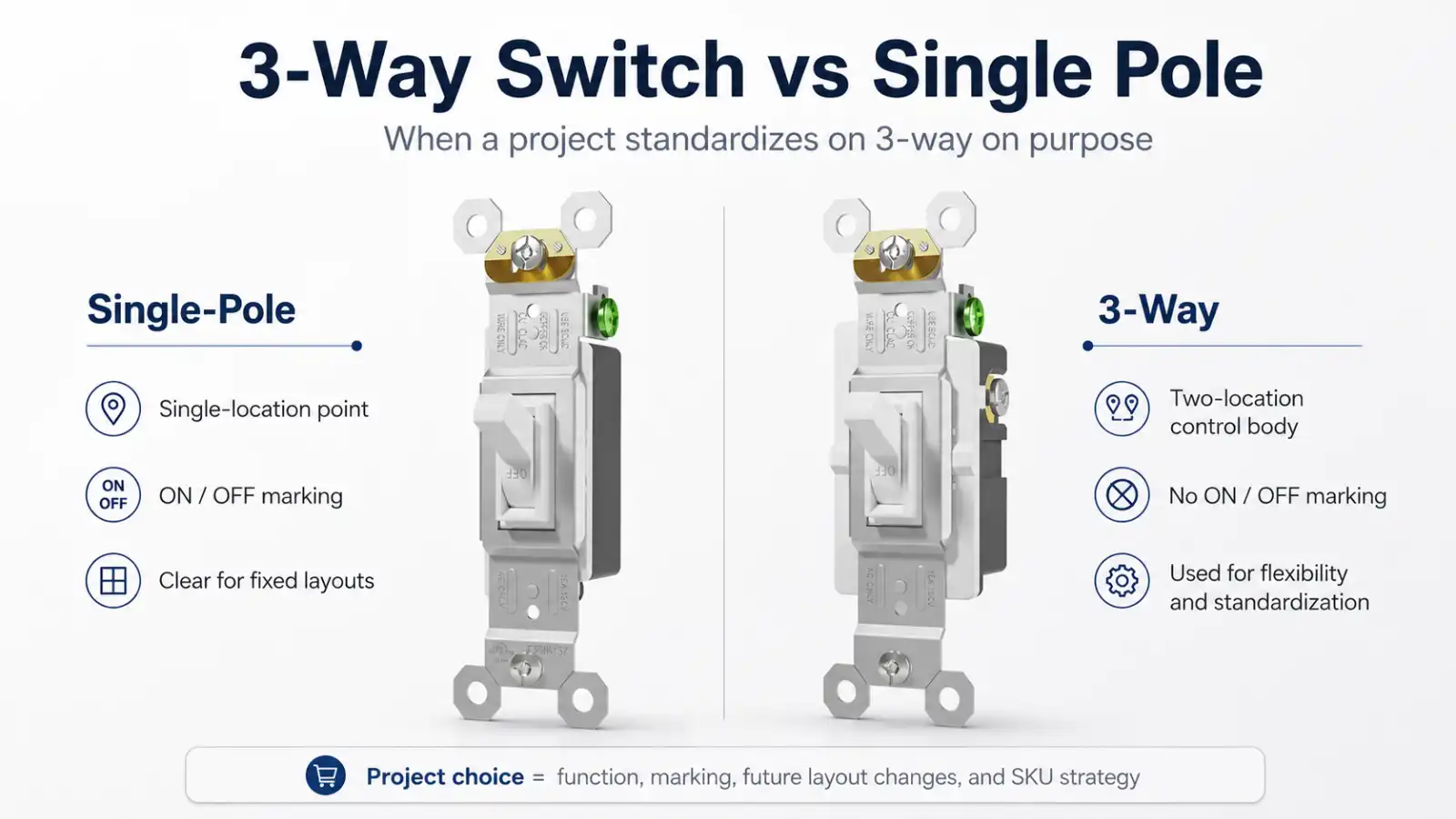
A single-pole switch carries ON/OFF on the toggle. A three-way does not — its on or off state depends on its partner, so a fixed label would be wrong half the time. Standardize a job on three-way bodies wired as single-pole and every one of those switches reads as a possible multi-location device to anyone who opens the wall later.
That cost shows up after handover, not on the PO. A service electrician sees an unmarked toggle and has to test whether it is one end of a three-way pair or a lone switch dressed as one. On one device it is nothing. Across a building it is a small standing tax on every future troubleshooting visit, paid by someone who was not in the room when the SKU got simplified. The flexibility is real. So is this.
What the Schedule Is Actually Built From
Switch counts come off control locations, not off the device back. One location is a single-pole point; two is a three-way pair; three or more brings a four-way into the run between two three-ways. The number in the name is a terminal count — three terminals controlling from two places — which is why “I need three-way for three doors” is a miscount that lands in real orders.
A four-way does not rescue a wrong guess here. It is built to bridge travelers between two three-ways. A field electrician can force one into other roles with a non-standard connection, but it does not stock or substitute cleanly for a three-way or a single-pole, and buying the most complex switch as a universal part is the three-way salvage run in reverse — the complex device does not downgrade to cover the simple points.
Putting It on a PO
Two clean lines, plus the one that names the standardization on purpose.
Single-location line
15A single-pole switch, 120V or 120/277V as required, UL 20 / cUL listed, [color], wallplate family to match the gang.
Two-location line
15A three-way switch, one common + two travelers, no ON/OFF marking, UL 20 / cUL listed, [color], matching switch family.
Standardized line
Three-way switch used at single-location points for inventory consolidation — confirm color, carton count, and that the no-ON/OFF-marking is acceptable to the GC before the run ships.
Plate size — standard, mid, or jumbo — is a separate call from the switch, sized to the wall cut rather than the device: jumbo vs mid vs standard. The switch line and the wallplate series come from one family so the openings agree before the carton is packed.
We make the switch, the rating, the face, and the plate, and we estimate the single-pole-to-three-way split when a schedule arrives without one. We do not wire the box or sign the inspection — and when a buyer overrides our split to standardize on three-way, we flag the marking and the spare-terminal tradeoff, then build what the schedule says.
Before the switch line is locked
Send the device schedule and we’ll estimate the single-pole-to-three-way split, flag any single-location points where standardizing on three-way is worth it, and call out the no-ON/OFF-marking tradeoff before the run ships. Browse the wall switch line, or send the schedule to the team.
Related
The same Toronto take-off is where we cut a GFCI count from 8,000 to 4,500 by reading the protection path instead of the device list — the GFCI receptacle sourcing decision map walks that logic. Switch face is a separate axis from switch function: rocker or toggle rides on the wallplate opening, covered in decorator vs standard receptacle. And the habit underneath all three — read the rating and listing on their own line, not off the device’s face — runs through 15A vs 20A receptacle.
FAQ
Can a 3-way switch be used as a single pole?
Yes — land the hot on the common terminal, use one traveler, leave the other unused. On a single device that’s a fine fix. As a purchasing pattern across a whole job, it’s worth it when the control layout is still moving and the SKU consolidation buys real flexibility; on a fixed retail layout, single-pole is the cheaper, clearer line.
Does 3-way mean three switch locations?
No. It controls from two locations. The “three” counts terminals — one common and two travelers. Three or more locations need a four-way wired between two three-ways.
Why doesn’t a 3-way switch have ON/OFF printed on it?
Because its on or off state depends on the other switch in the pair, so a fixed ON/OFF label would be wrong half the time. That missing marking is also why a three-way wired as single-pole reads as ambiguous to anyone servicing the wall later.
Can a 4-way switch be used as a 3-way or single pole?
Not as a stock substitution. A four-way is a traveler-to-traveler crossover built to sit between two three-ways; a field electrician can force other behavior with a non-standard connection, but it doesn’t replace a three-way or single-pole on a purchase order. Buy to the control points, not to the most complex part on the shelf.
Is a UK 2-way switch the same as a North American 3-way?
Functionally yes — both are SPDT, three terminals, two control locations. The label differs by market: North America calls it three-way, the UK and IEC regions call it two-way. A buyer writing “single way” or “2-way” into a North American order is using another market’s product language, and we confirm the control intent before quoting.
What should a switch PO line include?
Pole and throw (single-pole, three-way, four-way), amperage, voltage (120V or 120/277V), the listing and mark (UL 20 / cUL), color, and the wallplate family the gang has to match. If three-way is being used at single-location points on purpose, write that on the line so the marking tradeoff gets decided before the run ships, not discovered after.
Sources
- UL 20, General-Use Snap Switches — scope covers manually operated, general-use snap switches and modular switch assemblies used under NEC, Canadian Electrical Code, or NOM installation systems:
UL 20 Scope - UL 20 / CSA C22.2 No. 111 — general-use snap switch standard path for the Canadian cUL side:
Intertek Standards Update Notice - SPDT terminology by market — RealPars describes SPDT as a 2-way switch in the European Union and a 3-way switch in North America:
RealPars Two-Way Switching Reference