When Does NEC 210.8(F) Start Mattering for Outdoor HVAC?
The 2026 NEC was issued by the NFPA Standards Council on August 20, 2025, with an effective date of September 9, 2025. That does not mean every project is reviewed under the 2026 NEC immediately. State and local adoption moves on separate timelines, and many jurisdictions continue to enforce earlier NEC editions or local amendments while the newest cycle is being reviewed.
For quoting, this matters more than the publication date. A protection path that makes sense under the 2026 NEC may not be the exact path an AHJ is enforcing in a jurisdiction still working from an earlier NEC cycle. Large markets can also be one or more code cycles behind the newest edition. The adopted edition should be checked before the device type, disconnect marking, and submittal package are locked in.
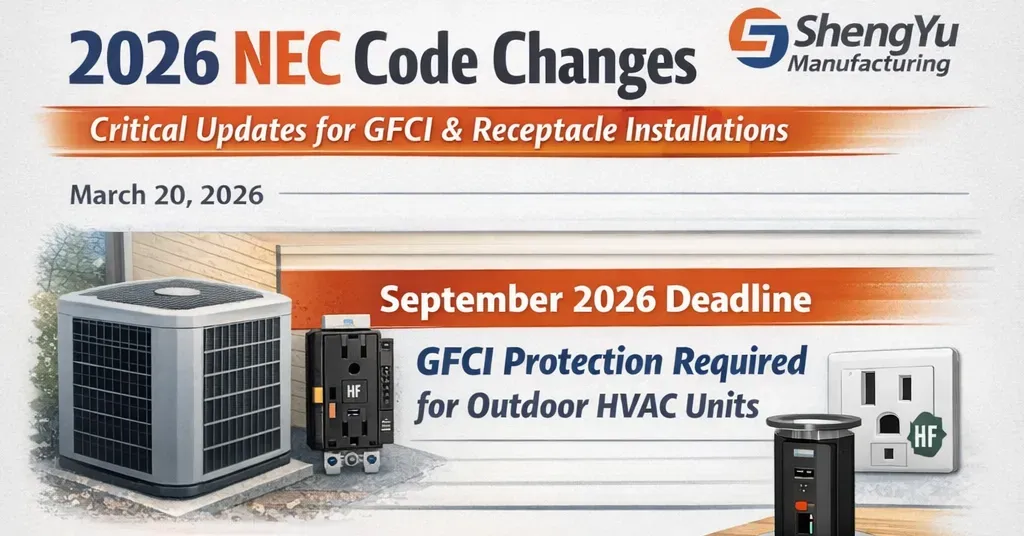
What is consistent across the recent NEC path is the September 1, 2026 expiration date on Exception 2 of 210.8(F), which currently delays GFCI protection for listed HVAC equipment. After that date, listed outdoor HVAC equipment at dwelling units covered by 210.8(F) needs an applicable GFCI protection path, subject to the adopted code and local enforcement.
An “outlet” in NEC Article 100 is the point on the wiring system where current is taken to supply utilization equipment. That definition matters here because 210.8(F) applies to the outdoor outlet supplying hard-wired equipment, including HVAC equipment. The buyer assumption that “hard-wired” automatically means outside the GFCI discussion is not a safe assumption.
Why the 50 A to 60 A Change Matters for Outdoor HVAC Quotes
The 2026 NEC raises the 210.8(F) threshold for single-phase branch circuits at dwelling units from 50 A to 60 A, for circuits rated 150 volts or less to ground. In practical quoting language, that pulls more outdoor HVAC-style disconnect conversations into the GFCI protection review, especially where a 60 A outdoor AC disconnect is treated as a routine line item.
In quotation reviews for outdoor HVAC work, the request often arrives on the BOM as a one-line item: “60 A GFCI disconnect for outdoor AC.” For 2026-cycle work that extends past the September 1 deadline, that wording is not specific enough. The buyer or distributor still has to confirm whether the project requires a standard Class A GFCI, an HF-rated Class A device, or a listed Class C SPGFCI path with the required disconnect marking.
A submittal can be pushed back when the protection device, equipment listing, disconnect marking, and code path do not point to the same answer. The problem is not only price. It is documentation alignment.
This rule does not override Article 680 for pool, spa, fountain, or similar equipment, which has its own GFCI and SPGFCI requirements. If a quote covers pool or spa equipment, both 210.8(F) and the relevant Article 680 requirement need to be checked against the equipment’s listing and installation instructions before the device SKU is locked in.
Which GFCI Path Belongs Where: Class A, HF Class A, and Class C SPGFCI
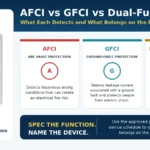
For outdoor HVAC equipment under 210.8(F) after September 1, 2026, the protection conversation is no longer just “GFCI or no GFCI.” The sourcing path depends on how the equipment is listed, how it behaves with leakage current, and whether the disconnect marking required by the code path is present.
| Protection Path | Standard / Listing Context | What Buyers Should Verify |
|---|---|---|
| Standard Class A GFCI | UL 943 Class A GFCI, commonly discussed around the 4–6 mA personnel-protection range. | Use only where the equipment and circuit can operate within Class A limits without recurring compatibility issues. |
| Class A GFCI marked HF | UL 943 with Supplement SB — Optional High Frequency — HF Rating. | Confirm HF marking, product listing, and equipment compatibility where variable-speed drives or inverter-based loads are involved. |
| Listed Class C SPGFCI | UL 943C path for Special-Purpose Ground-Fault Circuit Interrupters. | Verify that the equipment is listed for the application and that the disconnect is marked: “Warning: Class C SPGFCI Protection Provided for HVAC Unit.” |
| HF-rated Class C SPGFCI | UL 943C provisions for SPGFCI devices marked HF or HF+. | Use where the Class C path and high-frequency leakage compatibility both need to be documented for submittal review. |
HF-rated devices should not be described as devices that ignore leakage current. The device still responds to differential current according to its class and listing. The sourcing question is whether the device is listed, properly marked for the application, and matched to equipment evaluated for the relevant leakage-current behavior.
For a deeper look at nuisance tripping and HVAC equipment compatibility, the related guide on HF GFCIs, Class C SPGFCIs, and the NEC 210.8(F) deadline covers the selection logic in more detail.
Why NEC 406.4(D) Makes Replacement Orders Harder Than a Like-for-Like Swap
NEC 406.4(D) makes replacement receptacles a location question, not only a device question. A replacement order may begin as “standard duplex,” but the actual outlet location may require tamper-resistant construction, weather-resistant marking, GFCI protection, a suitable cover, or a combination of those requirements.
That is where spec-review mistakes tend to start. A buyer may be replacing an old receptacle, but the replacement device still has to be checked against the current requirements for the location being served.
- Tamper-resistant: Check whether NEC 406.12 applies to the location. Do not treat TR construction as a face-style preference where the rule requires it.
- Weather-resistant: Outdoor, damp, and wet locations need WR marking where required, and the cover requirement is a separate part of the installation review.
- GFCI protection: Kitchens, bathrooms, garages, basements, outdoor outlets, laundry areas, and other locations may require GFCI protection depending on the adopted NEC edition and local amendments.
For distributors, replacement orders create a different kind of risk. A quote that says only “standard 15 A duplex” may look complete in the ordering system, but it does not tell the counter team whether the location needs TR construction, WR marking, GFCI protection, or an in-use cover. A standard duplex can be the wrong SKU simply because the replacement location changed the requirement.
That mistake is easy to miss on the BOM. The receptacle itself may not be defective, but the order can still create a field problem if the installed location requires TR marking, WR marking, GFCI protection, or a suitable cover that was never specified. The project then loses time to clarification, reorder, and documentation cleanup.
Separating standard, TR, WR, and GFCI SKUs in the quoting workflow will not solve every replacement problem, but it removes one avoidable mistake: treating location-specific receptacle requirements as if they were optional upgrades. The TR and WR receptacle selection guide covers the location-by-location breakdown in detail.
2026 NEC Sourcing Reference Table
This table is not a substitute for AHJ review. It is a quoting checkpoint. The goal is to catch device-path, marking, and documentation mismatches before the order moves into submittal review.
| Code / Standard | 2026 Planning Point | What to Check Before Quoting |
|---|---|---|
| NEC 210.8(F) | Outdoor dwelling-unit outlet threshold moves to 60 A for covered single-phase branch circuits rated 150 V or less to ground. The listed HVAC equipment exception expires September 1, 2026. | Confirm whether the protection path is Class A GFCI, HF-rated Class A GFCI, listed Class C SPGFCI, or HF-rated Class C SPGFCI. |
| NEC 406.4(D) | Replacement receptacles must be checked against the current requirements for the outlet location. | Do not quote standard duplex receptacles for replacement work until TR, WR, GFCI, and cover requirements are checked. |
| NEC 406.9 | Weather-resistant receptacles and suitable covers may be required for outdoor, damp, and wet locations. | Verify WR marking on the device and confirm cover compatibility separately from the receptacle listing. |
| NEC 406.12 | Tamper-resistant receptacles are required in many dwelling-unit and listed locations. | Verify that the receptacle is listed and marked tamper-resistant where 406.12 applies. Do not treat TR as a cosmetic option in those locations. |
| UL 943 / UL 943C | UL 943 covers Class A GFCI devices, including the HF-rating path. UL 943C covers SPGFCI devices. | Keep UL 943 and UL 943C documentation separate in product records, submittals, and quotation files. |
Self-Test Under UL 943: Check the Listing, Marking, and Label
Newly manufactured UL-listed Class A GFCI receptacles and circuit breakers have been required to include auto-monitoring, often called self-test, under UL 943 since June 29, 2015. The device runs an automatic internal test on a periodic basis and applies a defined response if the test fails. The manual test button still matters and should still be used during normal field verification.
For submittal review, the problem is usually not whether a buyer has heard of self-test. The problem is whether the paperwork lines up. The listing file, device face marking, carton label, instruction sheet, and product schedule should describe the same device. A mismatch there can turn a correct electrical concept into a rejected documentation package.
A safer buyer question is not whether a supplier says it follows the latest NEC direction. Ask whether the exact SKU has the listing documentation, device marking, carton label, and submittal file that match the requirement being quoted.
What Buyers Should Adjust Before the September 2026 HVAC Deadline
The September 1, 2026 deadline gives buyers a clear planning window, but the code issue is not the only sourcing variable. Tariff conditions, raw-material planning, listing documentation, and submittal timing can all affect when a distributor should lock the final specification.
From a manufacturing-side planning view, raw-material coverage is generally a safer commitment than finished-goods inventory when the listing path or required marking can still move. Final SKU planning depends on project specification, certification path, color, packaging, quantity, and required documentation — these are also the items a buyer should confirm in the supplier’s quotation file before committing to a delivery schedule.
For North American buyers, the practical goal is to confirm the protection path early enough that tariff assumptions, documentation files, carton labeling, and production planning can move together. Changing the protection path after submittal review starts is where cost and timing usually become harder to control.
Before the next HVAC or replacement-receptacle quote is released, review these items as part of the quoting workflow:
- Check outdoor HVAC and outdoor outlet quotes around the 60 A threshold before the protection device is priced.
- Separate Class A GFCI, HF-rated Class A GFCI, Class C SPGFCI, and HF-rated Class C SPGFCI sourcing paths in the catalog or quotation notes.
- Keep UL/cUL listing files, device markings, carton labels, and instruction-sheet references ready before submittal review.
- Confirm the adopted NEC edition and local amendments with the AHJ instead of assuming the newest code cycle is already enforceable.
- For replacement receptacles, check TR, WR, GFCI, and cover requirements by location before treating the order as a standard duplex replacement.
Frequently Asked Questions
FAQ source: questions assembled from People Also Ask, Bing Grounding Queries, and recurring buyer inquiries on GFCI/SPGFCI sourcing for the 2026 NEC cycle.
When does the HVAC GFCI exception in NEC 210.8(F) expire?
The listed HVAC equipment exception in NEC 210.8(F) expires on September 1, 2026. After that date, listed outdoor HVAC equipment at dwelling units covered by 210.8(F) needs an applicable GFCI protection path, subject to the adopted code edition, local amendments, and AHJ enforcement.
What is a Class C SPGFCI?
A Class C Special-Purpose Ground-Fault Circuit Interrupter is a ground-fault protection device used for specific equipment applications where a standard Class A GFCI may not be the right protection path. Class C SPGFCIs are associated with UL 943C, not UL 943. In a 2026 NEC outdoor HVAC quote, the device name alone is not enough — the equipment listing, protection device, disconnect marking, and submittal documentation need to support the same code path.
What does the disconnect marking for a Class C SPGFCI need to say?
When a Class C SPGFCI is used for listed HVAC equipment under the 210.8(F) Exception 3 path, the disconnect serving that HVAC equipment must be marked: “Warning: Class C SPGFCI Protection Provided for HVAC Unit.” Without that marking, the protection device may be technically relevant but the installation documentation is still incomplete.
Do replacement receptacles need to be TR or WR?
They do when the outlet location currently requires that construction or marking. A replacement receptacle should be checked against the current requirements for the location, including tamper-resistant requirements under 406.12, weather-resistant requirements under 406.9, and GFCI protection under 210.8 where applicable. The word “replacement” does not automatically mean a standard like-for-like device is acceptable.
Are self-test GFCI receptacles required under UL 943?
For newly manufactured UL-listed Class A GFCI receptacles and circuit breakers, auto-monitoring or self-test functionality has been required under UL 943 since June 29, 2015. The manual test button still remains part of normal field verification. For buyers, the submittal issue is whether the exact SKU, listing file, device marking, and carton label all reflect the current self-test GFCI requirement.
Is the 2026 NEC enforceable everywhere now?
No. The 2026 NEC has been issued, but enforcement depends on state and local adoption. Some jurisdictions may still enforce an earlier NEC edition or local amendments. For quoting, the stable rule is simple: verify the adopted edition and AHJ requirements before locking the device type, listing path, marking, and submittal package.
Related Reading
Related Product Categories
Review the Device Path Before the Quote Is Released
For replacement or 2026-cycle submittal planning, send the required location, amperage, TR/WR/GFCI requirement, marking needs, and target market. We can review the device schedule against the documentation package before the quote is released.
Sources
Primary sources
- UL Solutions — The Coordination Between Model Codes and Standards: 2026 National Electrical Code
- UL Solutions — Special Purpose Ground-Fault Circuit Interrupters
- UL Solutions — High-Frequency Ground-Fault Circuit Interrupters
- IAEI Magazine — UL Question Corner: Self-testing GFCI Requirements
- NFPA — NEC Enforcement Maps
- USTR — China Section 301 Tariff Actions and Exclusion Process