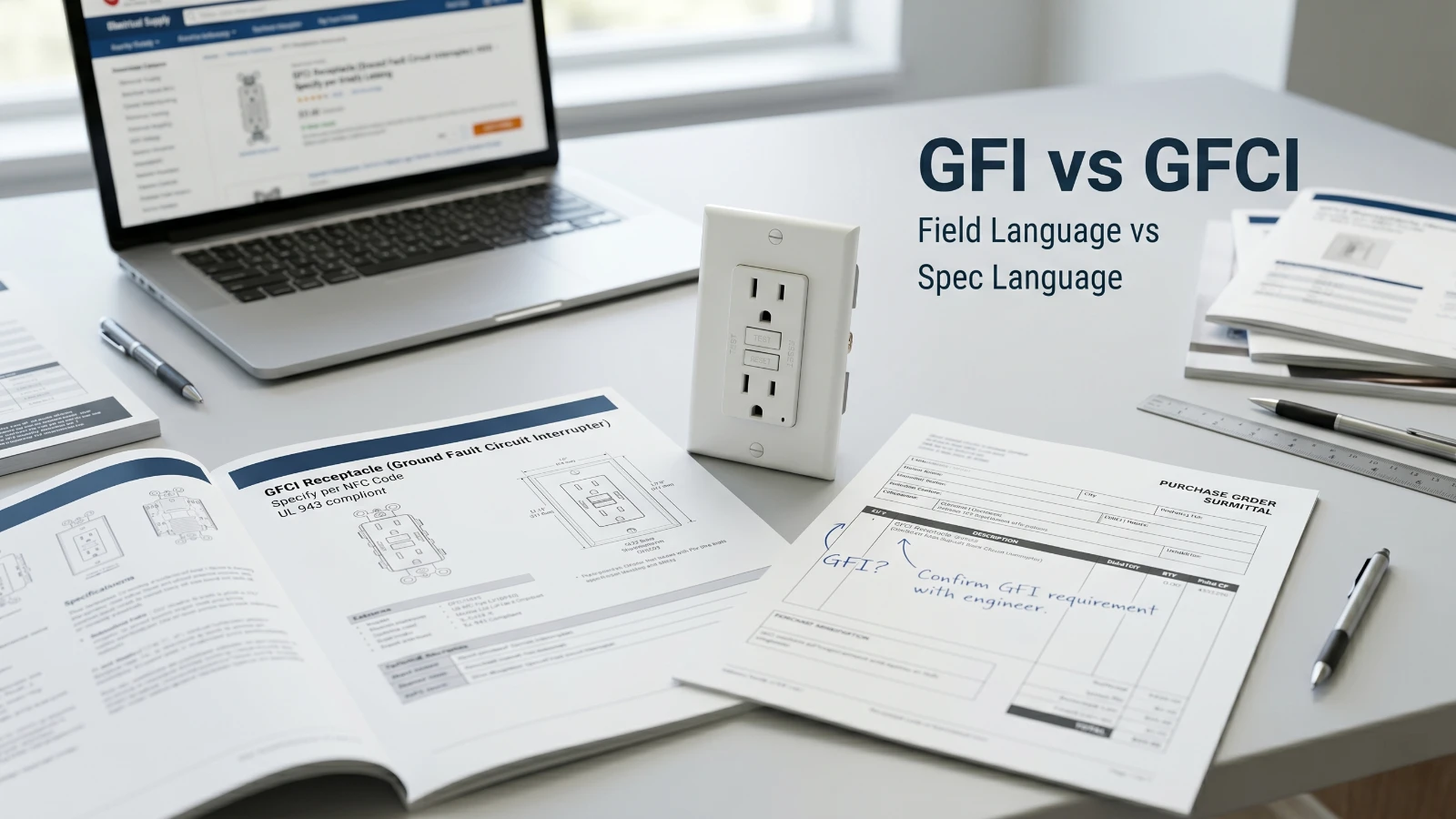
In everyday talk, GFI and GFCI mean the same thing: ground-fault protection that trips on current imbalance. On a document, GFCI is the term that holds up — it maps to UL 943 and NEC Article 100, while GFI has no standard of its own. The mix-up that actually costs a buyer time isn’t GFI vs GFCI. It’s confusing four terms that all share the words “ground fault.”
| Term | What it is | Trips at | Listed to | Where it belongs |
|---|---|---|---|---|
| GFI | Field shorthand for a Class A GFCI — the same device | 4–6 mA | No standard of its own | Conversation, packaging, search — not specs |
| GFCI (Class A) | Personnel protection, ≤150V to ground | 4–6 mA | UL 943 | POs, datasheets, NEC 210.8 receptacle locations |
| SPGFCI | Special-purpose, >150V to ground (Class C/D/E) | ~15–20 mA | UL 943C | Pools, HVAC condensers, horticultural (NEC 680.5, 410.184) |
| GFPE | Equipment protection, not personnel | 30 mA or higher | UL 1053 | Service/feeder equipment (NEC 230.95, 240.13) |
GFI is shorthand for the Class A GFCI device. SPGFCI and GFPE are separate listing categories with higher trip thresholds and different code sections.
GFI vs GFCI usually point to the same protection category in everyday conversation — ground-fault protection that detects current imbalance and disconnects power. Inside documentation, the two terms behave differently. NEC Article 100 defines GFCI as a Class A device with a 4–6 mA trip range, and it defines a separate term — GFPE — for equipment protection at higher trip thresholds. GFI, used on its own, sits outside that clean documentation structure.
The term gap first showed up for us in 2012, with our very first customer. His inquiry came through Alibaba that September and said GFCI. When he visited the factory that October, sample in hand, he said GFI the whole time — never the C — and we assumed we’d misheard. In November, confirming details before he placed the order, he emailed asking for “GFI with wall plate, screws included.” Seeing it in writing was when it clicked: GFI and GFCI were the same device to him. GFI was just his habit.
For a B2B supplier, this question belongs more to spec review than to installation troubleshooting.
The Short Answer: Same Everyday Meaning, Different Documentation Risk
In casual conversation, GFI usually gets the point across. In a purchase order, datasheet, or submittal package, GFCI is the term that creates fewer questions.
CPSC’s public guidance on ground-fault circuit interrupters treats GFCI and GFI as interchangeable names for the same homeowner-facing device. At that level, GFI is fine.
The picture changes at the document level. UL 943 is the standard for ground-fault circuit-interrupters intended for protection of personnel, and its formal language is GFCI. The 4–6 mA Class A definition in NEC Article 100 uses the same vocabulary. GFI may be understood in conversation, but it is not the term to anchor a UL 943 or NEC Article 100 reference. What changes at the document level isn’t the physics, it’s how precisely the reviewer can read the requirement.
Why GFI Still Appears in Field Language and Product Suffixes
GFI stayed because field language does not always follow standards language.
The shorthand is faster on a job site or at a counter, where two syllables travel better than four. CPSC’s homeowner-facing material acknowledges both names, which keeps GFI alive in consumer-facing channels — packaging, retail signage, search queries, support articles.
Breaker manufacturers also carry GFI in product-line names. Schneider Electric’s QO and Homeline ground-fault circuit breakers use the GFI suffix in part numbers such as QO-GFI and HOM-GFI, even though the products themselves are described as ground-fault protection for people. The suffix is product-line history, not a different device class.
Once a term is in part numbers, packaging, and search behavior, it doesn’t fade fast, so both names keep showing up.
What GFCI Means in Standards and Listing Language
GFCI is the term that maps more directly to standards, listing categories, and safety guidance.
UL 943 covers ground-fault circuit-interrupters intended for the protection of personnel. The Scope language in the standard is specific to GFCIs, and Class A is the device class defined for general personnel protection. The trip threshold is 4–6 mA.
For Class A personnel protection, the relevant listing path is UL 943. OSHA’s ground-fault protection guidance describes the same operating principle in plain language: a GFCI compares the current flowing out on the hot conductor with the current returning on the neutral, and if those values differ by approximately 5 mA, the device interrupts the circuit. NEC Article 100 uses the same Class A definition, and the Code references GFCI consistently in 210.8, 215.9, 590.6, and other personnel-protection sections.
A submittal line that says only “GFI receptacle” is usually still understood. It gives the reviewer less precise language than “Class A GFCI receptacle listed to UL 943.” On a tight approval schedule, that wording gap is not where a buyer wants the discussion to start.
For broader code context, see our guide to how NEC updates expand GFCI protection requirements.
GFCI vs GFPE: When “Ground Fault” No Longer Means the Same Protection
GFCI is intended for personnel protection. GFPE is intended for equipment protection. The two share a family of detection but differ in trip threshold, scope, and the code sections that reference them.
NEC Article 100 defines GFPE separately. GFPE devices are designed to trip at 30 mA or higher, and the Code’s GFPE-specific sections include 230.95 for certain services, 240.13 for large branch circuits over 150V to ground, and 426.28 for fixed outdoor electric deicing and snow-melting equipment. UL covers GFPE devices under UL 1053, not UL 943.
Because both names contain ‘ground fault,’ a jobsite note that says ‘GFI breaker, 30 milliamp’ can’t be read as Class A by default. In many product lines, 30 mA language points toward equipment protection, not personnel protection.
If a project specification calls for Class A GFCI personnel protection at a receptacle location, and the BOM accepts a 30 mA equipment-protection device because the line item only says “GFI breaker,” the problem is no longer vocabulary. It becomes a documentation and approval risk — the device on the wall does not match the protection class the Code requires for that location.
GFCI Outlet, GFCI Receptacle, GFCI Breaker: Similar Search Terms, Different Product Forms
These terms often appear in the same conversation, but each describes a different product form.
GFCI outlet is the consumer-search term. It points at a wall device with TEST and RESET buttons in the kitchen or bathroom — useful for finding the right product, less useful for describing it on a datasheet.
GFCI receptacle is the spec-side term. NEC Article 100 distinguishes between an outlet, meaning a point on the wiring system where current is taken to supply utilization equipment, and a receptacle, meaning a contact device installed at the outlet for the connection of an attachment plug. In code language the two point to different things. When the document is a UL/cUL listing reference, a product datasheet, or a B2B catalog, “receptacle” is the form the supplier quotes against.
GFCI breaker is a different product form. Same Class A protection, different installation point. The breaker sits in the panel and protects the entire circuit downstream, while a GFCI receptacle protects at the wall point and any downstream receptacles wired through its LOAD terminals.
“GFCI outlet” works for what the reader is searching for; “GFCI receptacle” is what the supplier needs to quote against.
For when a project should use a GFCI breaker at the panel versus a GFCI receptacle at the wall, see our guide on when to specify a GFCI breaker instead of a receptacle.
SPGFCI: Why “GFCI” Alone Is Not Always Specific Enough
In 2023, NEC Article 100 added a separate definition for SPGFCI — Special Purpose Ground-Fault Circuit Interrupter. UL 943C frames SPGFCI around applications where voltage-to-ground conditions or grounding arrangements make Class A GFCI protection impractical or outside its intended use. UL 943C defines sub-classes, including Class C, D, and E, by voltage range and trip threshold, with thresholds sitting between Class A GFCI and GFPE.
Class A GFCIs are rated only up to 150V to ground, which excludes some commercial pool pumps, water-park equipment, horticultural lighting, and similar circuits operating at voltages where Class A devices are not rated to operate. NEC 680.5 and 410.184 now reference SPGFCI for those locations.
For standard 125V receptacle locations where the code calls for personnel protection, Class A GFCI remains the term buyers should expect to see. SPGFCI is the right term when the specification involves a higher-voltage location or a listed Class C path, such as certain HVAC condenser applications. The adopted NEC edition and AHJ interpretation still control the final requirement.
For HVAC condenser nuisance tripping at the boundary between Class A and Class C devices, see our guide on HF GFCI and Class C SPGFCI distinctions.
Which Term to Use in Specs, POs, and Submittal Documents
For a buyer or spec writer, the practical question is not which term is correct in the abstract. It is which term to put on the document.
When the document controls what gets quoted, listed, shipped, or reviewed, we would use GFCI. When the conversation is verbal or homeowner-facing, GFI is usually understood.
Precision should match the audience. On homeowner-facing material — packaging, retail signage, support articles — GFI and GFCI are interchangeable, and CPSC uses both, so nothing breaks. In a B2B catalog or datasheet, GFCI earns its place by mapping straight to UL 943 and keeping the line consistent once breakers and SPGFCI variants show up later.
Where it actually matters is the submittal, the BOM, the PO. There, GFCI is the safer choice, and the protection class is worth adding when accuracy is on the line. “Class A GFCI receptacle, 15A or 20A, listed to UL 943, weather-resistant if outdoor” hands the reviewer everything in one line. “GFI receptacle” hands them one term and several follow-up questions.
The cost of getting this wrong is not catastrophic. It shows up as a clarifying email, a revised submittal, or a cross-check on whether “GFI breaker” meant a Class A GFCI breaker or a 30 mA GFPE breaker. Those small clarification loops are exactly what spec discipline is meant to remove.
For the GFCI receptacle range listed to UL 943, see our UL/cUL listed GFCI receptacles for project sourcing.
Frequently Asked Questions About GFI vs GFCI
Are GFI and GFCI the same thing?
In everyday conversation, yes. CPSC’s public guidance treats GFCI and GFI as interchangeable names for the same homeowner-facing protection device. In documentation, GFCI is the term that maps cleanly to UL 943 and NEC Article 100.
Why do electricians say GFI instead of GFCI?
The shorthand stayed because field language rewards speed, not formal terminology. GFI is shorter to say, CPSC accepts both names in homeowner-facing material, and some breaker families still carry GFI in part numbers such as QO-GFI and HOM-GFI. None of that changes the listing language. It only explains why the term keeps appearing in conversations and search queries.
Is a GFCI receptacle the same as a GFCI breaker?
Picture the two installation points. The receptacle goes in the wall and protects at that point, with any downstream receptacles wired through its LOAD terminals also covered. The breaker goes in the panel and protects the whole circuit from there. Both can provide Class A protection listed to UL 943, but they are not the same product form. Same protection category — different place to install it, and different reset behavior when something trips.
Is GFPE the same as GFCI?
No. GFPE, or Ground-Fault Protection of Equipment, is intended for equipment protection rather than personnel protection. GFPE devices are designed to trip at 30 mA or higher and are listed under UL 1053. GFCI devices are Class A personnel-protection devices listed under UL 943. The two terms describe different listing categories with different trip thresholds, even though both detect ground-fault current.
What should a buyer write in a PO: GFI or GFCI?
Use GFCI, with the protection class added when it matters. A clean PO line reads: “Class A GFCI receptacle, 15A or 20A, listed to UL 943, weather-resistant if outdoor location.” Add color, face style, packaging, wall plate, and project documentation requirements separately.
Final Specification Check for GFI vs GFCI
Before a PO or submittal package is released, the buyer and supplier should be using the same protection language. “GFI” may be clear in conversation, but the written document should identify the device class and product form.
- For casual communication: GFI and GFCI are usually understood as the same protection category.
- For product pages and datasheets: use GFCI receptacle, GFCI breaker, or GFCI-protected outlet depending on the product form.
- For UL/cUL documentation: use the terminology that maps to the listing path, such as Class A GFCI listed to UL 943.
- For PO and BOM review: do not let “GFI breaker” hide whether the device is Class A GFCI or 30 mA GFPE.
- For higher-voltage applications: confirm whether Class A GFCI, SPGFCI, or GFPE language belongs in the specification.
- For AHJ review: check the adopted NEC edition and local interpretation before treating any single wording pattern as final.
Need GFCI Receptacles Reviewed Against Your Project Spec?
Send the specification or BOM — we can review whether the wording aligns with the protection class and listing path the project requires.
Related articles on this site
Related product links
Sources and references
Primary
- U.S. Consumer Product Safety Commission: GFCI Fact Sheet
- OSHA: Ground-Fault Circuit Interrupters
- UL Solutions: GFCI Personal Protection Devices Testing and Certification
- UL Code Authorities: Understanding Ground Fault and Leakage Current Protection
- UL Code Authority: Special Purpose Ground-Fault Circuit Interrupters
- NFPA 70: National Electrical Code, 2026 Edition
Supporting