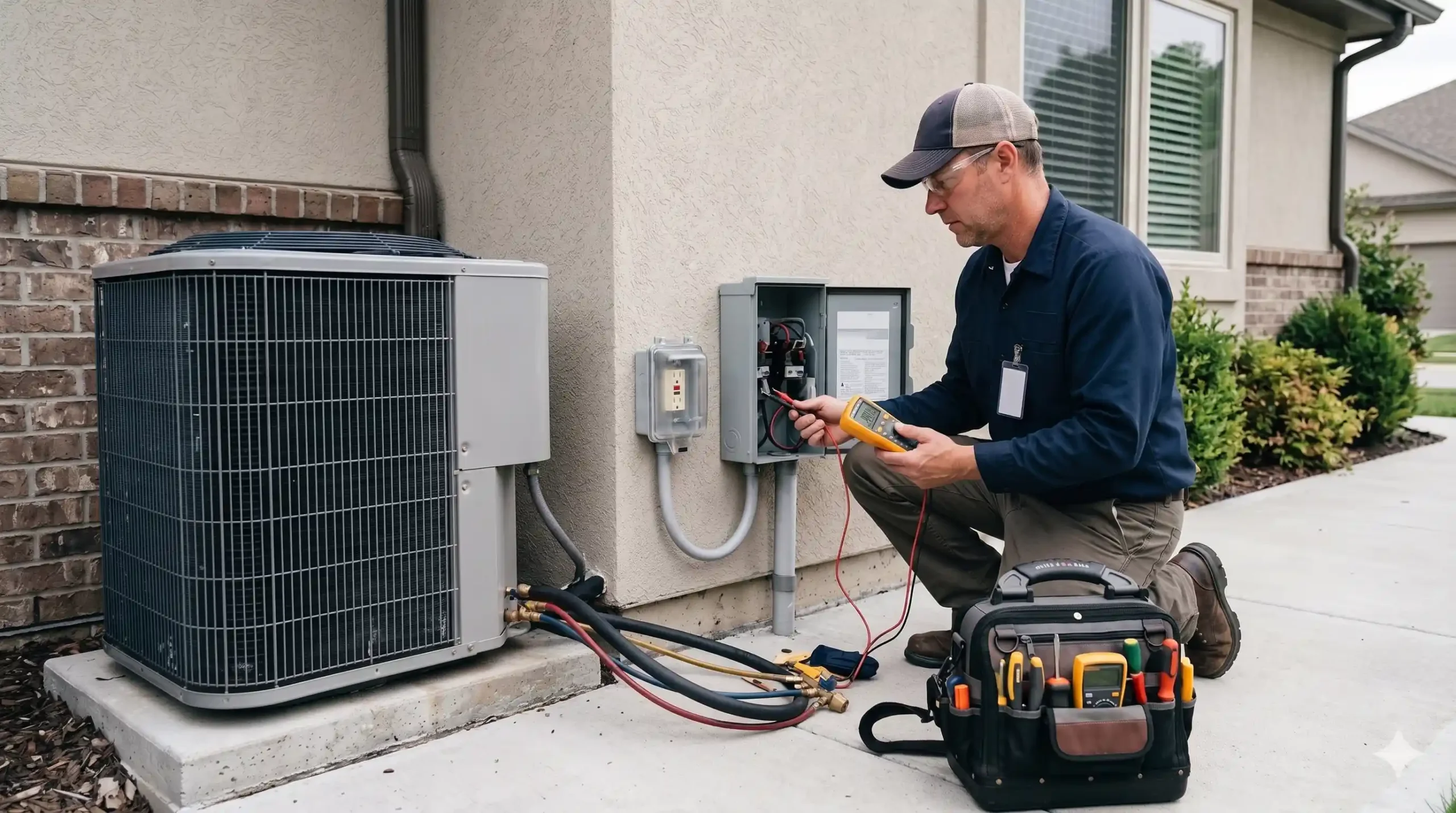
Quick answer: Starting September 1, 2026, NEC 210.8(F) Exception 2 expires. Listed outdoor HVAC equipment supplied by an outdoor outlet covered by NEC 210.8(F) will need GFCI protection or a permitted SPGFCI protection path in jurisdictions that have adopted and enforce the 2026 NEC. Two recognized compliance paths address modern HVAC leakage-current compatibility: an HF-marked Class A GFCI evaluated under UL 943 Supplement SB, or a listed Class C SPGFCI under UL 943C where NEC 210.8(F) Exception 3 applies. The Class C SPGFCI path requires the HVAC disconnect to be marked: “Warning: Class C SPGFCI Protection Provided for HVAC Unit.”
Why GFCI HVAC Nuisance Tripping Became a 2026 NEC Issue
Many contractors working with inverter-driven heat pumps, variable-speed compressors, and ECM-motor HVAC equipment have seen the same field problem: the equipment is listed, the installation appears correct, but a standard GFCI device trips during operation. The cause is often not a wiring mistake. It can be an interoperability issue between modern power-conversion equipment and a protective device originally designed around 60 Hz ground-fault behavior.
The 2026 NEC does not solve that problem by extending the HVAC exception indefinitely. Instead, the compliance path moves toward devices that can address modern leakage-current behavior more directly: HF-marked Class A GFCIs evaluated under UL 943 Supplement SB, and listed Class C SPGFCIs under UL 943C where Exception 3 applies.
For distributors and specifiers writing RFQs for 2026 residential projects, the sourcing question is no longer only “GFCI or no GFCI.” The better question is: which protection path is shown on the project documents, which product listing supports that path, and which code cycle has the jurisdiction actually adopted?
The Technical Reason Standard GFCIs Can Trip on Modern HVAC Loads
A standard Class A GFCI is designed to provide personnel protection and is commonly understood around the 4–6 mA Class A trip level for 60 Hz ground-fault conditions. That protection threshold remains central to bathrooms, kitchens, outdoor receptacles, and other NEC 210.8 applications.
Modern HVAC equipment can introduce leakage-current signatures at frequencies above 60 Hz because of inverter drives, variable-speed compressors, and power electronics. These high-frequency leakage currents are not the same condition as a 60 Hz personnel shock fault, but they can interact with protective-device sensing and cause unwanted tripping.
Some standard Class A GFCI designs may respond undesirably to high-frequency leakage signatures from power-conversion equipment, depending on the connected load and the protective device. UL 943 Supplement SB was added to provide an optional HF rating framework for evaluating GFCI immunity performance in the presence of high-frequency signals from utilization equipment evaluated to the GFCI Interoperability Test of UL 101.
What NEC 210.8(F) Requires in the 2026 Code Cycle
NEC 210.8(F) applies to outdoor outlets at dwelling units supplied by single-phase branch circuits rated 150 volts or less to ground and 60 amperes or less. In the 2026 NEC, the ampere threshold moved from 50 A to 60 A, which makes 60 A outdoor equipment planning more important for residential HVAC and other outdoor outlet applications.
The HVAC-specific planning issue is Exception 2. That exception allowed GFCI protection to be omitted for listed HVAC equipment, but the exception expires on September 1, 2026. After that date, listed outdoor HVAC equipment supplied by an outlet covered by NEC 210.8(F) must follow an applicable GFCI or SPGFCI protection path in jurisdictions enforcing the 2026 NEC.
Exception 3 is the new Class C SPGFCI path. It permits listed Class C SPGFCI protection for listed HVAC equipment. If Class C SPGFCI protection is provided, the disconnect serving the HVAC equipment must be marked: “Warning: Class C SPGFCI Protection Provided for HVAC Unit.” The informational note directs users to UL 943C for SPGFCI information.
Timeline: UL 943, UL 943C, and the 2026 Deadline
| Date | What Happened / What Changes |
|---|---|
| August 25, 2025 | UL 943 revision issued, adding the optional High Frequency / HF rating framework and Supplement SB for GFCIs. |
| 2026 NEC cycle | NEC 210.8(F) includes the 60 A outdoor outlet threshold, a temporary listed-HVAC-equipment exception, and Exception 3 for listed Class C SPGFCI protection for listed HVAC equipment. |
| September 1, 2026 | NEC 210.8(F) Exception 2 expires. Listed HVAC equipment supplied by an outlet covered by 210.8(F) will need an applicable GFCI or SPGFCI protection path in jurisdictions enforcing the 2026 NEC. |
How the HF Rating Works Under UL 943 Supplement SB
Supplement SB is optional. A manufacturer can list a Class A GFCI with or without the HF evaluation. A device carrying an HF mark has been evaluated through a supplemental procedure intended to address immunity performance in the presence of high-frequency signals from utilization equipment evaluated to the GFCI Interoperability Test of UL 101.
An HF-marked Class A GFCI is still a Class A GFCI — the HF evaluation addresses interoperability with high-frequency leakage, not a lower personnel-protection threshold for a true 60 Hz fault. It also doesn’t make a defective HVAC unit acceptable; it’s a compatibility path for compliant equipment and properly listed devices, so the markings, listing docs, instructions, and adopted edition still have to line up before it’s specified.
HF GFCI vs. Class C SPGFCI: Different Device Classes, Different Code Paths
HF GFCI and Class C SPGFCI are not the same thing. HF is an optional high-frequency rating applied through the UL 943 framework for GFCIs. Class C SPGFCI is a special-purpose ground-fault protection class listed under UL 943C and used under a separate NEC path for listed HVAC equipment.
| Device Type | Protection Characteristic | Listed Under | NEC Path | Typical Use |
|---|---|---|---|---|
| Standard Class A GFCI | Class A personnel protection for standard GFCI applications | UL 943 | General NEC 210.8 applications | Bathrooms, kitchens, general outdoor outlets, and other standard GFCI locations |
| Class A GFCI with HF mark | Class A GFCI with supplemental high-frequency immunity evaluation | UL 943 with Supplement SB HF evaluation | Main GFCI protection path where Class A protection is required | Outlets feeding inverter-driven or VFD-type loads where high-frequency leakage compatibility is a concern |
| Class C SPGFCI | Special-purpose GFCI protection generally described around the 15–20 mA range, with Class C designs relying on reliable equipment grounding or double insulation as part of the protective scheme | UL 943C | NEC 210.8(F) Exception 3 for listed HVAC equipment | Listed outdoor HVAC equipment where the Class C SPGFCI path is used and the required disconnect warning label is provided |
Which path you’re on is set by one thing: voltage to ground. How hard the unit nuisance-trips doesn’t change which class applies. A Class A GFCI, HF-marked or not, is rated only to 150 volts to ground. Most single-phase residential outdoor outlets under 210.8(F) sit at or below that, so Class A is the path, and the HF mark is the lever when a standard Class A trips on inverter or variable-speed leakage: same 150 V ceiling, same personnel-protection basis, better immunity to high-frequency signatures.
Class C SPGFCI is the other path. It’s listed to UL 943C, trips around 15–20 mA — between Class A and GFPE — and is used under 210.8(F) Exception 3 for listed HVAC equipment, with the disconnect marked “Warning: Class C SPGFCI Protection Provided for HVAC Unit.” That higher trip band is why the Code gave it its own exception: it is not Class A personnel protection. For a buyer the read is clean: if the outlet is at or under 150 V to ground and the only problem is high-frequency nuisance tripping, an HF-marked Class A keeps the job inside the receptacle category; once a design calls for the Exception 3 Class C path, the order has left standard receptacle territory and belongs with a UL 943C device and its label.
The September 1, 2026 date and the Exception 3 path only bind where the 2026 NEC has been adopted and is enforced, and adoption runs on each state’s and locality’s own schedule, which lags the NEC’s print date. A project permitted under the 2020 or 2023 edition stays governed by that edition, and local amendments can keep or change an exception the model code moved on from.
So confirm the edition the way the inspector will read it. Pull the edition the AHJ enforces on this permit, check the state adoption, then the local amendments on top of it, since a city or county can amend the state’s version. For HVAC, confirm whether the jurisdiction took 210.8(F) as written or amended the HVAC exception. Then put the adopted edition on the RFQ itself, so the device category — standard Class A, HF-marked Class A, or Class C SPGFCI — is picked against the code that governs this job.
What Distributors and Specifiers Should Verify Before a PO
Before approving substitutions or issuing purchase orders for 2026 HVAC-related work, buyers should check the following items:
- Confirm the NEC edition adopted and enforced by the project jurisdiction. A project permitted under the 2020 or 2023 NEC may not be governed by the new 2026 Class C SPGFCI path.
- Identify the protection path on the drawings: standard Class A GFCI, HF-marked Class A GFCI, or Class C SPGFCI. These categories should not be substituted without engineer and code review.
- If Exception 3 is used, confirm that the HVAC equipment is listed and that the Class C SPGFCI path is permitted for the installation.
- For Class C SPGFCI installations, confirm the disconnect warning label: “Warning: Class C SPGFCI Protection Provided for HVAC Unit.”
- For outdoor receptacle work, verify the required WR, TR, and GFCI markings for the location. See our TR and WR receptacle selection guide for how those markings map to NEC 406.
- For Canadian or dual-market projects, verify the cUL or CSA approval and the applicable provincial code separately. A U.S. listing path should not be assumed to transfer automatically to Canadian installations.
Frequently Asked Questions
Why does a new HVAC system keep tripping its GFCI even though the installation appears correct?
Modern variable-speed compressors and inverter-driven heat pumps can produce leakage-current signatures at frequencies above 60 Hz. Some standard Class A GFCI designs may respond undesirably to those high-frequency signals, creating unwanted trips even when the installation does not show a simple wiring fault.
Does an HF-marked GFCI lower the safety threshold for people?
No. An HF-marked Class A GFCI remains a Class A GFCI. The HF evaluation addresses immunity performance in the presence of high-frequency signals from compatible utilization equipment. It does not turn the device into a lower-safety substitute for standard personnel protection.
What changes on September 1, 2026 under NEC 210.8(F)?
Exception 2, which allowed GFCI protection to be omitted for listed HVAC equipment, expires on September 1, 2026. After that date, listed HVAC equipment supplied by an outdoor outlet covered by NEC 210.8(F) must use an applicable GFCI or SPGFCI protection path in jurisdictions enforcing the 2026 NEC.
When should Class C SPGFCI be used instead of an HF-marked Class A GFCI?
Class C SPGFCI is used only where the NEC 210.8(F) Exception 3 path applies to listed HVAC equipment. It is listed under UL 943C, uses a different special-purpose protection scheme, and requires the specific disconnect warning label. An HF-marked Class A GFCI remains a Class A GFCI with supplemental high-frequency evaluation under UL 943.
Do Canadian HVAC projects follow the same NEC 210.8(F) rule?
No. Canadian installations follow the Canadian Electrical Code and the applicable provincial code, not the NEC. Buyers should verify cUL or CSA markings and the adopted provincial requirements separately before specifying HF GFCI or SPGFCI-related products for Canadian projects.
What This Means for 2026 Stock and Spec Sheets
For contractors, the September 1, 2026 date is about reducing callbacks and avoiding inspection problems after the HVAC exception expires. For distributors, the September 1, 2026 date is mostly an inventory problem: standard Class A, HF-marked Class A, and Class C SPGFCI are three separate categories, and once they’re mixed on a shelf a substitution turns into a field-confusion call. Specifiers carry the other half — an RFQ that names the intended protection path clearly enough that procurement doesn’t swap the category. For the contractor, it comes down to fewer callbacks and a cleaner inspection once the exception lifts.
The practical move is to separate inventory and specification language into three categories: standard Class A GFCIs for standard GFCI applications, HF-marked Class A GFCIs for applications where high-frequency leakage-current compatibility is required and confirmed by listing, and Class C SPGFCIs for listed HVAC equipment under NEC 210.8(F) Exception 3 with the required disconnect label.
As recent CPSC enforcement activity has shown, UL/cUL certification documentation matters more than ever. For GFCI products specifically, product class, listing category, marking, and installation instructions should be checked before purchase orders are approved.
ShengYu Product Scope for NEC 210.8(F) Planning
| NEC planning path | What we ship | Listing / documentation note |
|---|---|---|
| General outdoor receptacle locations under 210.8(F) (≤150V to ground), where Class A protection is required | 15A and 20A self-test Class A GFCI receptacles, in non-TR, TR, and TR/WR; LINE and LOAD marked on the body, LOAD terminals covered, instruction sheet and “GFCI Protected” labels in the carton | Listed to UL 943 and UL 498; verify the file number and markings against the current product listing |
| Outlets feeding inverter or variable-speed HVAC where an HF-marked Class A GFCI is wanted | HF is a separate optional rating, not a default — a standard Class A receptacle is not HF-marked unless its own listing and marking say so. Confirm before specifying anything as HF | The HF mark is its own evaluation under UL 943 Supplement SB (added August 25, 2025); “self-test Class A” does not mean “HF” |
| 210.8(F) Exception 3, listed outdoor HVAC equipment on the Class C SPGFCI path | Outside our line — we make Class A GFCI receptacles, not Class C SPGFCI devices or GFCI breakers | Class C SPGFCI follows a separate UL 943C listing and needs the disconnect label “Warning: Class C SPGFCI Protection Provided for HVAC Unit” |
For current ShengYu GFCI receptacle listing support, buyers can verify applicable file and product information through UL Product iQ or request documentation from our sales team.
Preparing GFCI Specifications for 2026 HVAC Projects?
ShengYu manufactures UL/cUL-listed GFCI receptacles and provides product documentation, submittal sheets, and certification support for North American distributors and specifiers reviewing NEC 210.8(F)-related projects.