Table of Contents
Where a topic falls outside what a B2B receptacle factory can actually speak to — Article 680 pool and spa boundaries, AHJ local supplements, branch-circuit design — we say so and stop there.
The SKU side creates one complication. We read selection from the SKU side first. NEC code language treats TR, WR, and GFCI as three independent characteristics. The catalog has already bundled most of them. WR rarely sits on a shelf without TR. That gap between code-language characteristics and what actually exists at the SKU level is where most of the spec questions in this memo come from.
The three characteristics in spec language
TR — NEC 406.12 and UL 498
Tamper resistant outlets use internal shutters behind the energized slots, so the contacts only open when an attachment plug pushes both blades at once. NEC 406.12 in the 2023 cycle calls for listed TR receptacles for 15A and 20A, 125V and 250V nonlocking-type receptacles in ten location categories: dwelling units (including attached and detached garages, accessory buildings, and common areas of multifamily dwellings); hotel and motel guest rooms, guest suites, and common areas; child care facilities; preschools and education facilities; public-access spaces in clinics, medical and dental offices, and outpatient facilities; a defined subset of assembly occupancies (transit waiting areas, gymnasiums, skating rinks, fitness centers, auditoriums); dormitory units; residential care, assisted living, social and substance-abuse rehabilitation, and group home occupancies; foster care, nursing homes, and psychiatric hospitals; and certain agricultural-building areas accessible to the general public.
Four exception conditions sit outside that list. Receptacles more than 1.7 m (5½ ft) above the floor. Receptacles that are part of a luminaire or appliance. Certain not-readily-accessible appliance receptacles. Nongrounding replacements permitted under NEC 406.4(D)(2)(a).
TR construction is evaluated under the tamper-resistant requirements of UL 498. The device carries a “TR” mark so the characteristic shows up during field inspection and submittal review. You’ll hear “tamper-proof” on jobsite conversations. It is not the code word, and it is not what shows up on a listed device’s marking.
WR — NEC 406.9 and UL 498 Supplement SD
Weather resistant duplex receptacles get evaluated under UL 498’s Supplement SD. The marking rule sits in clause SD9: the device has to be marked “Weather Resistant” or “WR” using letters not smaller than 3/16 inch (4.8 mm), and the mark has to stay visible after the cover plate goes on.
Supplement SD covers the construction side — corrosion protection, cold impact, accelerated aging, ultraviolet exposure, and related outdoor-exposure conditions. NEC 406.9 then governs where a WR receptacle is required: 15A and 20A, 125V and 250V nonlocking-type receptacles installed in damp or wet locations.
For wet locations specifically, NEC 406.9(B)(1) requires the enclosure to stay weatherproof whether or not an attachment plug is plugged in. If an outlet box hood is what carries that protection, the hood must be listed and identified as extra-duty. Other listed assemblies that provide equivalent weatherproof protection without an outlet box hood do not need to carry the extra-duty marking.
WR construction and GFCI protection are independent. A receptacle can be WR without GFCI, and a GFCI receptacle can be indoor-only unless it also carries a WR marking.
GFCI — NEC 210.8 and UL 943
GFCI receptacles fall under UL 943 for ground-fault protection at the device level. NEC 210.8 governs where GFCI protection is required by location. The 2023 NEC cycle added NEC 406.4(D)(3), which now requires GFCI receptacles to be listed — a gap the previous code had left open, since AFCIs already needed listing while GFCIs did not, even though both sit in the same safety-device class.
Self-test is a separate UL 943 conformance item. A GFCI receptacle whose UL number reflects the current standard is self-test by default; the standard does not let anything else through. That said, “self-test” still belongs on the PO line if the buyer wants it spelled out. The word does work.
How the three combine at the SKU level
Worth slowing down here, because the SKU side of the supply chain has already done some bundling that the NEC text does not show.
Our line does not produce stand-alone WR receptacles. Every WR receptacle we build is also TR. Every WR GFCI is also TR. The combinations we actively run:
- 15A / 20A standard receptacle, neither TR nor WR
- 15A / 20A standard receptacle, TR
- 15A / 20A standard receptacle, TR + WR
- GFCI receptacle, neither TR nor WR
- GFCI receptacle, TR
- GFCI receptacle, TR + WR (the WR GFCI receptacle)
USB outlets all ship TR, and we do not make a WR version. That is a product-design call, not a code reading. The USB face does not get along with water, and the spots where USB outlets actually get specified — desks, nightstands, hotel-room work surfaces, kitchen perimeters away from sinks — are not the spots where WR matters.
Across our active production, the picture looks roughly like this. For standard receptacles, TR is what we ship most often. Plain non-TR still moves — retrofits, locations outside the 406.12 list, replacement orders — but the default request that comes in is usually TR. TR + WR sits well behind both. Outdoor receptacle counts in a building are never going to match indoor counts.
GFCI looks different. Plain non-TR/non-WR GFCI is still where most of the volume goes. There is steady demand for it in dry indoor commercial space where neither 406.12 nor 406.9 applies. TR GFCI comes next. WR-side GFCI variants run thinner — bathrooms and wet-adjacent zones cover less floor area in a typical building than kitchen counters, garages, basements, and commercial common-area circuits put together.
USB outlets ship TR. Every unit.
The takeaway for spec writers: at the catalog level, “WR” almost always resolves to “TR + WR.” A project that genuinely needs WR without TR should expect a substitution conversation, a longer lead time, or both — most North American B2B manufacturers do not keep a WR-without-TR SKU on the line. That is the main reason we lean toward putting all three characteristics on a single PO line whenever any one of them is triggered. They travel together at the SKU level even though NEC treats them independently. There is 15A vs 20A receptacle selection.
The PO line where most submittal questions start
Submittal review keeps surfacing the same kind of line. A PO that names a catalog number, or that lists ampacity and color but skips characteristics, leaves the manufacturer guessing which of four to six SKUs the buyer actually means.
The problem line
This skips the question of TR. It skips damp or wet location. It skips GFCI. It does not name the UL listing reference, the country market (NEC versus CEC), or self-test for a GFCI variant. It does not say where, or in which marking format, the buyer expects to verify those characteristics once the goods arrive.
A line like that comes back from submittal review with one or more change orders attached if the project sits in any of the 406.12 occupancy categories. Plenty of commercial, hospitality, and assisted-living projects do.
The corrected line
Two changes do most of the work. Swapping “duplex receptacle” for three characteristic statements that name the standards. And the parenthetical-condition format — WR and GFCI sit in conditional brackets so the same line template can be reused across a project where some receptacle locations need WR, some need GFCI, and some need both.
Field reference for the PO line
| PO line field | What it does |
|---|---|
| Amperage / voltage / NEMA configuration | Selects the physical receptacle type; without it, the rest of the line cannot be priced |
| TR per UL 498 | Selects the shutter construction and the “TR” marking on the device |
| WR per UL 498 Supplement SD | Selects WR construction and the “WR” or “Weather Resistant” marking (letters ≥ 3/16 in., visible after cover plate install) |
| GFCI per UL 943 (Class A, self-test if specified) | Selects the GFCI sensing module, the trip threshold, and the self-test cycle if called for |
| UL listed / cUL listed | Selects the certification scope; cUL is what gets checked at the Canadian border, not at submittal |
| Color / device style | Selects the finish family |
| Packaging note (instructions in-box?) | Lets the manufacturer flag whether individual-unit packaging is needed (this is a price input — see below) |
The corrected line is not longer for its own sake. It carries the minimum needed for a manufacturer to pull a single SKU without a clarification email back to the buyer.
Pre-shipment review
Pre-shipment stays narrow on the manufacturer side. Field checks belong to the contractor and the AHJ; we do not try to substitute our view for theirs. Three layers run before a receptacle order leaves the line.
Visual and marking. A QC operator checks every required marking — listing mark, TR symbol if applicable, WR or “Weather Resistant” text if applicable, amperage and voltage rating, GFCI Class designation if applicable, country-of-origin. The same operator covers cosmetic conformity: color match, face and body and yoke flat and smooth, no visible defects.
Electrical. Voltage withstand and function get verified on the test rig, not by eye. GFCI SKUs run the self-test cycle and confirm the trip threshold on that pass. Every unit, not a sample.
Mechanical. A separate pass inserts and withdraws a calibrated plug to confirm the AC face engagement is smooth and within the spring-tension range the design calls for. Devices that pass electrically but feel rough or gritty during plug insertion get caught here.
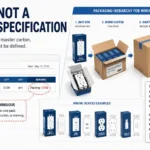
The documentation question that catches a lot of first-time B2B buyers off our line is the one about installation instructions in the carton. Standard receptacles ship shrink-wrapped, 20 pieces to a master carton, no individual retail-style packaging. There is no spot to put a printed instruction sheet. If a project actually needs instructions packed with every individual unit, the factory has to switch to single-unit packaging — and that change shows up in the unit price more than anywhere else.
GFCI receptacles are the exception. Those ship with installation instructions in the carton regardless, because LINE / LOAD wiring matters for whether downstream protection works as intended, and that distinction has to be in print every time. Not field shorthand.
Boundaries we do not try to cover
Several judgments stay off the table on the manufacturer side.
AHJ local supplements and amendments. We can read the 2023 NEC text on 406.12 and 406.9. We cannot read what the AHJ in a specific county has adopted, amended, or interpreted. That review sits with the project’s engineer of record and the local inspector. On projects that cross multiple AHJs the spread between interpretations can outweigh the device-level decision.
Branch-circuit design and 210.8 application. Whether a specific receptacle on a specific branch circuit needs GFCI under 210.8 is a circuit-design decision, not a device-level decision. We pull the GFCI receptacle the spec calls for. We do not redraw the panel schedule on the buyer’s behalf.
Article 680 — pools, spas, fountains. Receptacle requirements inside the Article 680 envelope layer on top of 406.9 and 210.8, with bonding, distance, and equipotential rules that belong with a pool installer or the engineer of record, not the receptacle factory.
Field installation. We are a factory. We do not visit job sites. We do not install. Installation guidance is something the engineering team can supply on request — application notes, wiring diagrams, LINE/LOAD reminders — but the install itself runs through a qualified electrician under local rules.
Quick selection matrix: TR, WR, GFCI by application
| Application | TR | WR | GFCI | Reference | Typical SKU |
|---|---|---|---|---|---|
| Residential dry room | Yes | No | Usually no | 406.12 | TR receptacle |
| Residential bathroom | Yes | No | Yes | 210.8(A), 406.12 | TR GFCI receptacle |
| Kitchen countertop | Yes | No | Yes | 210.8(A), 406.12 | TR GFCI receptacle |
| Hotel / motel guest room | Yes | No (unless damp/wet) | Per location | 406.12 | TR receptacle (TR GFCI in bathroom) |
| Education / public-access facility | Yes | No (unless damp/wet) | Per location | 406.12 | TR receptacle |
| Assisted living / nursing / care facility | Yes | No (unless damp/wet) | Per location | 406.12 | TR receptacle; GFCI where required |
| Covered outdoor damp location | If occupancy requires | Yes | Per 210.8 | 406.9(A), 210.8 | TR/WR or TR/WR GFCI + listed cover |
| Open outdoor wet location | If occupancy requires | Yes | Per 210.8 | 406.9(B), 210.8 | TR/WR GFCI + listed extra-duty in-use cover |
For SKU-level selection where TR and GFCI are both required indoors, a TR self-test GFCI receptacle covers the indoor application. For outdoor or damp/wet locations, the WR GFCI receptacle adds WR construction and marking on top of the same TR + GFCI base.
What about documentation? The honest version
This is the part where most spec-review articles list documents the buyer should ask for. The reality on the sales side rarely matches that list.
B2B buyers who order from our line almost never request a separate documentation package per shipment. The reason is structural. Every device carries its UL or cUL marking directly on it. The UL file number can be verified on UL’s product certification database (productiq.ulprospector.com / database.ul.com) before the PO is placed — and by the time the PO is signed, most buyers have already done that check. Product spec sheets are standard documents that do not change between orders, so there is little reason to “send a fresh one” each time the goods ship.
A few notes on the documents that come up most often:
- Listing and certification. Read off the device marking and verified on the UL database. cUL listing for Canadian shipment works the same way — the device either carries the cUL mark or it does not. There is no separate file that needs to change hands at PO stage.
- Spec sheets. Available on request as PDFs. A buyer who has been running the same SKU does not normally re-request them per order; they live as product files and do not change between batches.
- Self-test GFCI. Class A self-test is what the current UL 943 listing produces by default. A device whose UL number reflects the current standard is self-test. The self-test cycle is exercised on the QC line on every unit, not in a separate transmitted document.
- Installation instructions. In every GFCI carton. PDF on request for non-GFCI. (See the packaging note above for why non-GFCI does not have a printed sheet inside.)
What does get asked for, occasionally: a marking exemplar for an unusual color or a custom marking layout, where the buyer wants to confirm placement before tooling. That is project-specific, not a routine documentation step.
The PO workflow that actually works on the manufacturer side is the one where certification scope, country market, and characteristic list (TR / WR / GFCI / self-test) get locked at quote review. Once those are settled, the documentation pulls itself — through the marking on the device and the UL database lookup. Not through a separate PDF transmission per shipment.
Frequently Asked Questions
Are tamper resistant receptacles required by NEC?
Yes — NEC 406.12. The 2023 cycle lists ten location categories for 15A and 20A, 125V and 250V nonlocking-type receptacles: dwelling units, hotel and motel guest rooms, child care, education, certain medical office spaces, assembly occupancies, dormitories, residential care, foster care and nursing homes, and specified agricultural areas. Four exceptions apply: receptacles above 5½ ft, receptacles that are part of a luminaire or appliance, certain not-readily-accessible appliance receptacles, and nongrounding replacements under 406.4(D)(2)(a).
What standard applies to receptacles in North America?
UL 498 covers the receptacle itself. WR construction sits under Supplement SD of the same standard. GFCI receptacles add UL 943 for the ground-fault module. Canadian shipment generally needs cUL marking, reviewed against the Canadian Electrical Code. A UL listing does not automatically carry cUL.
Does a weather resistant receptacle also provide GFCI protection?
No. WR and GFCI are different characteristics that happen to live on the same device in some SKUs. WR addresses outdoor exposure under UL 498 Supplement SD. GFCI addresses ground-fault protection under UL 943. Outdoor wet-location installations often need both, plus the right weatherproof cover under NEC 406.9(B)(1).
Can one receptacle be TR, WR, and GFCI at the same time?
Yes. A listed TR/WR GFCI combines all three. At the SKU level it is the practical option for outdoor receptacles in occupancies that also require TR — which describes most outdoor residential, hospitality, and care-facility outlets. WR without TR is the unusual combination on most North American B2B catalogs.
What certifications should B2B buyers require for receptacles?
US-only: UL listing under UL 498, plus UL 943 if a GFCI is in scope. Canadian: cUL or CSA on the same device, against the Canadian Electrical Code. Dual market: combined UL/cUL is the smoother path. Certification scope belongs on the quote review, not the customs paperwork.
Sources
- NFPA 70, National Electrical Code (2023 edition) — Articles 406.12, 406.9, 210.8, 406.4(D)(3). Free read-only access via the NFPA library: NFPA 70
- ANSI/UL 498, Attachment Plugs and Receptacles — including Supplement SD, Weather-Resistant Receptacles. ULSE Standards Catalog: UL 498
- ANSI/UL 943, Ground-Fault Circuit-Interrupters. ULSE Standards Catalog: UL 943
- IAEI Magazine, “Significant Changes to the 2023 NEC by CMP-18”: IAEI Magazine
- Electrical Contractor Magazine, “Receptacles in Damp or Wet Locations: Notable NEC Changes for Dwelling Units”: Electrical Contractor Magazine
- UL Product iQ certification database: UL Product iQ
Author & Review
Prepared by the ShengYu Engineering Team — the five-engineer product and compliance group behind ShengYu’s UL- and cUL-listed wiring devices since 2006. The team covers UL/cUL submittal review, NEC compliance, product design, and QC. This article was reviewed against NFPA 70 and UL 498 / UL 943 source text before publication.
Related Reading
Working on a project where TR, WR, or TR/WR GFCI receptacles are part of the scope?
If your PO already lists the location schedule, send that together with the receptacle line items. We do not need the full project drawing to start a SKU check. A room schedule, destination market, required color, and certification scope are usually enough to confirm whether the quoted device should be TR, WR, GFCI, or a combined version.
Related Technical Guides
Continue reading related sourcing, compliance, and product selection guides.
- Inside ShengYu’s UL/cUL Wiring Device Production Line: What North American Buyers Should Verify Before Sourcing A buyer-side look at ShengYu’s wiring device production line, with practical checks for UL Product iQ verification, SKU coverage, documentation packages, and...
- UL 498 Changes Taking Effect June 20, 2026: A Buyer’s 8-Point Pre-Shipment Checklist for Receptacle Orders UL 498’s current public revision takes effect on June 20, 2026. This buyer checklist helps distributors, importers, and contractors verify certification records,...
- 2026 NEC Code Changes: Critical Updates for GFCI and Receptacle Installations What the 2026 NEC changes for GFCI and receptacle sourcing — the new 60 A threshold under 210.8(F), the September 1, 2026...
- Why 65W Dual USB-C Wall Outlets Are Gaining Ground in Hotels, Offices, and Modern Renovation Projects A sales-side look at where a 65W USB-C wall outlet fits in hotel rooms, serviced apartments, offices, hot desks, and renovation projects...
Author & Review
ShengYu Engineering Team
This guide was prepared by the ShengYu Engineering Team, the product and engineering staff behind ShengYu's UL/cUL-listed wiring devices since 2006. The team works on submittal review, UL documentation, and NEC compliance for North American B2B projects, and reviewed this article against NFPA and UL Solutions sources before publication.
Learn more about ShengYu's full editorial process and team background →Product Categories
Send target market, rating, color, marking needs, and documentation requirements before the quote is finalized.
Contact ShengYu →