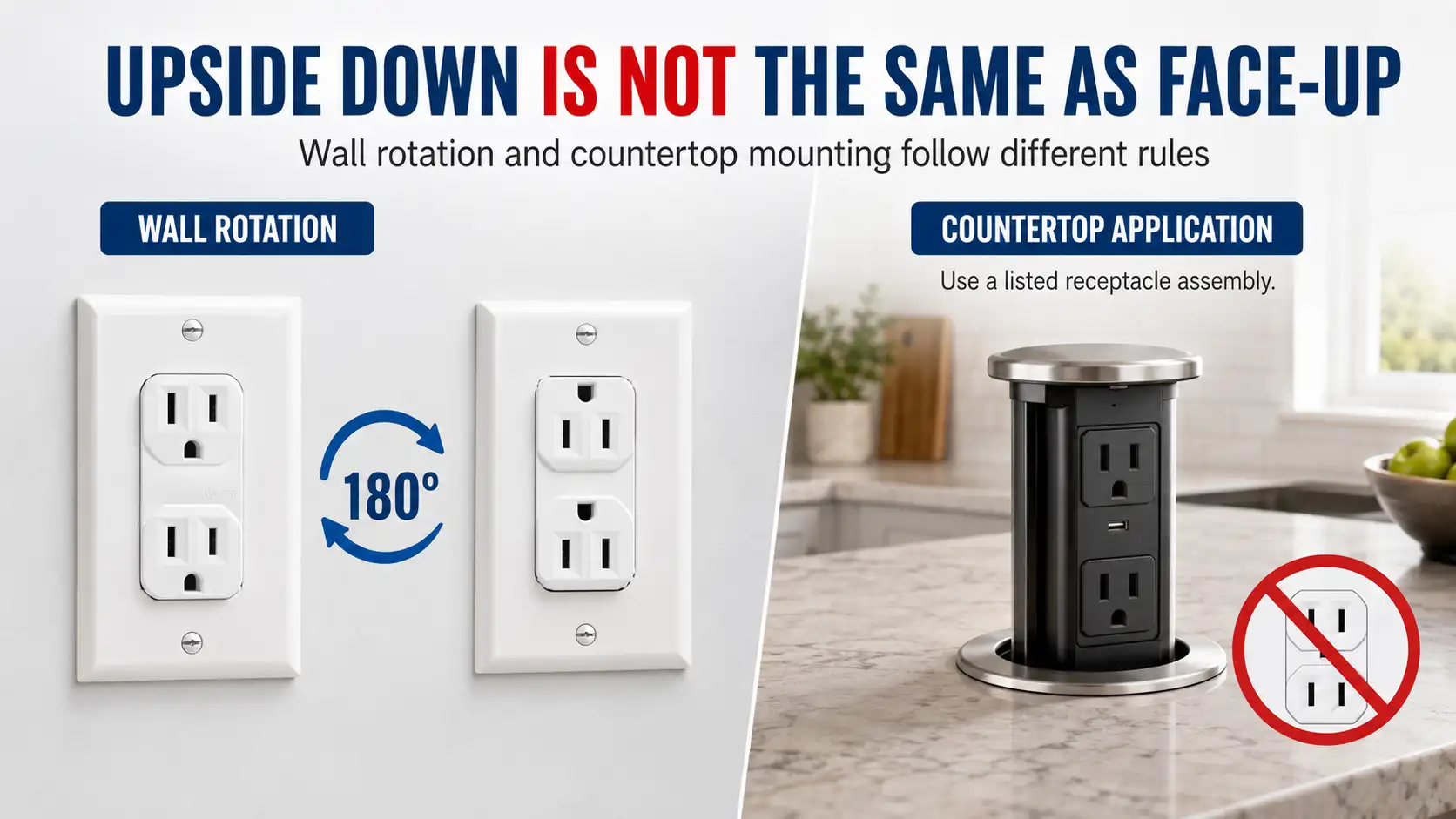
Yes — on a wall. An outlet installed upside down is not a code violation. Ground pin up, ground pin down, or turned sideways. The NEC does not choose one orientation for an ordinary wall-mounted receptacle. A project specification or a local amendment can still state one. Now lay that same receptacle flat, face pointing at the ceiling. The answer flips. A face-up installation stops being a question about the device. It becomes a question about what the whole assembly was tested for.
The Code declines to pick a side, and says so in writing
NEMA got asked this directly. All the flat-blade receptacle drawings in WD 6 show the ground pin up — was that an instruction hiding in plain sight?
The answer in NEMA WD 11-2023 is no. There was no hidden intent in the drawings. Functionality should drive the orientation. Consistency inside one building matters for looks, and it comes down to local convention. Then the line that closes the device side of it. Manufacturers print labels, names and instructions in both orientations. The NEC makes no distinction as to installation orientation. Industry practice is divided.
NEMA also takes up why one entire metro area does it sideways. It says it believes Chicago’s horizontal convention grew out of the steel-conduit rules that followed the Great Chicago Fire. The code did not require horizontal receptacles. The box position made rigid conduit easier to run without a bend.
That is what local convention looks like up close. A wiring method made one mounting position cheaper, and it got repeated until it looked like a rule.
The ground-up argument, and the frame it needs
The case for ground up runs like this. A plug hangs slightly loose. Something metal falls down the wall — a tape measure, the edge of a picture frame. It lands on the ground pin, which normally carries no current, rather than bridging the hot and neutral blades. Some project specifications still call for ground up. Where a project wants it, that direction belongs on the drawing.
The reasoning holds inside its own frame. That frame is a vertical wall with gravity pulling straight down across the face of the device.
Take the frame away and it answers nothing. Turn the receptacle sideways, the Chicago case, and “up” becomes left or right. Nothing falls past the face any more. Put one in a ceiling and the geometry inverts outright. The ground-up argument never loses to a better argument. It runs out of the situation it was built for.
What the cord is doing matters more than the folklore
NEMA’s answer has a third part that rarely gets quoted. Orientation is also driven by the type of cord set plugged into the receptacle. Where the cord makes an immediate 90-degree turn, install the device in the direction the cord already wants to go.
A wall wart, a right-angle plug, a transformer block, a USB cable — each one leaves the face in one direction. Either it lies flat toward the baseboard, or it kinks against the furniture in front of it. Behind a bed or a desk, that decides whether the plug seats fully. It also decides whether the second half of the duplex is still usable.
On our side we build so that neither answer costs anything. We make GFCI, USB outlets, receptacles, switches, wallplates and slab boxes, UL and cUL listed, for distributors and contractors. The printing runs in both directions. On a GFCI, the TEST and RESET wording is printed twice, once for each orientation. It reads right side up either way. The mounting strap is symmetrical. The screw slots are elongated, so the device can be leveled in the box. Wallplates have no top. NEMA leaves plate depth to the installation code and the AHJ, with one functional limit: the plate must not interfere with a plug seating flush against the receptacle. That limit reads the same in either orientation, which is one more reason a plate does not need a top. That was already how it was done when I started selling these, and I don’t know the year the industry settled on it.
We make the device readable both ways because the choice isn’t ours to make. It belongs to whoever can see which way the cord leaves the wall.
The NEC has exactly one section actually titled “Receptacle Orientation.” It is 406.5(G), and it says nothing at all about the ground pin. Both of its parts are about face-up mounting. Receptacles shall not go face-up in or on countertops or work surfaces unless listed for that application. They shall not go face-up below a sink.
Set that against the wall debate. The section carrying the word orientation deals only with the horizontal plane.
The way out of that rule is not a rotation. It is a listing. Under 406.5(E), receptacle assemblies installed in countertop surfaces have to be listed for countertop applications. UL describes what gets through. A retractable flush-mount receptacle, an outlet box and a flush device cover plate, certified together as one assembly for fixed installation. Then mechanical endurance, mechanical loading, dielectric withstand, temperature and spill testing. That is a product category, arrived at by testing rather than by rotation.
We build wall-mounted and box-mounted devices, plus slab boxes. We do not build countertop assemblies. A slab box is not a quiet substitute for one. It is a box for roughing in during construction — no cover, no liquid protection, not an outdoor enclosure. Nothing we ship becomes countertop-legal by being pointed upward.
What a countertop listing covers, and what a work-surface listing doesn’t reach
UL runs a 64 oz saline spill test on hard-wired countertop assemblies, and on furniture power distribution units marked for kitchen or bathroom countertops. An FPDU intended only for an ordinary work surface gets the smaller 8 oz test. The countertop version is poured at the most disadvantaged area, with the assembly extended and any cover opened to its worst position. A dielectric withstand test follows immediately.
The permission runs one way. Under 406.5(F), a countertop-listed assembly can also serve a work surface. A work-surface-only listing does not authorize installation in a kitchen countertop.
A third category hides behind the same-looking product. A cord-and-plug-connected FPDU mounted to portable or stationary furniture is its own product category. That is not the same installation as a hard-wired assembly built into a countertop attached to the building, though both ship in a box that says pop-up.
The section number moves; the product doesn’t
UL’s guide information for pop-up receptacle assemblies points at 2023 NEC 406.5(E) and at 406.14(E) in the 2026 NEC. Same assemblies, two numbers. NEMA’s own FAQ says why that matters. The NEC is guidance. Each state and municipality decides which edition to adopt, with local amendments attached. Quote the edition alongside the section number.
What a PO line still doesn’t say
“20A countertop pop-up outlet, UL Listed” is not yet a spec. It leaves open:
- fixed building countertop, or furniture
- hard-wired, or cord-and-plug connected
- listed for countertop applications, or only for a work surface
- whose listing it is — the assembly, or just the receptacle sitting inside it
- GFCI built into the assembly, or protection from upstream
- cutout dimensions and the counter thickness it fits
That fourth line is where the trouble sits. A pop-up can carry a certification mark that belongs to the receptacle inside it, not to the finished assembly. Those are different approvals. Checking the mark against the actual file and category takes a minute and settles it.
For wall devices the equivalent list is shorter, because orientation never appears on it. Ground up or ground down gets decided at the box, by whoever can see the cord.
FAQ
Is it against code to install an outlet upside down?
No. The NEC makes no distinction as to device installation orientation on a wall.
Should the ground pin face up or down?
Neither is required. NEMA’s position: function should drive it, with consistency inside one building as a matter of local convention. Some project specifications still call for ground up. Where a project wants it, put it on the drawing.
Can a standard receptacle be installed face-up in a countertop?
No. 406.5(G)(1) blocks face-up mounting in countertops and work surfaces unless the product is listed for that application. A standard wall device carries no such listing.
Is every UL Listed pop-up approved for a fixed kitchen island?
No. “UL Listed” alone does not state the permitted installation. The certification has to cover the finished assembly and its intended countertop application. A hard-wired assembly built into a fixed counter and a cord-and-plug FPDU fixed to furniture are separate categories.
Does a countertop pop-up need GFCI built in?
It needs GFCI protection where 210.8 calls for it. That protection sits in the assembly or upstream. The PO has to state which one you are buying.
Sources and Internal Basis
External Sources
-
- NEMA WD 11-2023, Wiring Devices: Frequently Asked Questions. Referenced for ordinary receptacle installation orientation, cord-set direction, horizontal receptacle practice in Chicago, and the role of locally adopted codes and amendments:NEMA WD 11-2023 PDF
-
- NFPA 70, National Electrical Code, 2023 edition. Primary code basis for Sections 406.5(E), 406.5(F), and 406.5(G), covering countertop assemblies, work-surface assemblies, face-up receptacle orientation, and the area below a sink:NFPA 70 Official Code Page
- UL Solutions, Pop-up Receptacle Assemblies for Kitchen Countertops. Referenced for the countertop receptacle assembly category, hard-wired and cord-and-plug-connected assemblies, mechanical and spill test conditions, and the 2023 NEC 406.5(E) / 2026 NEC 406.14(E) references.: UL Solutions Countertop Receptacle Assembly Guide
- EC&M, NEC Requirements for Receptacles. Referenced as secondary technical commentary for Article 406 mounting requirements and the 2023 NEC treatment of countertop, work-surface, and face-up installations:EC&M Article 406 Commentary
Internal Basis
- ShengYu device construction — dual-direction TEST / RESET printing on the GFCI face, symmetrical mounting straps, elongated mounting slots, and wallplate geometry used for ordinary wall-box installation.
- ShengYu product-scope boundary — wall-mounted and box-mounted wiring devices and slab boxes are within our production scope; complete countertop receptacle assemblies are not.
- ShengYu sales-side specification review — separating ordinary wall-device orientation from the listing and installation scope of a finished countertop or furniture power assembly.
Wall devices that read right side up either way
Wall devices that read right side up either way — GFCI, USB outlets, receptacles, switches and wallplates, UL and cUL listed. → View the ShengYu wiring device range