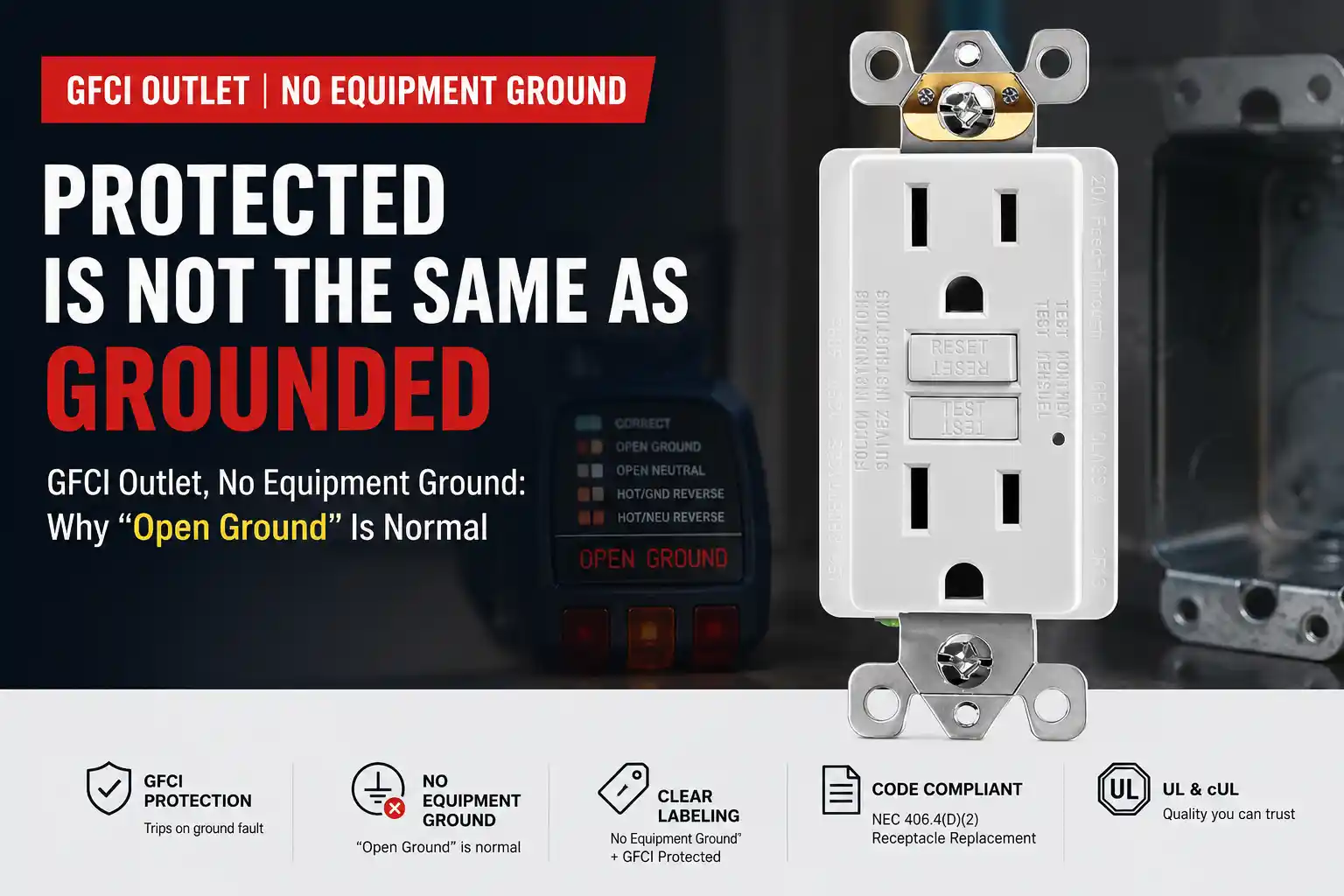
Put a GFCI receptacle on a two-wire circuit with no ground, and it still protects the person in front of it. The device works on the hot and neutral; it never needed the ground for that. That’s the part that starts the trouble. Once the three-prong face goes in, a grounded plug fits, and the outlet gets called “grounded.” On a spec sheet or a PO, that one word changes what someone thinks they bought.
In October 2022 a small contractor sent us an RFQ: upgrade the receptacles in a batch of older Detroit houses to compliant GFCIs. The houses were old enough that many circuits had no ground. His problem: the inspector’s plug-in tester kept reading no ground, and some outlets were failing the walkthrough. He asked if we could fix it on the device — build something into the receptacle so the tester read right. We told him no. That’s a branch-circuit condition. The part can’t change it. He’s a buyer rather than an electrician, and he’d landed where a lot of people do: that a “self-grounding” receptacle makes its own ground. It doesn’t, and neither does a GFCI.
What a GFCI is doing when there’s no ground wire
A GFCI compares the current leaving on the hot with the current returning on the neutral. When they stop matching — current leaking off where it shouldn’t, maybe through a person — it cuts power. That check needs no equipment ground. It runs on the hot-neutral pair alone. That’s why the code lets a GFCI sit on a two-wire circuit at all: the ground wire does no work in how it trips.
So a GFCI outlet not grounded still does the one thing it’s there for. What it can’t do is invent a ground the wiring never had.
The code already named this, and it makes you label it
The code is explicit here. NEC 406.4(D)(2) lays out your options when you open a box and find no ground. You can put back another two-prong receptacle. Or step up to a GFCI — either the GFCI receptacle itself, or a regular grounding-type receptacle fed from a GFCI upstream. The last two carry a condition. The device or its cover plate has to be marked “No Equipment Ground,” and the grounding-type-through-GFCI case adds “GFCI Protected.” Both have to be visible after install. You also can’t run a ground wire between those receptacles, since there’s no ground for it to reach.
Read that label rule again. The code is making you put a tag on the outlet that says, in plain words, this thing is not grounded. The “No Equipment Ground” sticker is the code’s own admission, left on the wall, that protection and grounding are two different things.
Every GFCI we ship carries both. The “No Equipment Ground” label sits on the back cover; the “GFCI Protected” label goes in the box. One per unit, asked for or not. We don’t make those optional, because 406.4(D)(2) doesn’t either. If the outlet lands on a no-ground circuit, the label is already there.
The downstream version catches people too. One GFCI can protect a run of ordinary outlets behind it. On a no-ground circuit, every one of those downstream outlets wears the “No Equipment Ground” label as well. Not just the GFCI at the head of the run.
One more boundary before it bites a project. This permission is for replacements. It doesn’t cover a new outlet pulled off an existing box with no ground. Swapping an old receptacle for a GFCI on a dead-ground circuit is fine. Extending fresh wiring off that same dead box doesn’t get the same pass.
Where the missing ground actually bites
The shock risk is covered. The gaps are elsewhere.
A surge protector needs a ground to do anything. It sends a spike down the equipment ground. With no ground there, the spike has nowhere to go. The strip becomes close to a plain power bar with a light on it. With no ground there, the spike has nowhere to go, so the strip works about like a plain power bar with a light on it.
Some equipment wants a real ground outright, and the manual will say so. The code points right at it. A note under the replacement rule flags that certain gear is built to need a ground. That gear shouldn’t sit on a circuit without one. For a buyer speccing outlets into a building, that note decides something — whether a GFCI swap is enough, or whether part of the job needs real rewiring.
Then there’s resale. A three-prong outlet that tests ungrounded with no label gets written up at a home inspection. That write-up can stall a closing or turn into a rewiring demand.
“Open ground” on the tester is reading the wall, not the part
Back to Detroit. The outlets failed because a plug-in tester lit up “open ground.” That reading was right. The circuit had no ground. But it’s describing the wiring behind the box. The receptacle is fine. That gap is where a return gets misfiled.
A three-light tester reads the hot-neutral-ground relationships at the face. On a two-wire circuit it reports open ground every time, even on a new device. There’s nothing back there for the ground pin to reach. We’ve had this come back as “your GFCI reads open ground, it must be bad.” It isn’t the device. A no-ground GFCI shows open-ground on the tester and still trips on its own TEST button. The TEST button is the check that tells you the protection works. Before anything ships back, the real question is whether the GFCI actually failed or the circuit simply has no ground. That’s a different test than the tester’s ground light, and the face indicator is model-specific on top of it.
“Grounded receptacle” on the PO doesn’t say which ground path
The Detroit buyer got stuck partly because “ground” carries several meanings, and a PO treats them as one word. There’s the equipment grounding conductor — the wire back to the panel. There’s the self-grounding clip on the yoke, which bonds the receptacle to a metal box. It only counts when the box is already grounded. On a two-wire plastic-box circuit it does nothing. There’s metal-to-metal contact on a surface box. “Grounded receptacle, 15A” picks none of these; it assumes a ground exists. On the Detroit circuits, none did.
Isolated ground wears the same word, and belongs on a different PO
Isolated ground rides in on the same word, but it’s a separate animal. An IG receptacle runs its grounding contact back on its own insulated conductor and wears an orange triangle on the face. It answers a noise problem. A missing ground is a different issue. We don’t carry it on the default line. We build self-grounding as standard and run IG only when a job specs it, which is rarely a plain residential retrofit. It has no business on the same order line as a no-ground GFCI swap.
What we print on the carton, and what we don’t decide on the jobsite
We make GFCI, USB, and standard receptacles, switches, and wallplates for North America, UL and cUL listed. We sell to distributors and contractors rather than the individual homeowner. What we lock down before anything ships is the device side: the ground terminal, the two labels, the wiring diagram on the instruction sheet, the LINE/LOAD marking. Our instruction sheet shows standard grounded wiring with a diagram. It doesn’t script the retrofit. How a no-ground swap gets installed and signed off isn’t ours to direct. Labels go out in English by default. When a customer’s market runs another official language, we ask whether they want it added.
What we don’t do is judge whether that box has a ground. Or how the local inspector will close the job. That was the honest answer to the Detroit RFQ. It’s also the answer to the self-test question that sits next to this one: the self-test checks whether the GFCI can still trip, not whether the circuit has a ground. They’re unrelated, and a no-ground GFCI self-tests fine.
Whether that Detroit job ever ran on our parts, I don’t know. A one-line RFQ doesn’t always come back, and I didn’t chase this one.
FAQ
Does a GFCI outlet need a ground wire to work?
No. It trips on the hot-neutral imbalance and never touches the ground.
Is a GFCI with no equipment ground safe?
For shock, it does its job. But anything that actually needs a ground loses out: surge protectors stop protecting, some appliances shouldn’t be on the circuit, and the outlet still has to wear the “No Equipment Ground” label.
Why does my tester show open ground on a brand-new GFCI?
Because the circuit has no ground. The device is fine — the tester is reading the wall.
Can I run a ground wire from a no-ground GFCI to the next outlet?
No. The code forbids it. That wire couldn’t reach a real ground anyway, and it would only mislead whoever opens the box next.
Which label is required, and since when?
A GFCI replacing a two-prong receptacle has to be marked “No Equipment Ground” — “GFCI Protected” too if it’s a grounding-type fed through a GFCI. The “receptacle or cover plate” wording goes back to the 2017 cycle and holds in the 2023 edition. Check your locally adopted edition; that’s the book your inspector is holding.
Sources and Internal Basis
External Sources
- NFPA 70, National Electrical Code, 2023 edition — primary code basis for NEC 406.4(D)(2) and NEC 250.146(A)/(B)/(D). Referenced for non-grounding receptacle replacement, No Equipment Ground / GFCI Protected labeling, receptacle bonding, self-grounding contact devices, and isolated-ground receptacle treatment:NFPA 70 Official Code Page
- OSHA Construction eTool — Ground-Fault Circuit Interrupters (GFCI). Referenced for the GFCI operating mechanism: comparing current going to and returning from equipment, then interrupting current when the two differ by approximately 5 milliamperes:OSHA GFCI eTool
- EC&M — NEC Requirements for Receptacles and Article 406: Receptacles. Referenced as secondary commentary for Article 406 receptacle replacement and field interpretation:EC&M Article 406 Commentary
Internal Basis
- ShengYu internal — October 2022 Detroit RFQ involving older two-wire residential circuits, GFCI replacement, open-ground tester readings, and the buyer’s question about whether the receptacle itself could make the tester read grounded.
- ShengYu GFCI packaging practice — No Equipment Ground label on the device back cover and GFCI Protected label packed with each unit for no-ground replacement and downstream-protection marking scenarios.
- ShengYu product-scope boundary — device terminal, label set, LINE/LOAD marking, instruction-sheet diagram, carton language, and factory packaging are within our side; field grounding path, box condition, retrofit method, and AHJ close-out are not.
Need GFCI receptacles that ship with the No Equipment Ground / GFCI Protected labeling already in the box?
Confirm the project location, replacement condition, device rating, face configuration, label requirement, and downstream-protection plan before you lock the order line.