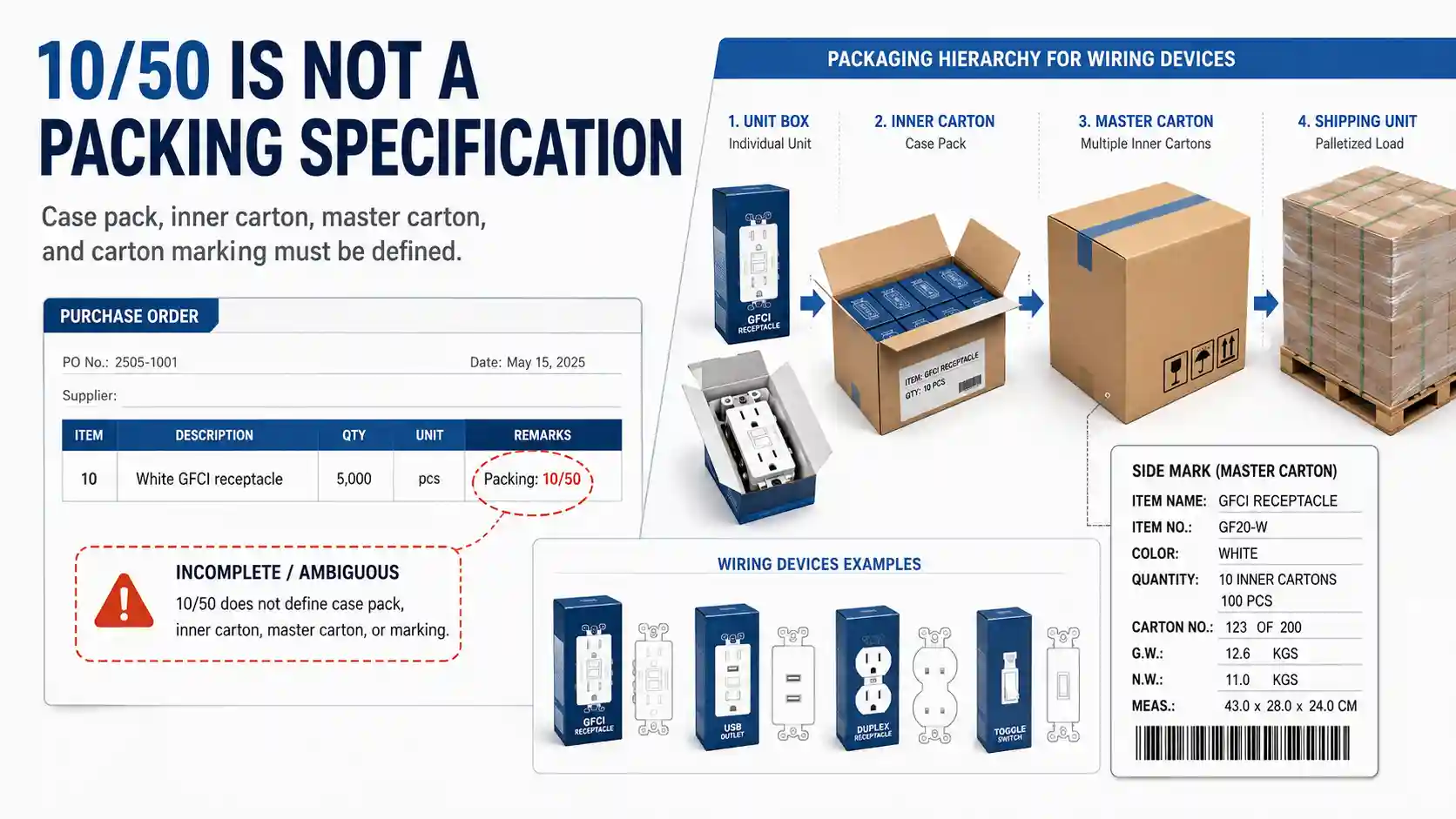
A purchase order line reads:
White GFCI receptacle, 5,000 pieces, packing 10/50.
Our packing team can map 10/50 to an existing factory pack table. A receiving warehouse cannot reconstruct that table from the PO line.
Does 10 mean devices per inner carton? Does 50 mean devices or inner cartons per master carton? Are wallplates included? Is the outer carton an orderable case or only a transport box?
We cannot determine the approved packaging hierarchy from 10/50 alone.
The problem reaches the warehouse before the carton is opened. Receiving specifications commonly require model, quantity and machine-readable data at the master-carton level. A wrong carton identity can place otherwise correct products on hold or into the wrong receiving record. DCL, for example, separates its label requirements by unit, inner carton and master carton, and treats nonconforming inbound inventory as subject to hold.[1]
“10/50,” According to Whom?
A case pack needs nouns, not only two numbers.
A complete instruction names the packaging relationship:
- one device per individual box;
- ten individual boxes per inner carton;
- five inner cartons per master carton;
- fifty devices per master carton.
Production can now count it. Inspection can open one carton and verify it. Receiving can compare the physical carton with the purchase order.
The instruction still needs a commercial role for each level. An individual box can be the sellable unit. An inner carton can be a replenishment pack. A master carton can remain a transport container, or it can become an orderable case in the customer’s system.
| Packaging level | Physical question | Commercial question | PO field |
|---|---|---|---|
| Individual unit | What is packed with one device? | Is it sold or inventoried separately? | Unit pack |
| Inner carton | How many units are grouped together? | Can the warehouse replenish by inner carton? | Units per inner |
| Master carton | How many units and inners are inside? | Is the master carton an orderable case? | Units and inners per master |
| Logistic unit | Which cartons move together? | Which shipment or receiving record identifies them? | Pallet, parcel or shipment label |
Quantity language also needs a counting unit. Devices, plug openings, yokes, wallplates and cartons do not describe the same thing. The distinction between device count and plug-opening count is covered separately in our receptacle quantity guide.
GS1 treats the base unit, pack, case and pallet as distinct levels in a packaging hierarchy when trading partners need to identify them separately. A unique GTIN is assigned at each existing identified level above the base unit.[2]
Our Default Packs by Product Family
Our default packaging depends on the product family.
| Product family | Individual packaging | Inner carton | Master carton | Included with each device |
|---|---|---|---|---|
| GFCI receptacle | 1 device per individual box | 10 devices | 50 devices | Wallplate, screws and instruction sheet |
| USB outlet | 1 device per individual box | 10 devices | 50 devices | Wallplate, screws and instruction sheet |
| Standard receptacle | No individual retail box by default | 20 devices | 200 devices | No wallplate or instruction sheet |
| Standard switch | No individual retail box by default | 20 devices | 200 devices | No wallplate or instruction sheet |
These are factory defaults, not fixed limits. Individual boxes, inner cartons, master cartons and printed artwork can be produced to an approved OEM specification.
The packaging description must still identify the exact SKU. A carton marked only RECEPTACLE does not separate 15A from 20A, residential from commercial grade, or standard from tamper-resistant construction.
Those distinctions already belong on the device line. Our 15 Amp vs 20 Amp Receptacle guide explains the amperage and grade fields. The TR and WR receptacle selection guide covers the TR, WR and GFCI characteristics that create separate SKUs.
Accessories also change the meaning of one unit. Our standard GFCI and USB-outlet packs include a wallplate, screws and instructions. Standard switches and receptacles do not.
A PO for 50 sets therefore needs a definition of set. The master-carton quantity cannot resolve an undefined unit.
USB outlets add another identity problem. The AC receptacle rating and USB charging output are separate specifications even when they appear on the same product. The difference is detailed in How Many Amps Is a USB Outlet?. A carton description should use the approved model number rather than reducing the product to 15A USB.
One Carton, Two Identities
The same physical carton can carry a trade-item identity and a logistic identity.
Under the GS1 system, a product or packaging level that is priced, ordered or invoiced is a trade item identified by a GTIN. A logistic unit created for transport or storage is uniquely identified on a GS1 Logistic Label by an SSCC.
These identities can coexist. GS1 specifically recognizes a logistic unit that is also a traded unit.[3]
| Identity | What it identifies | Repeated or unique? | Example use |
|---|---|---|---|
| Unit GTIN | One sellable device or pack | Repeated on identical units | Unit sale and inventory |
| Case GTIN | A fixed higher-level trade-item configuration | Repeated on identical cases | Case ordering and replenishment |
| SSCC | One specific logistic unit | Unique to that unit | Shipment tracking and receiving |
| Customer SKU | Customer’s internal product record | Repeated by SKU | ERP and warehouse matching |
| PO number | Commercial order | Repeated across the order | Receiving against the purchase order |
Use the unit UPC for the sellable unit, the case GTIN for the fixed case configuration, and the SSCC for one logistic unit. A scannable QR code is not automatically a GS1 identifier.
Our standard cartons do not include a default barcode program. Barcode content, symbology and placement follow the customer’s receiving requirement.
Before printing, the order needs to state:
- which packaging level the code identifies;
- who supplies or owns the number;
- which barcode format is required;
- whether human-readable data must appear below it;
- whether the warehouse or platform supplies an additional shipping label;
- how the printed code will be verified.
GS1 states that the company creating a logistic unit should assign the SSCC using its own GS1 Company Prefix. A later logistics provider or customer can assign one when the unit arrives without an SSCC. Responsibility therefore depends on the agreed supply-chain process, not on the word supplier.[3]
Mixed Cartons: The Receiving Rule Wins
Our standard orders do not mix:
- different product models;
- different colors of one model;
- switches and receptacles;
- unrelated SKUs to fill the final carton.
A customer’s receiving channel can impose a stricter data model. Best Buy permits only one unique UPC and one purchase order in an individual shipping carton. Its approved master pack must match the established case-pack quantity, and under- or over-packing that quantity is not accepted.[4]
GS1’s logistics framework also recognizes heterogeneous logistic units containing different trade items. In that situation, the guideline does not treat one GTIN as a complete statement of the mixed contents. It points toward electronic messaging linked to the SSCC.[3]
The GS1 data model does not grant permission to mix a carton. The receiving channel still decides whether it will accept that configuration.
| Packing question | Decision required before production | Why an outer mark cannot fix it later |
|---|---|---|
| Can two colors share one carton? | Approval by SKU and receiving channel | Color can be a separate inventory record |
| Can switches and receptacles share one carton? | Approved quantities for each SKU | One outer quantity no longer describes the contents |
| Can two POs share one carton? | Warehouse receiving approval | The carton cannot be assigned cleanly to one order |
| Can a short final carton ship? | Partial-carton rule | Standard case quantity is no longer correct |
| Can a master carton contain inner packs? | Approved hierarchy | The warehouse must know which level it receives |
Printing MIXED CARTON only describes what happened. It does not replace approval.
The Last Carton Starts at Order Entry
A partial carton begins with the ordered quantity.
We state the master-carton quantity before order release and ask the buyer to approve a full-carton multiple:
- GFCI and USB outlets: multiples based on 50 devices per master carton;
- standard switches and receptacles: multiples based on 200 devices per master carton.
OEM packaging changes the multiple. A customer can request forty GFCIs per carton, ten individually boxed switches per inner carton, or another approved arrangement. The order quantity should then be checked against that custom configuration.
When the quantity cannot follow the carton multiple, the exception needs its own instruction:
- whether a partial carton is accepted;
- the maximum number of partial cartons;
- the actual quantity to show on the side mark;
- the wording required by the receiving channel;
- how the carton appears on the packing list;
- how carton numbers continue across the shipment.
We do not use another model or color to fill a short carton under our standard packing.
When the Case Count Changes
Changing a master carton from fifty GFCIs to forty changes the physical packing immediately. Whether it also changes a product identifier depends on the role of the carton.
GS1 requires a new GTIN when the number of trade items changes in an existing identified higher-level packaging configuration. Its example changes a case from nine units to twelve. The base product can remain unchanged while the case receives a new identity.[2]
This rule does not mean that every unnumbered transport carton needs a GTIN. It applies when the case already exists as an identified level in the trade-item hierarchy.
Best Buy shows the receiving side of the same change. Before a new CPQ ships, its process requires approval, a stop date for the old configuration, and updates to the CPQ, GTIN-14, dimensions and weights.[4]
A case-count change therefore needs five checks:
- Is the carton an orderable or invoiced trade item?
- Does it already carry a case-level GTIN?
- Does the buyer’s ERP store the old pack quantity?
- Will old and new configurations exist at the same time?
- Have dimensions, weights and freight data changed?
The factory can change the physical pack. The party controlling the product and receiving data must approve the identifier change.
What We Actually Print on the Side Mark
Our carton marks are produced to the customer’s requirement.
The default side mark contains:
- item name;
- item number;
- gross weight;
- net weight;
- quantity;
- carton number;
- carton dimensions;
- color.
The mark is printed directly on the carton for most orders. A separate label is used on some customer packs.
We do not add a barcode by default. A barcode is printed when the customer supplies or approves the required data and format.
DCL’s current inbound specification shows why a neutral factory mark cannot cover every warehouse. It requires separate data at the unit, inner-carton and master-carton levels. Its master-carton rules include a human-readable and barcoded part number, carton quantity and a 14-digit GTIN when available.[1]
Best Buy uses another field set. Its five master-pack attributes are vendor identity, product or model, PO number, case-pack quantity and a trade-item number with a machine-readable barcode.[4]
A customer-specific carton may also require:
- customer SKU;
- PO number;
- country of origin;
- lot or production date;
- routing information;
- handling symbols;
- platform or carrier label.
Country-of-origin marking must follow the destination market and the approved packaging configuration. For U.S. imports, 19 U.S.C. §1304 and 19 CFR Part 134 govern how a foreign-origin article or its container is marked for the ultimate purchaser, subject to the applicable exceptions. A country name on the master carton does not automatically settle the marking requirement for the device or retail package.[5][6]
Write the Hierarchy on the PO
The PO should lock the quantities and commercial rules. The carton-mark proof should show the final printed execution.
A GFCI order based on our default pack can use:
Packing
One GFCI receptacle per individual box.
Ten individual boxes per inner carton.
Five inner cartons and fifty GFCI receptacles per master carton.
One wallplate, mounting screws and instruction sheet included with each device.Mixed cartons
Different models and colors are not permitted in the same master carton.Partial cartons
Not permitted unless approved before packing.Carton mark
Show item name, item number, color, quantity, gross and net weight, carton dimensions and carton number. Additional PO, origin and barcode fields follow the approved customer artwork.
A standard-switch order needs different language:
Packing
No individual retail box.
Twenty switches per inner carton.
Ten inner cartons and two hundred switches per master carton.
Wallplate and instruction sheet not included.
The proof then controls the visible execution:
- exact model and color;
- line breaks and wording;
- actual quantity;
- barcode data, when required;
- carton sequence;
- print or label position;
- applicable PO or shipment.
An inspection team cannot verify a carton against “the latest email.” It needs one approved reference.
Where the Factory Decision Stops
We can confirm and execute:
- individual, inner and master packaging;
- standard or OEM carton quantities;
- included wallplate, screws and instructions;
- carton dimensions;
- gross and net weights;
- direct printing or label application;
- separation by model and color.
The order must identify who supplies the receiving data:
| Field | Responsible party to name |
|---|---|
| Customer item number | Buyer or brand owner |
| Unit and case GTIN | GTIN owner or brand owner |
| SSCC | Party creating the logistic unit, unless another process is agreed |
| PO and routing data | Buyer or receiving warehouse |
| Platform shipping label | Platform account owner |
| Mixed or partial approval | Receiving channel |
| Physical carton dimensions and weights | Factory |
| Printed carton-mark execution | Factory against approved artwork |
The missing PO field is the relationship among the contents, the packaging level and the receiving identity.
FAQ
What does “10/50” mean on a switch or receptacle PO?
Nothing complete until the levels are named. State ten devices per inner carton and fifty devices per master carton, then define the individual packaging and included accessories.
Is case-pack quantity the same as master-carton quantity?
It can be, but the terms are not interchangeable by default. A buyer may use case pack for a sellable multipack, an inner replenishment carton or the approved master shipping carton. Write each physical level and its quantity separately.
Can different switch colors share one carton?
Not under our default packing. A different arrangement needs approval from the receiving channel before packing.
Does changing case quantity require a new GTIN?
Yes when the case is an existing identified higher-level trade item and its contained quantity changes. GS1 requires a new GTIN for that changed packaging level. An ordinary transport carton that has never been assigned a GTIN does not automatically become a new trade item because its count changes.
What appears on a ShengYu master-carton side mark?
Our default side mark shows item name, item number, color, actual quantity, gross and net weight, carton dimensions and carton number. PO, origin, barcode, routing and handling fields are added when the customer or receiving channel requires them.
Sources and Internal Basis
External Sources
- DCL Logistics, “Inventory and Labeling Specifications”. Public inbound requirements separating individual-unit, inner-carton, master-carton and pallet labels; it also states that nonconforming inbound inventory may be placed on hold.
- GS1, “Pack/case quantity” in the GTIN Management Standard. Public rule requiring a new GTIN when the number of trade items changes in an existing higher-level package or when a predefined pallet case quantity changes.
- GS1, “GS1 Logistic Label Guideline”. Public definitions and implementation rules for trade-item GTINs, logistic units, SSCC assignment, human-readable data, homogeneous units and heterogeneous units.
- Best Buy Partner Portal, “3.0 Receive-Ready Cartons”. Public vendor requirements for CPQ approval, one-UPC/one-PO shipping cartons, new CPQ data, GTIN-14, dimensions, weights and five required master-pack attributes.
- U.S. House Office of the Law Revision Counsel, 19 U.S.C. §1304, “Marking of imported articles and containers”. Statutory public anchor for U.S. country-of-origin marking of imported articles or qualifying containers for the ultimate purchaser.
- Electronic Code of Federal Regulations, 19 CFR Part 134, “Country of Origin Marking”. Current implementing regulations, including the scope, ultimate-purchaser definition, article marking, container rules and exceptions.
Internal Basis
- ShengYu standard packaging configurations for GFCI receptacles, USB outlets, standard receptacles and switches.
- ShengYu standard side-mark fields and print/label methods.
- ShengYu standard practice of separating models and colors and agreeing full-carton order multiples before production.