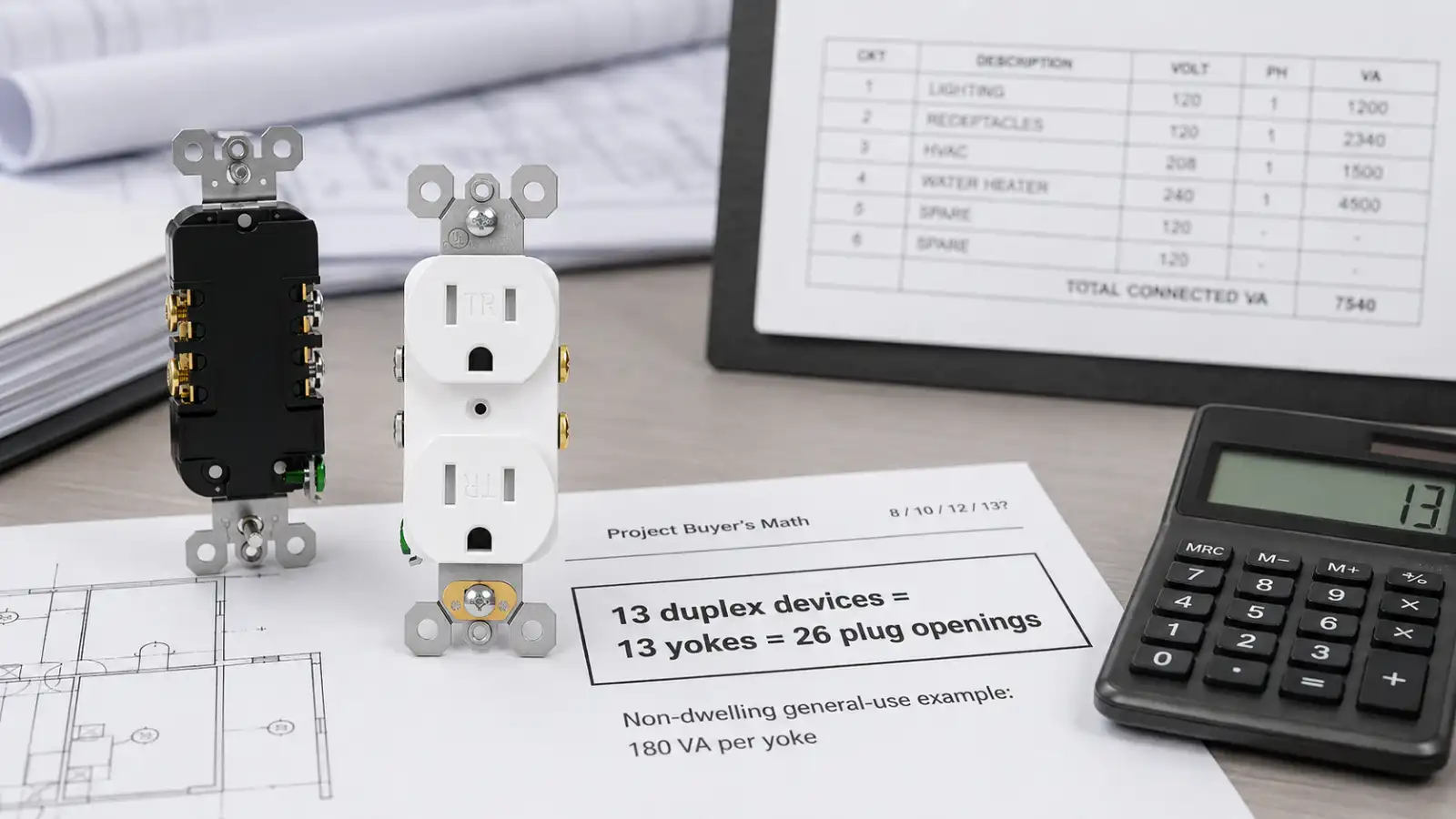
A buyer searches “how many receptacles on a 20 amp circuit.” Google returns 8, 10, 12, and 13. The four numbers come from different calculation paths — and one of them doesn’t trace back to a clear NEC starting point at all.
The pages giving those answers rarely state which calculation they used. The buyer ends up with four candidates and no way to pick.
Code basis. Section references below use the 2023 NEC edition numbering. A project should match the edition adopted by the local AHJ. The 180 VA per yoke calculation in 220.14(I) and the dwelling-unit handling in 220.41 have not changed substantively in the 2026 NEC revision.
The Four Numbers and Their Calculation Paths
The 8 path: 15A × 120V × 80% ÷ 180 VA = 8. The conservative calculation applies the 80% derate to a 15A circuit and assumes the receptacles are connected to continuous loads. The two assumptions stack on each other and produce a smaller count than the noncontinuous calculation does.
10 shows up in two different places. A 15A circuit at full capacity: 15 × 120 ÷ 180 = 10. A 20A circuit with the 80% derate: 20 × 120 × 0.80 ÷ 180 = 10.67, rounded down. The page giving 10 as an answer usually doesn’t say which of the two circuits it means.
12 is harder to track. NEC 220.14(I) does not produce 12 as a result for a 15A or 20A general-use branch circuit. When a page returns 12, the math behind it is usually some variation of “1.5 amps per outlet, 20A circuit, some derate,” reverse-engineered toward a round number. A buyer treating 12 as a code-derived ceiling is treating an estimate as a calculation.
Section 220.14(I), 2023 edition: “receptacle outlets shall be calculated at not less than 180 volt-amperes for each single or for each multiple receptacle on one yoke.” For a 20A 120V branch circuit at noncontinuous load: 2,400 VA ÷ 180 VA = 13.33, taken as 13 yokes.
Four numbers. Three traceable. One that doesn’t show up on a clear path through the code.
Why the 180 VA Calculation Doesn’t Drive the Dwelling Number
Section 220.14(I) sits in the part of Article 220 titled “Other Loads — All Occupancies.” Dwellings aren’t excluded from Article 220 entirely. They’re handled through 220.41 and the 220.14(J) reference, which together pull the general-use receptacle calculation for dwellings into a different pathway than the per-yoke estimate in 220.14(I).
The 2023 edition moved part of the dwelling load handling from 220.14(J) into 220.41. Under 220.41 the dwelling minimum unit load includes all general-use receptacle outlets of 20A rating or less, and the floor area used for the calculation is determined under 220.5(C). The result: a dwelling general-use receptacle isn’t counted at 180 VA per yoke against the branch circuit. The dwelling load is computed against floor area, and the number of receptacles per circuit comes out of design choices and the required circuits in Article 210.
The North Carolina OSFM electrical interpretation on Section 210.11 reaches the same conclusion in different words: there is no fixed NEC limit on the number of general-use receptacle outlets per dwelling branch circuit.
Continuous Load Is a Property of What’s Connected, Not the Receptacle
NEC Article 100 defines a continuous load as one where the maximum current is expected to continue for three hours or more. The classification attaches to the load, not the outlet that supplies it.
A receptacle outlet is a connection point. Whether the circuit feeding it should be sized for continuous operation depends on what the design or the foreseeable use puts on it. A receptacle in a back-office cubicle and a receptacle on a retail show floor can take the same 180 VA estimate at the yoke calculation level, even when the actual loads behave very differently in service.
The practical reading: a receptacle existing on a circuit doesn’t, by itself, automatically push the calculation through an 80% derate. The 80% comes in when the design or the load tells you it should — not because the count contains receptacles.
That’s why a non-dwelling 20A general-use branch circuit comes out to 13 yokes under the standard 220.14(I) reading, while 10 shows up when the same calculation gets the 80% derate added to it. 10 is the answer for a conservative design choice. 13 is the calculation result without the derate. Both can appear in the same project at different positions in the spec.
Count Yokes, Not Plug Openings
A buyer in Toronto messaged me on WhatsApp earlier this year about a 2025 renovation job. He had the schedule open in front of him and was working through the device counts. We were quoting against the schedule directly. When his line item came across as 1,000 duplex receptacles, the schedule showed 2,000 plug positions across the room layouts.
Two thousand plug openings. One duplex device covers two of them. The device count should have been 1,000 duplex devices — except his original plan needed 2,000 duplex devices, not 1,000. He’d counted opening positions twice and divided once, and the line landed at half what the project actually needed. We flagged it back to him before the shipment left.
He’s been carrying multiple projects at the same time. The line items had drifted between counting frameworks across his recent jobs.
Section 220.14(I) calculates by yoke. A duplex receptacle on one yoke is 180 VA. A single receptacle on one yoke is 180 VA. Both count as one yoke. The plug opening count on a duplex is two, but the two doesn’t enter the load calculation.
What this looks like for a 20A non-dwelling branch circuit at noncontinuous load:
- 13 yokes ≠ 13 plug openings.
- 13 duplex devices = 13 yokes = 26 plug openings, ordered as 13 devices with 13 wallplates.
- 1 single receptacle on one yoke = 1 yoke = 1 plug opening, ordered as 1 device with 1 wallplate.
- 1 quad device — four receptacles in one assembly — falls under the four-or-more clause and calculates at 90 VA per receptacle. The load on that device is 4 × 90 VA = 360 VA, not 180 VA.
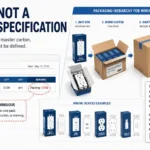
The BOM the buyer orders runs on device count and wallplate count. Plug openings don’t go in the line items.
Known Equipment Load Is a Separate Pathway, Not a Substitute for the General Estimate
The 180 VA per yoke calculation applies to general-use receptacle outlets — the ones where the load isn’t specified in advance. When a circuit is designed as a dedicated circuit, when the outlet is a specific equipment outlet, or when the connected load is known and identified in the design, the calculation moves to the equipment nameplate or to the applicable specific-equipment rule in Article 220.
A general-use receptacle that someone later plugs a copier into doesn’t retroactively become a specific-equipment outlet. The design intent at installation is what places the outlet into the general-use calculation or the dedicated-load calculation. Mixing the two pathways into the same circuit math produces a count that doesn’t match either rule.
Quantity Count and Receptacle Face Rating Aren’t the Same Decision
A 20A branch circuit calculation might come out to 13 yokes. The buyer does not, on that basis alone, need to order 13 NEMA 5-20R devices.
NEC 210.21(B)(3) allows 15A duplex receptacles on a 20A multi-outlet branch circuit. The yoke count comes out of the load calculation. The face rating selection depends on the equipment that will plug in, the project specification, and the circuit design — not on the breaker rating by itself. Two purchasing decisions, two different inputs.
We covered the face rating question separately in 15 Amp vs 20 Amp Receptacle: What Project Buyers Should Check Before Ordering. The two questions sit next to each other on the RFQ. The inputs that resolve them are different.
How We Handle Schedule-Based RFQs
A lot of our project quotes start with the buyer forwarding the full schedule on WhatsApp or email. The Toronto case is one of those. We quote against the schedule on the full SKU mix — duplex receptacles, GFCIs, USB outlets, switches, wallplates, TR and WR variants where the spec calls for them — and the schedule review takes place before the production line writes the order.
When a count on the schedule doesn’t reconcile against the yoke-versus-opening logic, or when a 5-20R quantity doesn’t match the circuit type called out in the panel schedule, we flag it back to the buyer at the quote stage.
The factory background on the SKUs we quote comes through in our UL-certified manufacturing facility overview and the production-line checks we add on top of UL Follow-Up Services in Receptacle Plug Retention Test: What UL 498 Evaluates and What We Check in Production.
Frequently Asked Questions
Does the NEC limit how many receptacles can be on a residential branch circuit?
The 2023 NEC does not set a fixed maximum count for general-use receptacle outlets on a dwelling branch circuit. Dwelling load is handled under 220.41, with the minimum unit load running off floor area determined per 220.5(C). The number of receptacles per circuit comes out of design choices and the required-circuit rules in Article 210.
How many receptacles can be on a 20 amp circuit in a commercial project?
The 220.14(I) calculation for a 120V 20A branch circuit at noncontinuous load is 2,400 VA ÷ 180 VA per yoke = 13 yokes. A project specification may limit the circuit to a smaller count for design reasons. The stricter document controls when both apply.
Why do some sources say 10 outlets on a 20 amp circuit while others say 13?
10 comes from applying the 80% continuous-load derate to the yoke calculation. 13 comes from running the calculation without the derate. The derate fits the design when the load on the circuit is expected to operate continuously. Without that assumption, the noncontinuous reading produces 13.
Does a duplex receptacle count as one or two when calculating quantity?
In the 220.14(I) calculation, a single receptacle and a duplex receptacle on one yoke each count as one yoke at 180 VA. The duplex has two plug openings; the openings don’t enter the VA calculation. The BOM the buyer orders is one duplex device and one wallplate.
Does a 20 amp circuit require 20 amp receptacles?
No. NEC 210.21(B)(3) allows 15A duplex receptacles on a 20A multi-outlet branch circuit. The face rating selection is a separate decision from the yoke count. The 15A vs 20A receptacle guide covers what drives the face decision.
Do kitchens, bathrooms, and laundry follow the same simple count?
These areas have their own branch-circuit, GFCI, and small-appliance requirements. The general 220.14(I) calculation isn’t the controlling rule for the small-appliance and laundry branches.
What changes if the equipment load is known before ordering?
When the outlet is designed as a specific-equipment outlet, a dedicated circuit, or a known connected load, the calculation moves to the applicable nameplate or specific-equipment rule in Article 220. A general-use receptacle that later happens to serve a particular appliance doesn’t switch pathways on its own.
Sources and Internal Basis
External Sources
- NFPA 70, National Electrical Code — official NEC source and code-development access point. Referenced for the NEC framework and the 2023 section references discussed in this article:
NFPA 70 Official Code Page - North Carolina Office of the State Fire Marshal, Electrical Section — 210.11: Number of Outlets on Circuits in Dwellings. Referenced for the state electrical interpretation that dwelling branch circuits do not receive a fixed receptacle-count limit under its applicable code context:
NC OSFM Interpretation PDF - Electrical Contractor Magazine — Branch-Circuit, Feeder and Service Calculations, Part VII. Referenced for the 180 VA-per-yoke calculation, the 20A / 120V example resulting in 13 receptacles, and the four-or-more receptacle calculation for a quad device:
Electrical Contractor Magazine Calculation Article
Internal Basis
- ShengYu internal — Toronto distributor 2025 renovation schedule review and pre-shipment duplex device count reconciliation.
Related Reading
Reviewing receptacle quantities before a purchase order is released?
Send the project schedule, circuit rating, receptacle type and any TR, WR, GFCI or face-rating requirements. We can review the quoted device mix and help identify quantity mismatches before the order is finalized.