Short answer: A GFCI breaker and a GFCI outlet both satisfy NEC 210.8 and give the same Class A personnel protection. The GFCI breaker vs GFCI outlet choice isn’t about which one is allowed — both are. It’s about what happens after a trip: how much of the circuit goes dark, who can reach the reset, how fast the fault is found, and how the circuit gets managed over time.
| After a trip / in service | GFCI Breaker | GFCI Outlet (Receptacle) |
|---|---|---|
| What loses power | The whole protected branch circuit, including hardwired loads | Its own face, plus any outlets on its LOAD side |
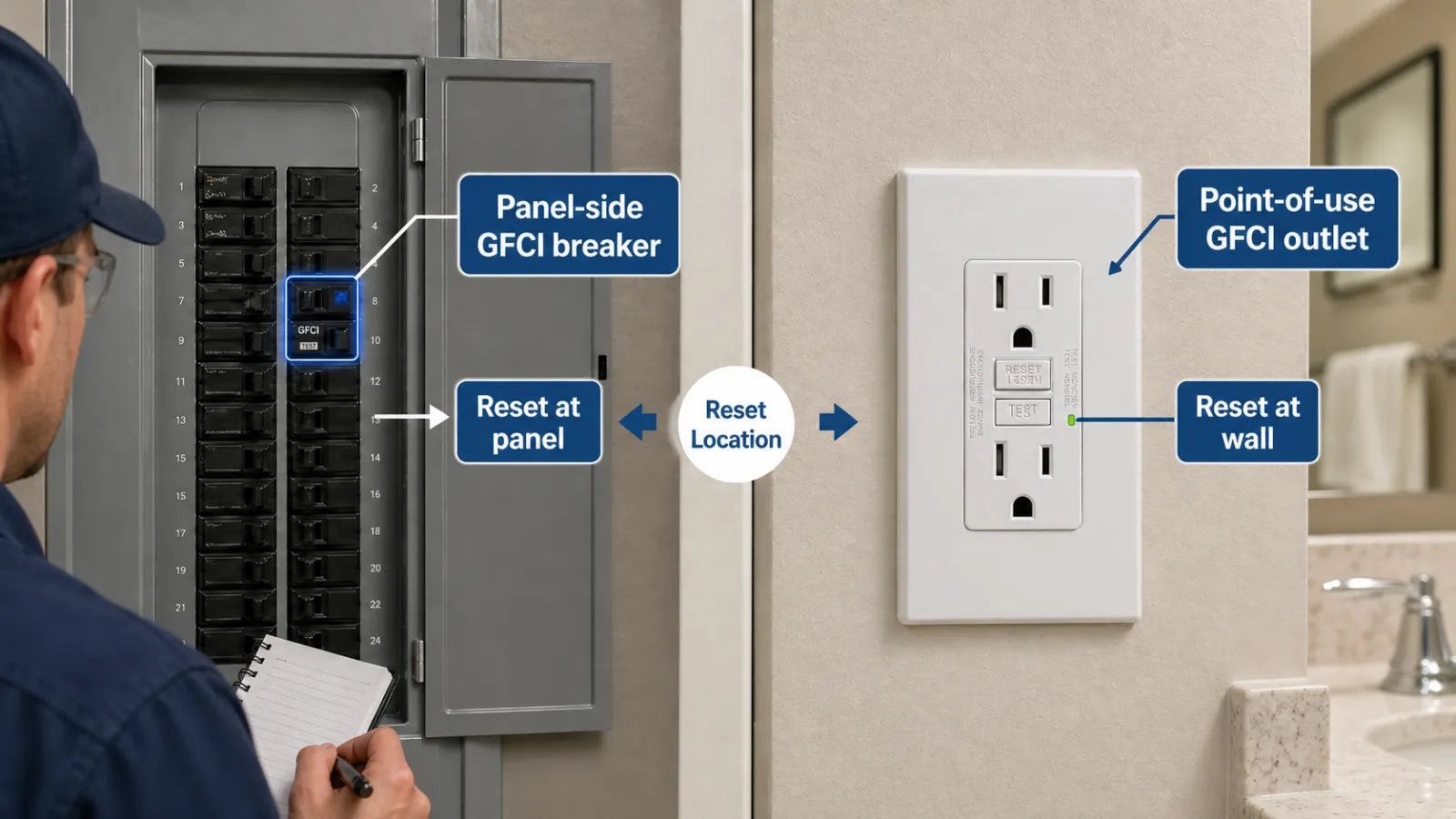
| Reset location | At the panel | At the wall, at the point of use |
| Fault localization | Tells you the circuit faulted, not which device caused it | The tripped device is visible at the wall |
| Relative unit cost | Higher per device | Lower per device |
| Usually fits | Centralized, hardwired, or panel-managed protection | Tenant-facing rooms, point-of-use reset, faster localization |
Same code compliance, different behavior in service. The rest of this guide is how to pick the protection point first, then the device.
Both Can Meet NEC 210.8 — So Why Does the Protection Point Still Matter?
A properly listed Class A GFCI breaker and a properly listed Class A GFCI receptacle can both provide NEC 210.8 ground-fault protection when installed in a covered location. UL 943 covers both. The 4 mA to 6 mA Class A trip range is the same, regardless of where the sensing element sits. So on a code-compliance basis, the GFCI breaker vs GFCI outlet question usually isn’t “which device is allowed?” — both are. The harder question is where the GFCI sensing and reset point should be placed, and that decision is what drives service cost over the life of the project.That placement question is not unique to the breaker-versus-receptacle call; it sits in front of almost every GFCI line on a project, which is why we laid it out as one sequence in the full GFCI receptacle sourcing decision map.
A Texas distributor pinged us on WhatsApp in 2022 — a voice note, the way he always reached out — asking whether you could just keep adding GFCI outlets in a house whose circuits were already drawn and whose rooms were already finished. Could every receptacle be a GFCI, if the owner wanted? Simple question. His electrician almost certainly knew the answer already. What he was really checking was whether there was a real manufacturer and a real engineer behind the product, not someone reselling boxes. We make the outlets; we don’t wire houses or design circuits, so instead of winging it I told him I’d confirm with our engineer first. The answer: in a dwelling the code doesn’t cap how many receptacles a GFCI can protect, and nothing stops an owner from making every one a GFCI — what decides it is cost and whether the protection is actually needed at that spot. The line that stuck, and the reason it belongs here: if the owner later wants to run a high-draw appliance from one location, a point-of-use outlet gives that flexibility without anyone opening the panel, while a breaker keeps protection managed from a single place. How many GFCIs belong on one circuit, and how to arrange them, is its own question, worked through in running multiple GFCIs on one circuit.
The two devices behave very differently after a trip. A GFCI breaker protects the load side of the branch circuit it serves, including downstream receptacles and any hardwired loads on that protected circuit. A GFCI receptacle protects its own face plus any standard outlets wired to its load terminals. When both are functional and properly installed, the personnel-protection level is comparable. When one of them trips, the operating cost is not.
What separates them in the field is mostly three things — but they don’t carry equal weight, and the importance of each shifts with the project type. Scope is the obvious one: how much of the circuit goes dark after a single trip. Reset access matters more in tenant-facing buildings than it does in industrial spaces; the person who notices the failure may not be the person who has access to the panel. And there’s fault localization, which doesn’t show up until you’re chasing intermittent trips. A breaker tells you the circuit faulted. It doesn’t tell you which downstream device was the cause. That distinction is invisible at bid review and very visible after occupancy.
For a broader view of how recent code cycles affect GFCI placement and receptacle selection, our guide to 2026 NEC GFCI code changes covers the location-by-location updates.
Why a GFCI Breaker Trip Can Take More of the Circuit Down
A GFCI breaker sits at the head of the branch circuit and senses imbalance for the protected run. When it trips, every receptacle and hardwired load on that protected branch circuit loses power together. Normal device behavior — not a defect — but it expands the area maintenance has to investigate.
The service call rarely arrives as a clean electrical diagnosis. It’s “the bathroom outlets and one wall of the bedroom stopped working” or “the kitchen prep outlet and the coffee station went dead at the same time.” Without a tripped indicator at the point of use, the technician usually starts at the panel, resets the breaker, and waits. If the trip returns, the next step is unplugging downstream loads one at a time. On a circuit feeding eight receptacles plus a coffee maker, a hair dryer, and a few chargers, the elimination process can run 20 to 40 minutes per occurrence. The technician may be fully competent. The circuit layout is working against fast localization, regardless.
A GFCI receptacle changes that pattern. The indicator and reset button sit at the wall, near the load. Maintenance can start at the failed room, station, bathroom, or garage wall — instead of starting at the panel. If the receptacle also protects downstream outlets from its load terminals, the fault is still narrowed to that local chain rather than the whole circuit.
One thing worth flagging on combination devices: in a GFCI-USB combo receptacle, the USB charging module may not behave the same way as the protected receptacle face after a trip. Whether USB output stays alive after the GFCI side trips depends on the internal line-side vs load-side architecture. We covered that in a separate analysis of why USB ports may stay powered after a GFCI trip, and it’s worth a read for hospitality projects.
Who Resets It, and Where? Reset Access in Tenant-Facing Projects
Reset access stops being a small convenience question once a project goes into service in a tenant-facing building. It becomes part of the maintenance model. A hotel guest, an apartment tenant, a kitchen worker, or a back-office staff member may know the power failed — but they don’t have keys to the electrical room. If the reset point is behind a locked door, every trip becomes a staff-response event.
The hotel bathroom is the cleanest illustration. A hair dryer trips a local GFCI receptacle; the guest sees the device, presses reset, problem ends. The same trip on a panel-side breaker becomes a front-desk call and a maintenance dispatch. The response time is now part of the guest experience.
Commercial kitchens have the same issue on a different schedule. Late-shift staff can usually reach a wall receptacle near a prep area or sink — they generally cannot reach the electrical room. So convenience receptacles favor local reset for downtime reasons. Hardwired equipment and built-in appliances with no accessible receptacle face are a different conversation entirely; those usually belong upstream.
The exception that complicates spec writing is built-in equipment. A receptacle hidden behind a fixed appliance, under a built-in counter, or inside a closed cabinet doesn’t give the user any meaningful reset point. In those layouts, GFCI protection has to be placed at the breaker, or at a separate accessible upstream device. The procurement question, then, isn’t “breaker or outlet?” in the abstract. It’s “where can the reset point remain accessible after the room is finished and the appliances are installed?”
When Can Panel-Side GFCI Protection Increase Nuisance-Trip Risk?
Panel-side protection makes nuisance-trip diagnosis harder when a long branch circuit, multiple downstream loads, moisture, or equipment leakage all sit behind one upstream sensing point. The breaker may be functioning exactly as designed. It’s measuring the combined leakage of everything downstream — and the sum is what determines whether it trips.
Cumulative leakage current is one of the most commonly overlooked causes of GFCI breaker nuisance tripping on long branch circuits. Modern electronics, switching power supplies, EMI filters, variable-speed drives, and motor-driven equipment each contribute small amounts of leakage. Individually, none of them is enough to trip a Class A GFCI. Several of them together, on the same circuit, can push the total close to the 4 to 6 mA range without an actual ground fault occurring.
Branch-circuit conductors contribute to the same problem. Henderson Engineers notes that GFCI circuit breakers on branch-circuit lengths over about 150 feet may experience capacitive leakage high enough to exceed the GFCI threshold — depending on wire type and size. Their recommended mitigation is to place the GFCI device closer to the equipment being protected, which often means using a GFCI receptacle or a blank-face GFCI device near the load.
This isn’t an argument against using GFCI breakers on long circuits. It’s an argument against making one upstream sensor watch a long run with several leakage-producing loads. In retrofit work where intermittent trips are already documented, moving the protection point closer to the load segments usually makes the fault easier to locate and reduces how much leakage accumulates ahead of any single sensor. Distributors who handle a lot of commercial retrofit business will recognize this pattern — it’s most of what drives the conversation when a contractor calls back to ask whether they can move from a panel-side approach to receptacle-level protection mid-project.
HVAC equipment is its own category because of high-frequency leakage from inverter-driven electronics. UL Solutions explains that the 2026 NEC introduces new SPGFCI language and permits a Class C SPGFCI for listed HVAC equipment at dwelling units under NEC 210.8(F) Exception No. 3 when the required conditions and disconnect marking are met. Our article on HVAC GFCI nuisance tripping under newer NEC requirements goes deeper on that topic.
Application Breakdown: Hotels, Commercial Kitchens, Bathrooms, Laundry Rooms, and Garages
Hotels and guest rooms
Hotel bathrooms and guest-room convenience locations almost always favor GFCI receptacles. Not because the receptacle is “more protective” than a properly listed breaker — it isn’t. The reason is service response. A local device gives the guest or maintenance team a visible test/reset point and keeps the trip located in the room where the problem actually happened.
Commercial kitchens
Commercial kitchens usually need a mixed strategy. Convenience receptacles near sinks, prep stations, and serving areas favor local GFCI receptacles for the wall-reset reason. Covered appliances under NEC 210.8(D), and hardwired equipment that has no accessible receptacle, usually need GFCI protection as part of the branch circuit — which is often handled upstream. Eaton, in its NEC 2023 review of 210.8(D), has consistently emphasized that the intent is to ensure the branch circuit serving the covered appliance is GFCI-protected, not to mandate a single device type.
Bathrooms
Bathrooms favor local GFCI receptacles. The reset point sits near the device being used, which matters when a hair dryer, grooming appliance, cleaning tool, or moisture event causes a trip. This is one of the few places where the answer is uncomplicated.
Laundry rooms
Laundry rooms need more care because the load mix is broader: a washer receptacle, utility outlets, and dryer circuits. A local GFCI receptacle works for accessible washer or convenience outlets. Dryer circuits and other covered appliance circuits may require upstream branch-circuit protection depending on the exact installation and the locally adopted NEC edition. Always confirm the adopted edition with the AHJ — the answer is rarely the same in two adjacent counties.
Garages and accessory buildings
Garages combine general-purpose receptacles, workbench loads, outdoor extension-cord use, EV chargers, freezers, and equipment circuits. A panel-side GFCI breaker can simplify whole-circuit protection. But when different work areas are likely to trip independently — say, a freezer in one corner and a battery charger on the other wall — local GFCI receptacles reduce troubleshooting time. On long runs to detached structures or remote equipment, the leakage profile of the conductor itself is worth checking before committing the whole branch to one upstream sensor.
What Goes Wrong on the Spec Sheet? Common Selection Mistakes We See
Most GFCI breaker vs GFCI outlet errors don’t start at the device. They start at the spec sheet. A line that says “GFCI required” is code-aware but operationally incomplete. It doesn’t say where the protection should sit, who needs reset access, or how the downstream layout should be labeled and documented for future maintenance.
Treating downstream protection as automatic is a frequent one. A GFCI receptacle can protect standard outlets wired from its load terminals — that’s fine, and it’s the design intent — but the layout has to be deliberate, and the downstream outlets have to be labeled. We’ve seen distributor returns and warranty-claim conversations triggered entirely by an unlabeled downstream chain: a tenant complains a hallway outlet “isn’t working,” and the issue is just that an upstream GFCI in a different room tripped. Wiring is technically correct. The labeling is the problem.
Hiding the reset point behind fixed equipment is the second category. A GFCI receptacle behind a refrigerator, a built-in microwave, a dishwasher, a washer, a vending unit, or any under-counter appliance is harder to reach than the panel. In that situation, the device choice has just defeated the service advantage that made receptacle-level protection attractive in the first place.
Then there’s panel availability — easy to overlook at bid stage and very hard to recover from in the field. GFCI breakers are panel-specific. Legacy load centers and projects with multiple panel brands need verified availability of the matching breaker, with the right listing for the exact panel. Eaton’s published material on its Classified Circuit Breakers states that the line is tested to standards including UL 489, UL 67 SB, UL 943, and UL 1699, and that the breakers are designed and tested to be mechanically and electrically interchangeable with breakers from several manufacturers. That kind of verification matters before a distributor substitutes a breaker on the truck.
The last one — and the one that comes up most often in distributor conversations — is treating unit cost as the comparison. A GFCI receptacle costs less than a comparable single-pole GFCI breaker, sometimes by a factor of three. That’s true at the bid. It is not the cost that shows up after the building is occupied and someone has to find the device, reset it, and explain why it tripped. The full cost shows up there, and it isn’t on the bill of materials.
A Spec-Sheet Detail Most Teams Miss: End-of-Life Behavior Under UL 943
UL 943 self-test and end-of-life behavior should be part of procurement review, especially on properties with long service expectations. A device that has reached end of life shouldn’t leave occupants with a false sense of protection — and the way that’s handled varies more between products than spec sheets usually disclose.
IAEI Magazine’s UL Question Corner explains that UL 943 revisions added requirements for automatic monitoring and power denial in GFCI receptacles and downstream connected devices when certain failures occur, while also recognizing specific visual or audible indication alternatives for some failure modes. In maintenance language: this is why a GFCI receptacle that won’t reset after years of service may simply be doing what the standard intends — denying power because protection can no longer be verified.
The relevant point for procurement is that receptacle GFCIs and circuit breaker GFCIs have historically had different end-of-life response requirements under the standard. IAEI’s analysis notes that GFCI circuit breakers are exempted from certain failure-mode response requirements that apply to receptacle GFCIs, and that the way this is implemented varies by manufacturer. The procurement-safe takeaway isn’t “all breakers are unsafe.” It’s narrower than that: verify the documented end-of-life response of the exact GFCI breaker model being specified.
For hospitality, assisted-living, multifamily, and commercial properties, this belongs in submittal review — not in a generic device schedule. Useful questions: does the device deny power after self-test failure? Does it trip and refuse reset? Does it provide a visual or audible indication only? Does it permit reset subject to another test cycle? The answer changes how easily occupants and maintenance staff can recognize a failed protection device years after the project closed out. On a 10- to 15-year service horizon, that’s the difference between predictable maintenance and a quiet failure mode that nobody notices.
How Contractors and Property Managers Actually Decide: A Quick Decision Framework
The fastest way to avoid a poor GFCI selection is to choose the protection point before choosing the device. Start with the circuit, the user, and the maintenance path — then decide whether breaker-side or point-of-use protection fits.
| Project Condition | Usually Favors | Why It Matters |
|---|---|---|
| Whole branch circuit needs centralized protection | GFCI breaker | Protection and reset are managed from the panel. |
| Hotel bathroom or guest room | GFCI receptacle | The reset point is visible and close to the user. |
| Commercial kitchen convenience receptacles | GFCI receptacle | Staff can reset locally without accessing the panel room. |
| Hardwired covered appliance | Upstream GFCI protection, often breaker | No accessible receptacle face may exist at the point of use. |
| Long branch circuit over about 150 feet | Point-of-use GFCI or blank-face GFCI near load | Reduces leakage accumulated before one upstream sensing point. |
| Multiple electronics or motor-driven loads | Split or local protection | Improves trip-cause localization and reduces cumulative leakage. |
| Legacy panel with limited breaker availability | GFCI receptacle, or verified classified breaker where permitted | Compatibility and listing must be verified before substitution. |
A simple bid-review rule: if the user who trips the device should also be the one who resets it, choose a visible point-of-use receptacle unless something in the layout prevents access. If the project really needs centralized protection — hardwired equipment, panel-managed reset, restricted-access maintenance — a GFCI breaker is cleaner. If the circuit is long or leakage-prone, don’t concentrate too many loads behind one Class A sensor without somebody on the design team having looked at the nuisance-trip risk.
For projects that look like they’ll specify point-of-use protection across multiple rooms or work areas, our UL-listed GFCI outlets for North American projects page is a reasonable starting point for the device schedule.
Frequently Asked Questions About GFCI Breakers and GFCI Outlets
Can I use a GFCI breaker instead of a GFCI outlet?
Yes — when the breaker is properly listed, compatible with the panel, and installed where NEC 210.8 calls for GFCI protection. Both devices satisfy the code. The GFCI breaker covers the load side of the branch circuit from the panel; the GFCI receptacle covers its own face plus any downstream outlets on its load terminals. The code question is usually whether protection is provided. The project question is whether the reset point makes sense for whoever will actually need to use it.
Why does my GFCI breaker keep nuisance tripping?
Cumulative leakage from multiple downstream loads is the usual suspect. Electronics, EMI filters, switching power supplies, and motor-driven equipment all contribute small amounts of leakage. Each one is fine on its own. Together they can sit close enough to the Class A trip range that a small disturbance pushes the total over. Long branch circuits compound the issue — over about 150 feet, capacitive leakage in the wiring itself adds to the total. Moving the GFCI device closer to the load is the standard remediation. Other contributing causes include moisture, defective downstream equipment, wiring errors, and devices that have aged out of reliable operation.
Should commercial kitchens use GFCI breakers or GFCI receptacles?
Both, on different parts of the same kitchen. Convenience receptacles near sinks, prep counters, and serving areas usually favor GFCI receptacles for after-hours reset access. Covered appliances under NEC 210.8(D) and hardwired equipment generally need upstream branch-circuit GFCI protection — often a breaker, sometimes another approved upstream method, depending on the layout and the locally adopted NEC edition. The mistake to avoid is putting both convenience outlets and a high-leakage hardwired appliance behind the same upstream GFCI breaker without first reviewing trip localization and cumulative leakage.
How do I locate which receptacle tripped on a GFCI-protected circuit?
Trip localization is a function of where the protection sits. A breaker tells you the circuit faulted; it doesn’t tell you which downstream load caused it, and the standard troubleshooting process is unplug, reset, reintroduce loads one at a time. With distributed receptacle GFCIs, the tripped device is visible at the wall, which immediately narrows the search to that device or its downstream chain. Distributed protection localizes faults. Centralized protection consolidates them.
Why will a GFCI receptacle not reset?
Several causes are possible, and the right one depends on the device’s age and history. On a new install, a reverse line/load wiring error will deny power until corrected — UL 943 has required this since 2015. An active downstream ground fault keeps the device tripped until the offending load is isolated. On a device 7 to 10 years old, refusal to reset is often normal end-of-life behavior under UL 943’s self-test and power-denial provisions, not a wiring fault. Replacement, in that case, is the correct response.
Are GFCI breakers safer than GFCI receptacles?
Not as a general rule. Properly listed Class A devices in either form are intended for personnel protection under UL 943. The practical differences worth verifying are reset accessibility, breaker compatibility with the panel, downstream load behavior, nuisance-trip risk, and the documented end-of-life response of the exact model being specified. On long-service-life projects, end-of-life behavior is the variable most often skipped at submittal review and the one most worth checking against manufacturer documentation.
Before You Spec or Order
The safest purchasing language is specific. Instead of writing only “GFCI required,” define the protection point, the reset access expectation, the downstream-load strategy, and the maintenance path.
- Hotel bathrooms, guest rooms, and tenant-facing areas: point-of-use GFCI receptacles when local reset and trip localization matter.
- Hardwired appliances or inaccessible receptacle locations: upstream branch-circuit GFCI protection — verify the exact method against the adopted code edition and the AHJ.
- Long branch circuits: review conductor length, load mix, and leakage profile before committing the whole branch to one panel-side GFCI breaker.
- Commercial kitchens: separate convenience-receptacle protection from high-leakage equipment circuits where layout permits.
- Legacy panels: confirm breaker availability, compatibility, UL classification, and warranty implications before substituting a breaker model.
- Facility buyers: include end-of-life behavior and reset access in the submittal review — not only amperage, face style, and listing mark.
Need help reviewing GFCI protection point selection before the PO is released?
Send us the room type, circuit length, load type, panel information, required amperage, and reset-access expectation. We can help review whether a GFCI breaker, a GFCI receptacle, a blank-face GFCI, or a split-protection strategy fits the project.
Related articles on this site
Related product links
Sources and references
- UL Code Authorities: Understanding Ground Fault and Leakage Current Protection
- UL Solutions: GFCI Personal Protection Devices Testing and Certification
- UL Solutions: Special Purpose Ground-Fault Circuit Interrupters, authored by Frederick P. Reyes and Michal Hofkin
- Henderson Engineers: Understanding GFCI Nuisances
- IAEI Magazine: UL Question Corner — Self-testing GFCI Requirements
- IAEI Magazine: It’s Time We Update UL-943 Again
- Eaton: GFCI 210.8(D) Protection for Specific Appliances
- Eaton: Classified Circuit Breakers
- Fluke: Chasing Ghost Trips in GFCI-Protected Circuits