A purchase line that reads “outdoor GFCI outlet with cover” looks finished. On a residential job it leaves more unsettled than it answers, and the word “GFCI” only pins down the protection. Whether the device is weather-rated, whether it’s tamper-resistant, and whether the cover is even in scope all get assumed.
The position, up front: settle where the GFCI protection sits first, because it decides which device the line calls for. The weather-resistant and tamper-resistant ratings stay on the device regardless. The cover is its own line.
Protection Can Move. The Weather Rating Can’t.
GFCI protection answers a circuit question — is something watching for current leaking to ground. Outdoor dwelling receptacles within the applicable NEC scope require it (NEC 210.8), and it can come from the receptacle itself or from a documented upstream GFCI device that protects that receptacle. A quote for the outdoor device doesn’t tell you which.
The weather-resistant rating is different in kind. It describes the part that sits outside — the plastics, the contacts, the construction evaluated under UL 498 for outdoor exposure. No breaker upstream changes what rain and sun do to the receptacle at the point. For the 15A and 20A nonlocking receptacles covered in this article, protection elsewhere on the run does not replace the weather-resistant device requirement at a damp or wet outdoor point (NEC 406.9).
“Weatherproof” and “Weather-Resistant” Describe Different Parts
“Weatherproof GFCI outlet” appears in search language, but it points at the wrong part of the assembly. Weatherproof describes the enclosure once it’s closed — the cover and box keeping water out of the wiring space. Weather-resistant is a rating on the device itself. A weather-resistant receptacle in an open box is still exposed the moment a cord goes in; a standard receptacle behind a good cover is still a standard receptacle. Ordering a “weatherproof GFCI outlet” names a condition you want, not a device a PO line can be built from.
WR Receptacle or WR GFCI Receptacle — Protection Path Decides
Two outdoor points can meet the same code and take two different devices.
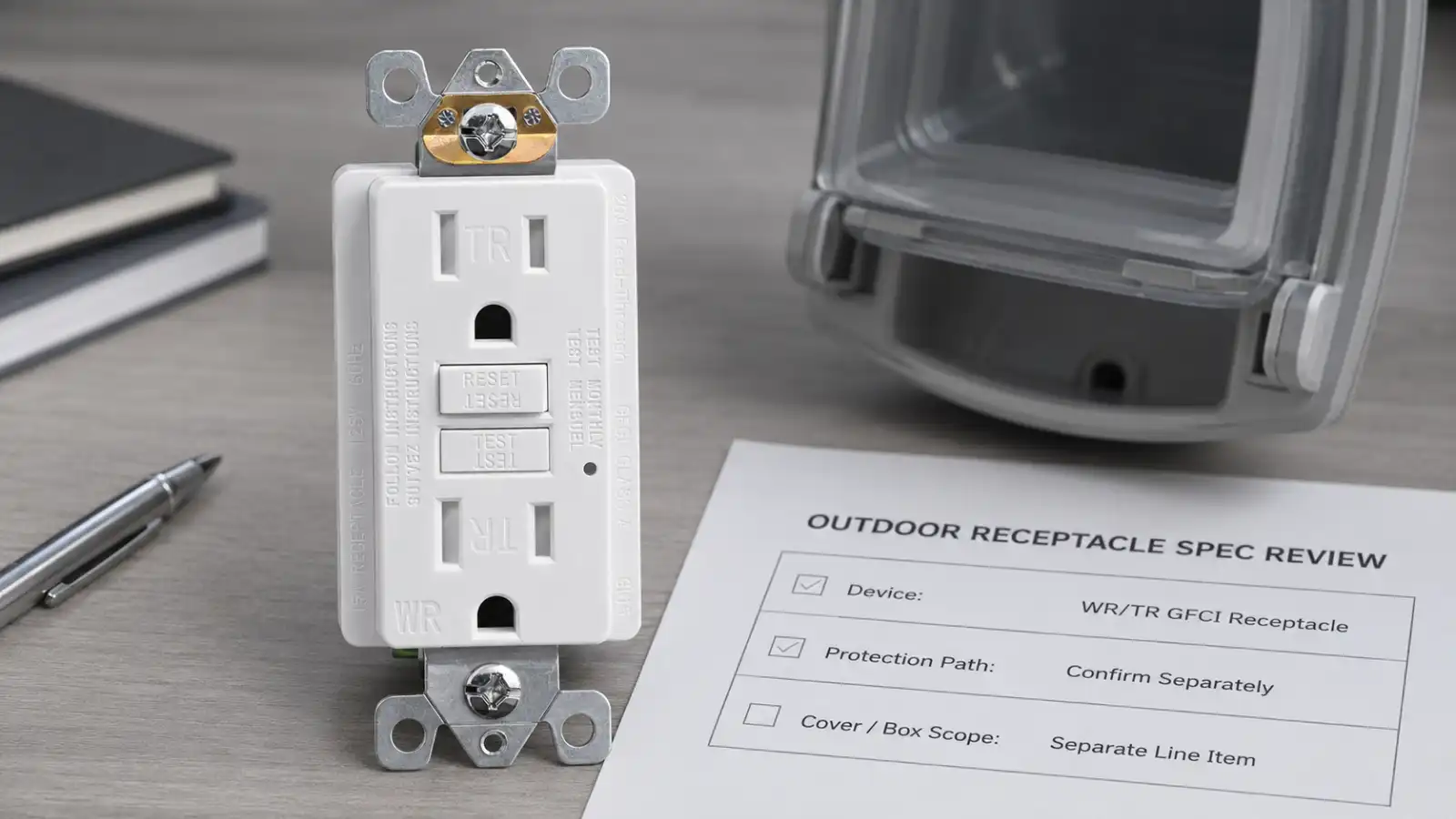
Local protection — nothing documented upstream, or you’d rather not depend on it — means a weather-resistant, tamper-resistant GFCI receptacle. One part does both jobs, and the reset is right there.
Protection already handled and documented upstream — a GFCI breaker on the branch, or a GFCI receptacle feeding the load side — means the outdoor point is a weather-resistant, tamper-resistant receptacle. Not a GFCI one. On our line those are two separate products under two SKUs; choosing between them is choosing a product class, not ticking a box on one device.
Get this backwards and the order shows it. A non-GFCI receptacle specified for a point with no documented upstream protection leaves the device line without a stated protection path, which has to be corrected before approval. Every point built as a WR GFCI receptacle when a breaker already protects the run carries GFCI cost where it wasn’t needed, plus a reset at each location instead of one at the panel.
Whether a site already has reliable upstream protection isn’t something I can read off a quote. The panel and the circuit behind it are the installer’s; the device line is the part a quote shows.
Tamper-Resistant Isn’t Optional Here
For 15A and 20A, 125V and 250V nonlocking receptacles in dwelling-unit locations, the tamper-resistant requirement applies under NEC 406.12, subject to the exceptions in the adopted edition. Outdoor receptacles at a dwelling sit inside that scope. Both order lines above carry TR on the device, and it isn’t a decision separate from WR — the two ratings live on the same part. How they get chosen together is a longer topic in our TR and WR receptacle selection guide.
The Cover Is a Separate Line
NEC 406.9 sets enclosure requirements by whether the receptacle sits in a damp or wet location, and for wet locations whether the enclosure has to stay weatherproof while a plug is inserted. That’s the enclosure’s job, decided on site. We supply and confirm the receptacle configuration; our quoted device scope does not include the outdoor cover or box. The cover gets its own line, with its own source, so a device shipment never reads as covering the enclosure.
Two Order Lines You Can Build
Local Protection
- Weather-resistant, tamper-resistant GFCI receptacle, 15A or 20A as specified for the receptacle schedule and applicable branch-circuit use, listed to UL 498 and UL 943.
- Weatherproof in-use cover and box — separate line, by installer or others.
Upstream Protection
- Weather-resistant, tamper-resistant receptacle, GFCI protected upstream — with the protecting device and circuit identified on the order.
- Weatherproof in-use cover and box — separate line.
Every GFCI we ship leaves with its instruction sheet and its No Equipment Ground and GFCI Protected downstream labels in the box, checked against the packing contents before it goes out. The actual SKUs live on the GFCI outlets product category page.
Frequently Asked Questions
Can a weather-resistant receptacle be used outdoors if GFCI protection is provided upstream?
Yes, Within the applicable NEC scope, and with the path documented. If a GFCI breaker or an upstream GFCI receptacle protects the load side of that run, the outdoor point doesn’t have to be a GFCI device — it has to be a weather-resistant, tamper-resistant receptacle. The protection requirement is met upstream; the weather and tamper requirements are met at the point. Write down the protecting device and circuit, so nobody reading the drawing later assumes the outdoor point is unprotected because its face doesn’t say GFCI.
Does a weatherproof cover let me use a standard receptacle outdoors?
No. The cover handles the enclosure; the device still has to be the listed weather-resistant type for the location. They’re checked separately.
How This Article Connects to the Rest of the ShengYu Library
This is the order-line version of the device-level comparison in the TR and WR selection guide. The habit of giving anything we don’t supply its own line is the same one behind the pre-shipment review in our UL 498 buyer’s checklist, and the boundary between what we confirm and what the site owns is the one drawn in our plug-retention production QC write-up.
Sources
- NFPA 70 (NEC) Article 210.8 — GFCI protection for dwelling-unit receptacles, including outdoor locations.
- NFPA 70 Article 406.9 — receptacles in damp and wet locations; weather-resistant type and enclosure requirements.
- NFPA 70 Article 406.12 — tamper-resistant receptacles in dwelling-unit locations.
- UL 498, Standard for Attachment Plugs and Receptacles — Supplement SD, Weather-Resistant Receptacles.
Confirm sections and exceptions against the NEC edition your jurisdiction enforces through NFPA free access.
Reviewing outdoor GFCI receptacle requirements before ordering?
Send the receptacle schedule, GFCI protection path, amp rating, WR/TR requirement and destination market. We can help review the device line before the order is finalized.