In 2022, a contractor in Tampa called us after a self-test GFCI receptacle in one of his client’s homes had quietly burned out behind the cover plate. The cover came off blackened. Nothing else was damaged. The face and back housing were UL-listed flame-retardant, which is the reason “burned out” did not become “house fire.”
What he wanted to know was not “is the GFCI defective.” It was “why did this happen.”
When he traced the history, the GFCI had been nuisance-tripping intermittently for weeks before it failed. Each time it tripped, someone in the house pressed reset. Power came back. The appliances kept running. A few days later it tripped again, and the cycle repeated.
The receptacle was not defective in the warranty sense. It was being asked to operate in a loop the standard was never written for.
That is the reason this guide starts with a question most troubleshooting articles skip — when does the GFCI trip — before anyone gets to what to replace.
The first question is when
We use this table because it stops the first mistake: treating every trip as the same failure.
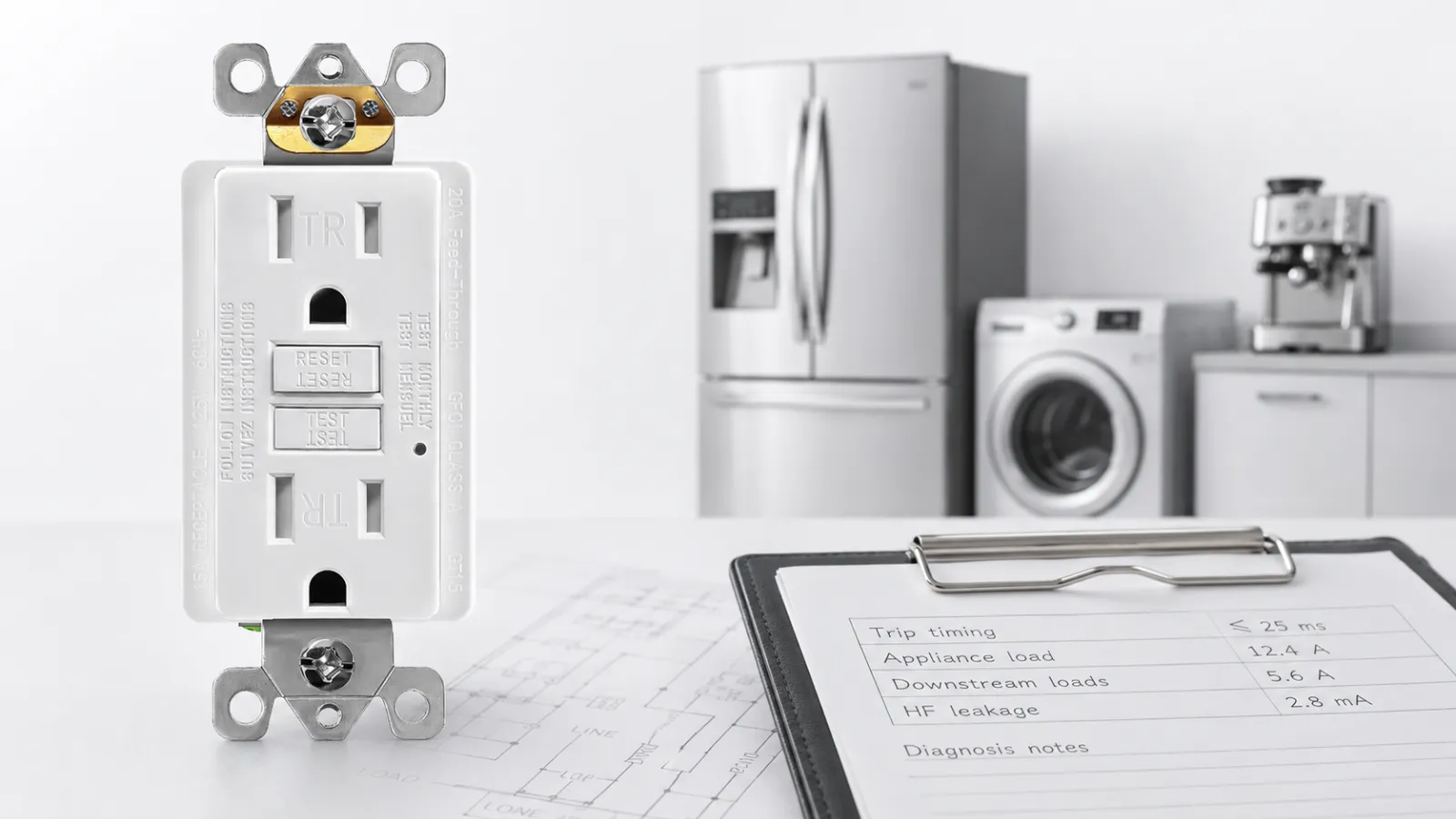
| Trip timing | More likely direction |
|---|---|
| Trips immediately after reset | Load-side wiring fault, downstream device fault, true ground fault, or failed protective device |
| Trips only when the refrigerator compressor starts | Appliance-side leakage, motor or inverter behavior, compatibility |
| Trips during a defrost or heating cycle | Heating element leakage, moisture in the element |
| Trips only when two appliances run together | Cumulative leakage across the protected load group |
| Trips after rain or washdown | Moisture intrusion at the outlet, cover, or downstream box |
| Trips with nothing plugged in | Downstream wiring fault, line/load reversed, or device failure |
The Tampa case sat in row 4 — the refrigerator, the washing machine, and one other VFD-driven appliance were on the same protected circuit. None of them tripped the device alone. Two of them running together did.
A GFCI is not the same thing as a breaker
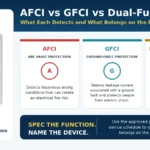
This trips up homeowners and sometimes contractors. A GFCI is looking for current imbalance between hot and neutral — 4 to 6 milliamps of current finding ground somewhere it should not. That is personnel protection. The branch circuit breaker is what watches the amperage rating.
If a coffee maker plus a toaster opens something at the panel, it matters which thing opened. GFCI? Leakage, possibly cumulative. Branch breaker? Overload. For the breaker-versus-receptacle protection-strategy question, we have a separate article.
What actually happened in the Tampa case
The contractor came back to us with a question we did not initially have a clean answer to. The receptacle was a Class A self-test GFCI, listed to the current UL 943 revision at the time of installation. It had been working as designed. The trip was real — the appliances on that branch were producing leakage that crossed the 4–6 mA threshold under certain combined-load conditions.
What ate the device was the repeated trip-and-reset cycle over weeks. Each reset closed the contacts under load. Each trip opened them, sometimes mid-cycle. The high-frequency leakage that was causing the trips also stressed the sensing circuitry. By the time the device finally failed, it had been through more switching cycles than a normal lifetime would have produced.
The UL flame-retardant housing did its job — the failure stayed inside the wall box, cover plate scorched, no spreading damage. Which is the reason this story has the ending it has.
Two takeaways the contractor brought to his next ten projects, which we have since brought into our own customer conversations:
A GFCI that trips, gets reset, trips again, gets reset again — three or four times in a short window — is no longer a “reset it and see” situation. It is a signal to stop and have someone with a meter look at the circuit. The standard does not write rules for what happens after the fifth reset because the device is not supposed to be there yet.
And the underlying cause in this case was a compatibility issue between standard Class A protection and the high-frequency leakage profile of modern variable-speed equipment. No swap to another standard Class A device would have changed the outcome. That is a different category of problem.
Modern appliances and the leakage they generate
Variable-speed compressors. Inverter-driven washing machines. VFD pool pumps. Electronically commutated HVAC motors. Induction ranges. Heat pump water heaters.
These are efficient. They are also electrically noisier than the appliances GFCIs were originally evaluated against. The high-frequency leakage that flows through the equipment grounding conductor during normal operation is a byproduct of the power conversion electronics, not a fault.
A 60 Hz Class A GFCI reads that leakage at face value.
The industry name for the gap is interoperability. UL Solutions and CPSC started addressing it around 2024. In August 2025, ULSE put out Supplement SB to UL 943 — a supplemental HF test procedure. Same month, the 2026 NEC was issued by NFPA with an effective date of September 9, 2025; Section 210.8 picked up an Informational Note pointing to GFCIs marked “HF.” Separately, the 2026 NEC also walked back some of the 2023 NEC’s 240V dwelling-side GFCI expansion, and made room for Class C SPGFCIs (15–20 mA trip) on listed HVAC equipment in dwellings, with the disconnect required to be marked accordingly.
From our side of the bench, all of this means the UL 943 revision our line is currently listed against — the one that produced the device on that Tampa wall — does not include the HF supplement. The supplement came out after. We are working on the next iteration. The market is in the middle of this transition.
For the HVAC-specific timeline and the September 1, 2026 expiration of the HVAC GFCI exception, our earlier article covers that ground in more detail.
Appliance vs circuit — how to tell which one is the suspect
The appliance moves up the list if you can take it to another known-good GFCI on a different circuit and the trip follows it. Also if the trip ties to a specific cycle — compressor start, defrost element on, heating element pulling current. Older refrigerators with degraded compressor winding insulation are the classic example; heating elements that have absorbed moisture in storage or shipping are another, and Mark Ode at ECMag has been writing about that one since the 1980s.
The circuit moves up the list if multiple appliances trip the same outlet, if two appliances together trip what neither does alone, if the wiring includes a long downstream run, if the protected outlet is outdoor without a properly rated cover, or if line and load got mixed up at the GFCI’s terminals. The last category — line/load mistakes, downstream protection that no one tracked, shared neutrals — shows up more often than people expect on retrofits.
The Tampa case sat in the second column. Three pieces of modern equipment, cumulative leakage on a 20A branch, no single device defective.
Where HF-rated GFCIs fit
HF-marked Class A GFCIs are designed for the interoperability problem above. They allow more high-frequency leakage to pass before tripping, while keeping the 60 Hz personnel protection close to the Class A standard.
What an HF device does not address: a damaged cord, a moisture problem, reversed line/load wiring, a shared neutral, or a branch circuit pulling more amperage than its breaker is sized for. Those are different mechanisms with different fixes.
At the time of publication, HF GFCI breakers have been introduced by a small number of major U.S. manufacturers, mostly for industrial and HVAC applications. HF-marked Class A GFCI receptacles for general residential and commercial use are still entering the market — we have looked at the major U.S. manufacturer catalogs while preparing this article and have not found HF-marked receptacle SKUs in active listings yet, which lines up with the standard having been published in August 2025.
Standard Class A self-test GFCIs — the kind we currently produce, listed to the current UL 943 Edition 5 revision — remain the dominant device for general-use NEC 210.8 applications.
What buyers and contractors should document before replacing parts
- Appliance make, model, approximate age
- GFCI device brand, type (receptacle or breaker), date installed
- Trip timing pattern (which row of the table)
- Whether the trip follows the appliance to a known-good GFCI on a different circuit
- Whether weather or moisture correlates
- Other loads on the same protected branch
The same data points get asked for by the appliance manufacturer, the GFCI manufacturer, and NEMA’s unwanted-tripping reporting workflow. Recording them once saves the next three rounds of part swapping.
What we do not try to cover
We are a factory. We do not visit job sites and we do not test in the field. That part belongs to a qualified electrician on site with a meter.
What the AHJ in a specific county will accept under the 2026 NEC, the 2023 NEC, or any local amendment is also outside what we can speak to. The engineer of record and the local inspector hold that conversation.
Whether a specific brand of appliance has been tested under UL 101 for interoperability with a specific GFCI is a question for the appliance manufacturer and that GFCI manufacturer — not for a third party.
And removing the GFCI from a location where NEC requires one is not a workaround. It is a code violation. The right path is correct diagnosis, not removal.
Frequently Asked Questions
Why does my GFCI keep tripping with a refrigerator?
Modern inverter-compressor refrigerators produce high-frequency leakage during compressor cycles that a standard 60 Hz GFCI can read as a ground fault. Older refrigerators with worn compressor winding insulation can produce real low-frequency leakage. The way to tell them apart is whether the trip follows the refrigerator to another known-good GFCI.
Why does my GFCI keep tripping with nothing plugged in?
Almost always a downstream load-side problem — wiring issue further down the protected circuit, line/load reversed at the GFCI itself, or a failed device. Not a category to solve by hitting reset.
Can a GFCI trip because of overload?
No. Overload is the branch breaker’s job. A GFCI opens on current imbalance. Two appliances running together that trip a GFCI are producing cumulative leakage, not overload.
Can modern appliances cause GFCI nuisance tripping?
Yes. It is one of the reasons UL added Supplement SB to UL 943 in August 2025 and the 2026 NEC added an Informational Note about HF-marked GFCIs the same month.
Should I replace the GFCI or the appliance first?
Neither, as the first step. The Tampa case showed why — there was nothing defective on either side, and replacing one or the other would not have changed the outcome. Document the trip timing first. If the trip follows the appliance to a known-good GFCI elsewhere, the appliance is the higher suspect. If the trip stays with one GFCI no matter what is plugged in, the device or its wiring is the higher suspect.
What is an HF-rated GFCI?
An HF-rated GFCI is a Class A GFCI evaluated under UL 943 Supplement SB for loads that produce high-frequency leakage currents. It is meant for interoperability with variable-speed and inverter-driven equipment. It is not a replacement for finding moisture, wiring errors, or a damaged appliance.
Sources
- NFPA 70, National Electrical Code (2026 edition) — Section 210.8 and Informational Notes. NFPA library: NFPA 70
- ANSI/UL 943, Ground-Fault Circuit-Interrupters, Edition 5 with 2025 revisions including Supplement SB. ULSE Standards Catalog: UL 943
- UL Solutions, “High-Frequency Ground-Fault Circuit Interrupters”: UL Solutions
- UL Solutions, “Special Purpose Ground-Fault Circuit Interrupters”: UL Solutions
- Mark C. Ode, “High-Frequency GFCIs: Tech to minimize nuisance tripping,” Electrical Contractor Magazine, September 2025
- AHAM, “Nuisance Tripping & Home Appliances”: AHAM
- CPSC Staff Comment on UL 943 Proposals, November 22, 2024
Author & Review
Prepared by the ShengYu Engineering Team — the five-engineer product and compliance group behind ShengYu’s UL-listed and cUL-listed wiring devices since 2006. The team covers UL 943 submittal review, NEC compliance, product design, and QC. This article was reviewed against NFPA 70 (2026 edition), UL 943 Edition 5 revisions through 2025, and the UL 943 Supplement SB introduction.
Related Reading
Working on a project where GFCI compatibility with modern appliances is part of the scope?
Send the appliance list, the protected branch circuit layout, and the destination market. Our engineering team can confirm whether a standard Class A self-test GFCI is the right device for those locations, what UL 943 revision our current line is listed against, and which conditions point toward waiting for HF-marked product availability.