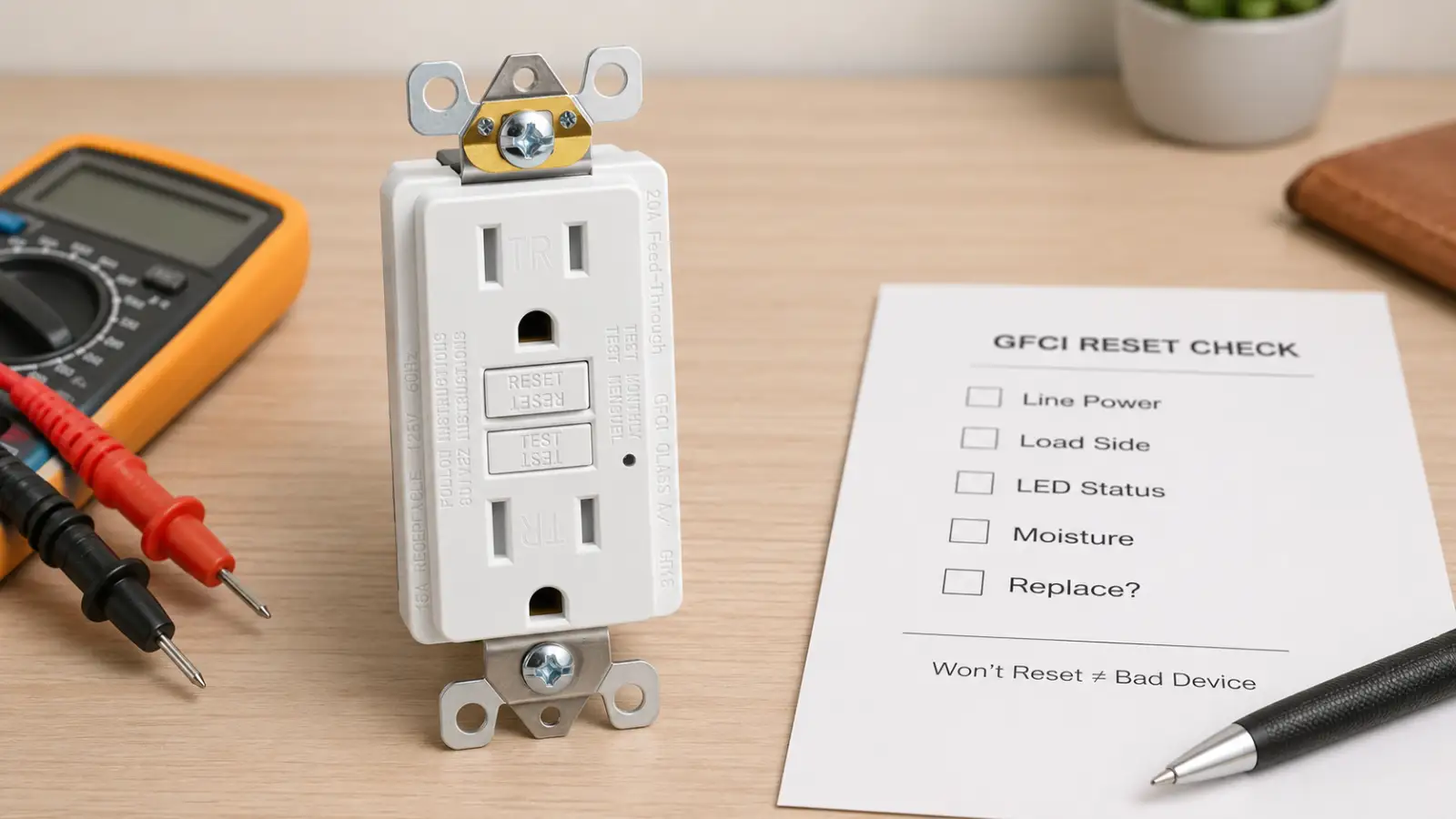
Yes, a GFCI outlet can go bad. The electronics and trip components inside a GFCI can fail like any other protective device. The catch is that the symptom people read as “bad” — a reset that won’t hold — is more often something else on the circuit, and on a modern device the refusal to reset can be the GFCI working exactly as designed.
Before a replacement, then: confirm the device is the problem, and rule out no line power, a downstream load fault, moisture and a wiring error. The order matters, because four of those five get fixed without buying a new outlet.
A 30-Second Check Before You Do Anything
| Symptom | Most Likely First Cause | First Move |
|---|---|---|
| Won’t reset, no power on it at all | Line side has no power — a GFCI can’t reset without it | Check the breaker feeding it; a dead line isn’t a dead GFCI |
| Won’t reset, line side is live | A fault on the load side, or a wiring error | Power off; have a licensed electrician isolate the load side. If it then holds, the problem was downstream. |
| Steady or blinking red, won’t reset | On a self-test model, possible end-of-life lockout or failed self-test | Follow the model sheet; if red persists or the device cannot reset, replace it |
| Trips right after rain, outdoors | Moisture or a real ground fault | Have the outdoor box, cover and downstream run checked before repeated resets |
| Just installed, won’t reset | Line and load wires reversed at hookup | Recheck the wiring before condemning the device |
A Reset That Won’t Hold Is a Symptom, Not a Verdict
A GFCI needs power on its line side to reset. No hot-neutral potential, no reset — and a tripped panel breaker or a dead upstream connection looks identical to a dead GFCI from the front. People swap the outlet, the new one won’t reset either, and the line was never live the whole time.
The load side is the other half. When the receptacle feeds outlets downstream and one of them has a fault, the GFCI is supposed to refuse the reset — the fault doing its job, not the device failing. Disconnect what’s downstream, isolate the load side with the power off, and try again; a unit that holds with the load gone was never the bad part. Reversed line and load wiring at install does the same thing, and that one is covered in full in our GFCI wiring mistakes write-up.
Why a Modern GFCI Refuses to Reset on Purpose
A stuck reset reads differently once you know what the device is doing on its own.
Since June 29, 2015, UL 943 has required permanently connected GFCIs to monitor themselves through an auto-monitoring or self-test circuit that periodically checks whether the device can still respond to a ground fault. When that check finds the protection is gone, the device denies power and locks out. It won’t reset, on purpose. The reason was a field finding that the parts most likely to fail — the integrated circuit, the SCR and the trip coil — could die while the outlet kept passing power, leaving a receptacle that looked fine and protected nothing. Power denial closed that gap.
So a self-test GFCI sitting in lockout might be failed. It might also be refusing to energize a circuit it can no longer protect. The outcome is replacement either way, but the device isn’t malfunctioning when it does this — it’s the safety behavior the standard asks for. The GFCIs we ship today are self-test models.
A 1 A.M. Call That Wasn’t a Defect
In 2023 a contractor in New York called me in the middle of the night, angry. A batch of our GFCIs on his site had all stopped resetting at once, and he wanted to know how we’d shipped defective product and whether anything got inspected before it left the floor.
I calmed him down, told him we’d see it through, and asked him to send whatever he could — the site, the conditions, what actually happened. He sent video. I didn’t open an engineering review yet. I had him kill the power, press reset by hand, and bring the power back. Everything worked.
A whole batch failing the same way at the same moment did not point at the devices. In that case, the site had misunderstood the startup behavior: the self-test circuit runs on its own, but the reset button still has to be pressed before the receptacle is energized.
When Replacement Is the Right Call
Replace it when the line side is confirmed live, the load is disconnected, and it still won’t reset. Replace it when a self-test model remains locked out after the model-sheet steps, when the TEST button won’t trip it, or when there’s heat damage, melted plastic, scorching, or a cracked face. Those are the device.
What doesn’t earn a replacement by itself: a unit that trips after rain at an outdoor point with a cover, an outlet that trips only when one appliance runs, or a fresh install that won’t take a reset. Our piece on why a GFCI keeps tripping with modern appliances covers the appliance side. Age sits on this list too — a date on the device only tells you to run a test. Behavior is the stronger evidence.
What the Indicator Light Is Telling You
LED meaning isn’t standard across brands, so the front of the device is a starting hint, no more than that. On the units we ship most there are two lights: one comes on for a fault or trip, the other shows the line side is live and protection is active. Some project specs only want the fault light, so a single-indicator version exists too.
A steady or blinking red on a self-test model points toward a failed self-test, end-of-life lockout, or another condition that the model sheet has to define. Green generally means powered and protected on the models that use a green status light. The instruction sheet for the exact model is the only place that settles it.
For Buyers and Distributors: Before You Call It Defective
A return that only says “won’t reset” can’t be classified. It doesn’t say whether the device ever saw line power, whether the load was disconnected when it was tested, what the LED showed, whether an outdoor box had water in it, or whether a self-test lockout did exactly what it was built to do.
Every unit we ship carries a stamped inspection mark — an “inspection / date / passed” record put on at the line. A return tied to that mark, with the line-voltage reading, the load-disconnected result, the LED state, and the install location, is one we can actually assess. Without those, “won’t reset” is a statement about a circuit, and we can’t read a defect out of it.
Frequently Asked Questions
Can a GFCI outlet go bad?
Yes. The sensing electronics can fail. But a GFCI that won’t reset is bad far less often than it looks — confirm line power, disconnect the load, and rule out a wiring error first.
How do you know if a GFCI outlet is bad?
When the line side is live, the load is disconnected, and it still won’t reset — or a self-test model is locked out, the TEST button does nothing, or there’s visible heat or physical damage. A unit that resets once the load is isolated was never the bad part.
How long do GFCI outlets last?
A fixed number isn’t the useful answer here. Environment does more than age: heat, moisture and surge exposure shorten the life of the sensing electronics, while a clean indoor circuit stretches it out. Treat the age of a device as a prompt to test it rather than a schedule for replacing it.
Why won’t my GFCI outlet reset?
No line power, a downstream fault, reversed line/load wiring, or self-test lockout are the main branches to separate before replacing the device. The device itself is the last thing to suspect.
Does a red light mean the GFCI is bad?
On a self-test model, a red light that persists after the model-sheet TEST/RESET steps, or appears with a device that cannot reset, points to replacement. On other models it can just mean tripped. Check the exact model’s instruction sheet.
Can a GFCI be bad if it still has power?
Older non-self-test units could lose protection while still passing power, which is the exact failure the self-test mandate was written to catch. A self-test model denies power instead.
How This Article Connects to the Rest of the ShengYu Library
The wiring branch above — reversed line and load, downstream faults — is the whole subject of our GFCI wiring mistakes write-up, and the appliance-trip branch is the one in why a GFCI keeps tripping with modern appliances. The rain-then-trip case at an outdoor point runs back to what we wrote on outdoor GFCI receptacles and covers. This page is the decision layer those three sit under: is it the device, or the circuit it’s protecting?
Sourcing Self-Test GFCIs for a Project or Replacement Run
If you’re specifying or restocking GFCI receptacles and want self-test, UL/cUL-listed devices with clear indicator behavior, the line is on our GFCI outlets product category page. For project quantities, send the amp rating, the indicator preference — fault-only or fault-plus-status — and the destination market, and we can review the device line before the order is placed.
Sources
- UL 943, Standard for Safety for Ground-Fault Circuit Interrupters — auto-monitoring / self-test and end-of-life power-denial requirements for GFCIs manufactured after June 29, 2015:
UL 943 Standard page - IAEI / UL Question Corner — explanation of self-testing GFCI requirements, power denial and the failure modes that prompted the requirement:
Self-testing GFCI requirements - Leviton technical literature on GFCI status indicator lights and reset behavior. Indicator meanings vary by model, so the instruction sheet for the exact device remains controlling:
GFCI status indicator light ·
How to test a GFCI
Reviewing self-test GFCIs for a project or replacement run?
Send the amp rating, indicator preference, destination market and project quantity. We can help review the GFCI receptacle configuration before the order is placed.