Two Sourcing Failures That Do Not Get Caught by the Same Check
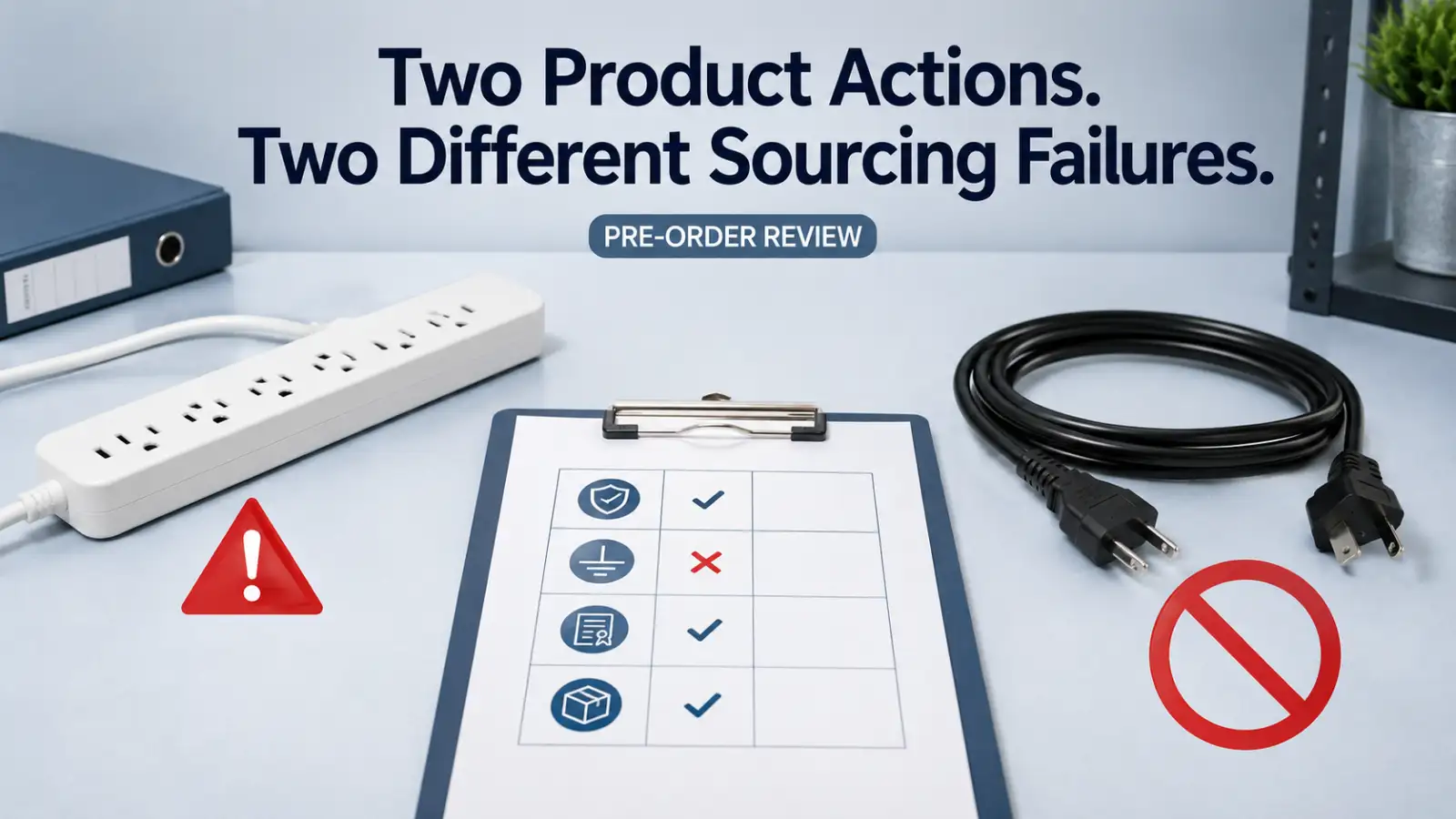
Two CPSC actions in 2026 point at two different sourcing failures, and they don’t get caught by the same check.
One was a power strip with a recognized product category and a missing safety part inside it. The other was a product whose entire category has no place in a normal purchasing catalog. An importer who runs both through the same vetting step misses one of them.
Source basis. CPSC action details below come from CPSC’s published recall and warning records in 2026. Product standard scope is described against the listed UL and CSA standards.
Two Actions, Two Failures
CCCEI-branded power strips, sold by Middle Way Electronics on Amazon. In the March 5, 2026 Product Safety Warning (26-313), CPSC stated that Middle Way had not agreed to an acceptable recall. On March 26, CPSC published recall 26-346 with a refund remedy, covering about 5,543 units sold between April 2024 and January 2026.
Relocatable power taps are a recognized product category, investigated in the U.S. under UL 1363. In this recall, CPSC identified the hazard as Relocatable power taps are a recognized product category, investigated in the U.S. under UL 1363. In this recall, CPSC identified the hazard as missing supplementary overcurrent protection in the recalled strips, creating a fire risk if they were overloaded. Two units were reported sparking and melting. Two units were reported sparking and melting.
A different kind of action followed. On March 31, 2026, CPSC secured delisting commitments from Walmart, eBay, and AliExpress for male-to-male extension cords — cords with a plug on both ends. The agency’s wording was direct: these have “no legitimate household use.” A cord with two male ends leaves live prongs exposed the moment one end is energized, and people use them to backfeed generators into a house, putting current onto lines a utility worker expects to be dead.
A buyer screening the male-to-male cord doesn’t start by asking which lab tested it. The first question is whether the product belongs in the catalog at all.
A Listing Mark on the Box Is Not the End of the Check
The CCCEI strip raises a second issue. Buyers read a certification mark as a finish line. It isn’t one.
UL Solutions has published a run of public notices over the past two years about products carrying UL marks that UL never authorized. A Wi-Fi smoke detector sold under the “Jllom” brand. A combustible gas detector from Shenzhen Yeezhou, model Y302. A 60V battery charger. Each carried a UL mark. None had been evaluated by UL Solutions to the standard the mark implied. Some were on Amazon, one on Walmart.
A mark printed on a label is a claim. The record behind it is the fact. The two get checked in different places — the label on the product, the record in UL’s Product iQ database by file number, product category, and model.
Product category does real work here. A power strip is investigated in the U.S. under UL 1363, the standard for relocatable power taps — indoor use, 250V AC or less, 20A or less, and not a substitute for fixed wiring. A GFCI receptacle is investigated under UL 943. A general receptacle under UL 498. The way product category drives the quantity and rating decisions on a receptacle order runs through our receptacles per circuit guide. A file number that covers one of these does not stretch to cover the others. An importer who sees “UL listed” on a supplier’s GFCI record and assumes it carries to a power strip in the same quote is reading a record that was never about the power strip.
Section 15(b) Puts the Importer in the Reporting Loop
The part that catches importers off guard sits in CPSC’s Recall Handbook.
Section 15(b) of the Consumer Product Safety Act applies to manufacturers, importers, distributors, and retailers. Not just the factory. Once a company has information that reasonably supports the conclusion that a product contains a defect creating a substantial hazard, it has 24 hours to notify CPSC. A company that needs to investigate before deciding can take a reasonable time, which the Handbook frames as generally not exceeding 10 working days.
The trigger is broader than a fire. The Handbook lists complaints, claims, injury reports, quality-control data, production data, and requests for returns or replacements as the kind of information that can start the clock.
Both 2026 cases had an overseas seller who went quiet. Middle Way did not agree to an acceptable recall. The male-to-male sellers were unresponsive to CPSC entirely. When the seller offshore stops answering, the reporting duty doesn’t move with it — it sits with whoever imported and distributed the product into the U.S. market. An importer who kept no record of what was ordered, what was certified, and what was reviewed is the one left explaining the gap.
Where We Fit, as the Manufacturer
We make what we sell. GFCI receptacles, USB outlets, standard receptacles, switches, wall plates. We don’t make power strips, relocatable power taps, or extension cords, and they aren’t in the catalog we send buyers. Our products are produced in China and sold into the North American market under our own UL and cUL listings.
In April 2026 a new buyer in Texas opened with two questions before anything else: how long is the warranty, and what happens if there’s a quality problem.
The answer we gave: two-year warranty, covering anything that isn’t user-caused damage. When a confirmed defect comes back, the replacement quantity goes out free in the buyer’s next order. If a report comes in, we open the investigation and work it through rather than push it back to the buyer.
The Order the Checks Belong In
The two CPSC cases set a sequence.
Screen the category first. A male-to-male cord fails here and never reaches a certification question. Confirm the safety construction the category requires second — in the CCCEI case, CPSC identified the missing supplementary overcurrent protection as the hazard. Verify the exact certification record third: file number, product category, model coverage, and markings that match the quoted SKU, checked in the certifier’s database rather than read off the box.
Start at the certificate and the whole thing runs backward. A real file number on a product that shouldn’t be in the catalog is still a product that shouldn’t be in the catalog.
How This Article Connects to Other Guides on This Site
The certification-record check described here is the buyer-facing half of what we cover from the production side in our receptacle plug retention testing article, where UL Follow-Up Services and our own voluntary tests sit on different lines. The decision to keep certain product types out of the catalog entirely — power strips here — follows the same boundary we drew in hospital-grade receptacles are not on our line.
Frequently Asked Questions
What did the CCCEI power strip recall involve?
CPSC issued a Product Safety Warning (26-313) on March 5, 2026, stating Middle Way Electronics had not agreed to an acceptable recall. On March 26, CPSC published recall 26-346 with a refund remedy, covering about 5,543 CCCEI power strips sold on Amazon from April 2024 to January 2026. CPSC identified missing supplementary overcurrent protection as the hazard.
Why are male-to-male extension cords treated as unsafe regardless of build quality?
The hazard is the design. A cord with two male ends exposes energized prongs and enables generator backfeeding. CPSC stated these cords have no legitimate household use and secured delisting commitments from major platforms rather than pointing buyers to a compliant version.
Does an importer have CPSC reporting responsibility?
Yes, when the reporting conditions are met. Section 15(b) of the Consumer Product Safety Act applies to manufacturers, importers, distributors, and retailers. A company that obtains information reasonably supporting a substantial-hazard conclusion has 24 hours to notify CPSC, and any preliminary investigation generally should not exceed 10 working days.
How do I confirm a UL mark is real?
Check UL’s Product iQ database, not the label — search by file number, product category, and model. UL Solutions has issued public notices about products carrying unauthorized UL marks, so a mark printed on the box is a claim until the record confirms it.
Does the same UL file cover every product from one supplier?
No. A file number ties to one product category and specific models, not to everything a supplier sells.
Does ShengYu make power strips or extension cords?
No. We make GFCI receptacles, USB outlets, standard receptacles, switches, and wall plates, produced in-house under our own UL and cUL listings. Power strips, relocatable power taps, and extension cords are not on our line.
What is ShengYu’s warranty and quality response?
A two-year warranty covering defects that aren’t user-caused. Confirmed defects are replaced free in the buyer’s next order. When a report comes in, we open and run the investigation rather than return it to the buyer.
Sources and References
- CPSC — CCCEI Brand Power Strips, Product Safety Warning 26-313 and Recall 26-346. Referenced for the warning-to-recall sequence, refund remedy, unit count, sales channel, and the missing supplementary overcurrent protection identified by CPSC.
- CPSC — Male-to-Male Extension Cords Warning and E-Commerce Delisting Commitments. Referenced for the “no legitimate household use” finding, backfeeding hazard, and platform delisting.
- CPSC — Product Safety Planning, Reporting, and Recall Handbook. Referenced for Section 15(b) reporting scope across manufacturers, importers, distributors, and retailers, the 24-hour notification window, and the 10-working-day investigation guideline.
- UL Solutions — Power Strips Testing and Certification. Referenced for UL 1363 scope for relocatable power taps and the CSA-C22.2 No. 308 Canadian basic standard.
- UL Solutions — Unauthorized UL Mark on Jllom Wi-Fi Smoke Detector.
- UL Solutions — Unauthorized UL Mark on Techamor Y302 Combustible Gas Detector.
- UL Solutions — Unauthorized UL Mark on FN 60V Battery Charger.
- ShengYu internal — Product scope covering GFCI receptacles, USB outlets, standard receptacles, switches, and wall plates; and the April 2026 Texas buyer warranty exchange.
Reviewing Wiring-Device Documentation Before a Purchase Order?
Send the quoted product category, model information, certification requirements, marking expectations, and documentation request. We can help organize the applicable ShengYu wiring-device materials for your review.