Slim GFCI outlets are marketed as the solution to shallow boxes. Reduced depth helps. It does not answer the full review question a hotel renovation buyer faces before standardizing one SKU across guest rooms, bathrooms, common areas and outdoor amenity locations.
The first check is device depth. The next is whether the box depth and box volume still pass for the installed wiring condition. The project schedule then has to separate GFCI protection, tamper-resistant construction and weather-resistant construction by location.
Code basis. Section references below use the 2023 NEC edition numbering. A project should match the edition adopted by the local authority having jurisdiction.
What “Slim” Actually Removes from Device Depth
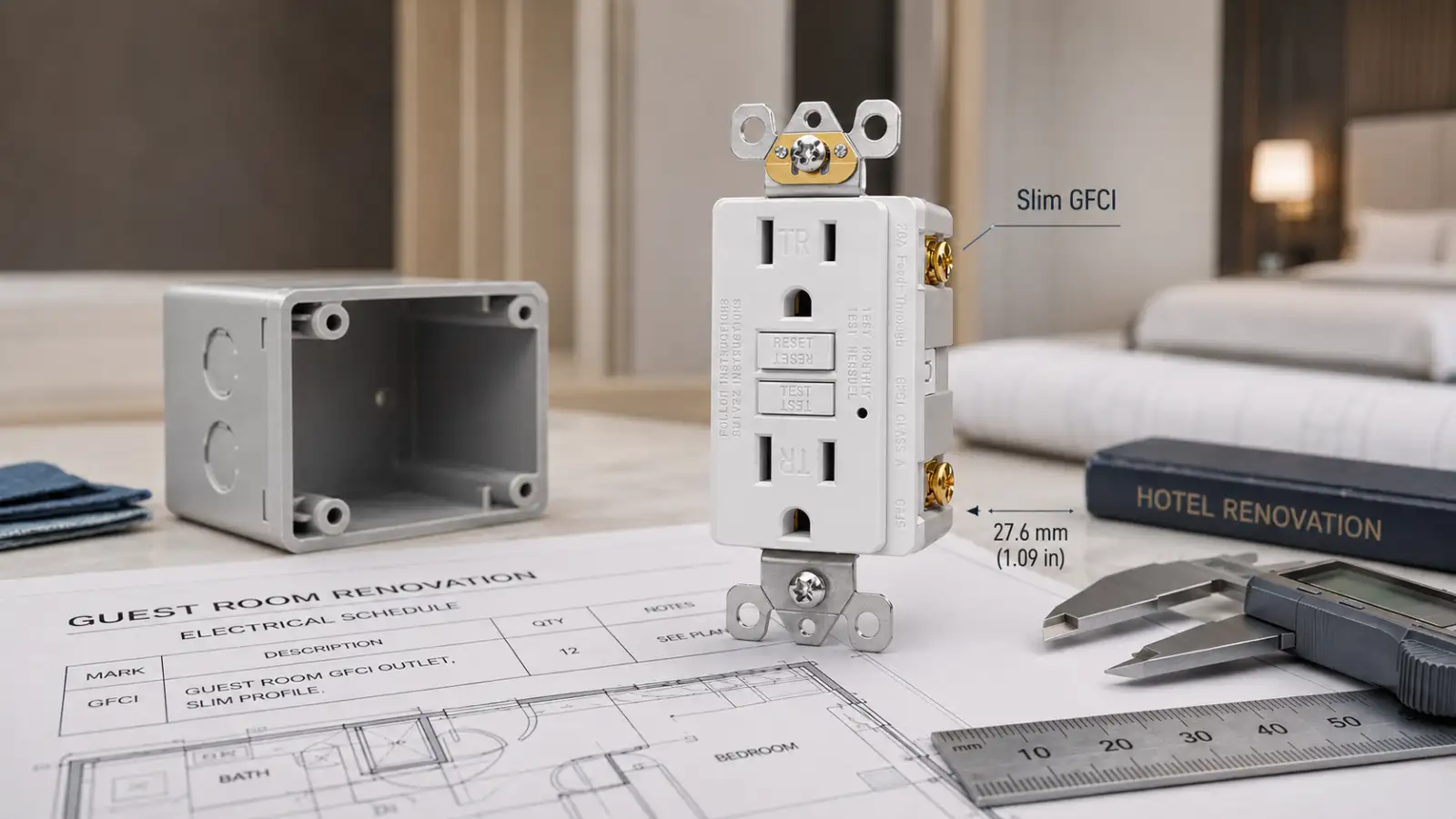
On our line, the slim 15A GFCI has a nominal rearward projection of 1.087 in. behind the mounting yoke, with a tolerance of ±0.004 in. The total device height including the face is 1.382 in. A standard 15A GFCI from the same line has a nominal rearward projection of 1.378 in. and a total height of 1.673 in.
The nominal difference at the rearward projection is 0.291 in. That is the dimension that matters first when an existing renovation box has limited room behind the device.
| Model | Rearward Projection Behind Yoke | Total Device Height | Review Note |
|---|---|---|---|
| Slim 15A GFCI | 1.087 in. nominal, ±0.004 in. | 1.382 in. | Use 1.091 in. as the maximum rearward projection for depth review. |
| Standard 15A GFCI | 1.378 in. nominal | 1.673 in. | Final review should follow the applicable drawing tolerance and wiring-entry condition. |
NEC 314.24(B)(4) and the Box Depth Review That Goes with the Device
For boxes enclosing devices supplied by 12 AWG or 10 AWG conductors, 2023 NEC 314.24(B)(4) sets three depth conditions:
- The internal depth must be at least 1-3/16 in.
- If the device projects rearward from the mounting plane of the box by more than 1 in., the box depth must be no less than the equipment depth plus 1/4 in.
- If wiring enters the center portion of the rear of the box opposite the device, the minimum clearance increases to 1/2 in.
Branch circuits supplied by 14 AWG conductors fall under NEC 314.24(B)(5) instead, with separate minimums. The 12 AWG example below should not be copied over as a fixed acceptance number for a 14 AWG installation.
For the slim 15A GFCI on our line, the depth review should use the maximum rearward projection, 1.091 in., rather than the nominal dimension. Because this exceeds the 1 in. trigger, the ordinary rear-clearance condition produces a reviewed minimum box internal depth of:
1.091 in. + 1/4 in. = 1.341 in.
Where wiring enters the center portion of the rear of the box opposite the device, the increased rear clearance produces a reviewed minimum internal depth of:
1.091 in. + 1/2 in. = 1.591 in.
The standard 15A GFCI on the same line has a nominal rearward projection of 1.378 in. Using that nominal figure only for dimensional comparison, the ordinary 1/4 in. rear-clearance condition produces a reviewed depth of approximately 1.628 in. Final acceptance for the standard model should still follow its applicable drawing tolerance and the actual wiring-entry condition.
Under the ordinary 1/4 in. rear-clearance condition, a box with an internal depth between approximately 1.341 in. and the standard model’s final reviewed threshold may pass the depth review for the slim version while failing it for the standard version. For example, a box documented at 1.50 in. internal depth falls between the slim calculation and the standard nominal comparison, provided the wiring-entry condition does not trigger the larger clearance requirement.
This is only the depth review. Center-rear wiring entry, side-wiring entry clearance, box fill under NEC 314.16, and the applicable product drawing still need to be checked before the device is accepted for installation.
Box Volume Is a Separate Check
Box volume runs under NEC 314.16. The device-yoke allowance in 314.16(B)(4) is based on the largest conductor connected to the device, not on the rearward depth of the device body.
A slim GFCI connected with 12 AWG conductors and a standard GFCI connected with 12 AWG conductors each require the same 4.5 cu. in. device-yoke allowance. Reduced body depth can improve the available working space behind the yoke; it does not reduce that box-fill allowance.
A device can clear the depth review and still fail the fill calculation if the marked box volume is too small for the conductor count, device-yoke allowance, grounding conductors and any internal clamps that must be counted.
A Builder Who Hit the Install Slowdown
A builder we had worked with for several years came back in October 2025. Their work was mostly construction and renovation in apartment projects. New construction had been running on our standard 15A GFCIs without difficulty. The slowdown showed up on the renovation side.
Some walls were thin. Older boxes left less room behind the device. Electricians were still getting the standard GFCIs in, but the openings took longer. On a turnover schedule with dozens of units, that difference showed up in labor time.
They moved part of the order to slim 15A GFCIs after that review. New construction continued on the standard SKU. The slim version went to renovation openings where existing box depth was the actual constraint.
That October 2025 order did not come from a hotel project. The same review issue can arise in hospitality renovation work: when an existing box is the constraint, reduced rearward projection can remove one installation barrier without settling the rest of the project schedule.
Why a Hotel Renovation Order Still Needs More Than a Depth Column
A hotel renovation schedule can include guest-room receptacles, guest-room bathroom receptacles, common-area receptacles and outdoor amenity locations. Reduced depth may solve one physical-fit problem. It does not determine the complete device configuration for each location.
| Schedule Field | What the Buyer Needs to Confirm |
|---|---|
| GFCI protection | Whether the receptacle location falls within an applicable GFCI-required location, such as a hotel bathroom or another NEC 210.8(B) location. |
| TR construction | Whether the location is within the guest-room, guest-suite or common-area tamper-resistant scope under the adopted NEC edition. |
| WR construction | Whether the receptacle is installed in a damp or wet location requiring separate weather-resistant review. |
| Rearward projection | Whether the selected slim or standard model passes the applicable depth review for conductor size and wiring-entry condition. |
| Box fill | Whether the marked box volume accommodates conductor count, device-yoke allowance, grounding conductors and any required clamp allowance. |
| Wall plate / gang layout | Whether decorator-style openings, device projection and plate selection match across the installed group. |
Separate Depth, TR and WR on the Order Schedule
Reduced depth is one variable on the order. Tamper-resistant and weather-resistant construction are two more.
ShengYu carries three SKUs in this family: a standard slim 15A GFCI, a TR slim 15A GFCI for locations under the adopted code’s tamper-resistant requirement, and a TRWR slim 15A GFCI for applications requiring both tamper-resistant and weather-resistant construction.
Under the 2023 NEC numbering used in this article, 406.12 includes guest rooms and guest suites of hotels, motels and their common areas among the locations where covered 15A and 20A nonlocking-type receptacles must be listed tamper-resistant. In the 2026 NEC, the tamper-resistant receptacle section is renumbered as 406.26. The project still needs to follow the edition adopted by the AHJ.
GFCI protection is a separate location-based check. Under 2023 NEC 210.8(B), a receptacle in a hotel bathroom falls within the bathroom GFCI scope. A receptacle in a guest room or guest suite can therefore fall within the TR scope without every receptacle in that room automatically becoming a GFCI receptacle.
Outdoor pool-deck or other outdoor amenity receptacles are reviewed under the weather-resistant rule separately. Whether a specific location requires both TR and WR markings depends on whether that location simultaneously falls into both scopes. That determination belongs to the project specification and the AHJ.
A renovation buyer selecting GFCI receptacles still needs to separate three questions on the order schedule: which GFCI locations also require TR construction, which damp or wet locations require WR construction, and whether any locations require both TR and WR. In a hotel guest-room bathroom under the 2023 NEC conditions discussed above, the combined review is GFCI protection plus TR construction, not an automatic WR requirement.
Our TR and WR Receptacle Selection Guide goes through how the two scopes separate.
The production process behind these SKUs comes through in our UL-certified manufacturing facility overview. The yoke-count logic that drives the box-fill calculation is covered separately in our guide to how many receptacles per circuit. For the 15A vs 20A face-rating question, our 15 Amp vs 20 Amp Receptacle guide goes through what drives that decision.
Frequently Asked Questions
Will a slim GFCI outlet fit in a shallow electrical box?
Sometimes. It depends on conductor size, wiring-entry condition, box internal depth, side-entry clearance and box fill. For a 12 AWG branch circuit under 2023 NEC 314.24(B)(4), the review value for our slim 15A GFCI is 1.091 in., based on the nominal 1.087 in. rearward projection plus its ±0.004 in. tolerance. That leads to a reviewed minimum internal depth of 1.341 in. under the ordinary 1/4 in. rear-clearance condition, or 1.591 in. where wiring enters the center rear opposite the device. Box volume under NEC 314.16 still has to pass independently.
Does a slim GFCI change the box-fill calculation?
No. NEC 314.16(B)(4) bases the device-yoke allowance on the largest conductor connected to the device, not on the rearward depth of the device body. A slim GFCI on a 12 AWG yoke requires the same 4.5 cu. in. device-yoke allowance as a standard GFCI on the same yoke.
Does NEC 314.24(B)(4) apply to 14 AWG circuits?
No. The 12 AWG and 10 AWG depth rules discussed in this article come from NEC 314.24(B)(4). Branch circuits supplied by 14 AWG conductors fall under NEC 314.24(B)(5), with separate minimums.
Are tamper-resistant receptacles required in hotel guest rooms?
Under the 2023 NEC numbering used here, yes. Section 406.12 includes guest rooms and guest suites of hotels, motels and their common areas among the locations where covered 15A and 20A nonlocking-type receptacles must be listed tamper-resistant. In the 2026 NEC, the corresponding tamper-resistant section is 406.26. The project must still follow the edition adopted by the AHJ.
Does every receptacle in a hotel guest room need to be a GFCI receptacle?
Not from the guest-room classification alone. GFCI protection is triggered by applicable location requirements, such as bathrooms or other locations covered by NEC 210.8(B). A guest-room bathroom receptacle can therefore require both GFCI protection and TR construction, while another receptacle in the room may require TR without being a GFCI device.
Is a weather-resistant GFCI required in an indoor hotel bathroom solely because it is a bathroom?
No. A normal indoor bathroom location does not by itself make the receptacle a WR application under the damp- or wet-location rule. If the actual device location is classified as damp or wet, or the project specification requires WR construction, that field still needs separate review.
Can one slim GFCI SKU cover an entire hotel renovation?
Usually not. A hotel renovation schedule may need separate decisions for GFCI protection, TR construction, WR construction, rearward projection, box fill and wall-plate coordination. Slim solves a depth problem. It does not settle the rest of the schedule.
What is the difference between a slim GFCI outlet and a shallow GFCI outlet?
In most searches, they refer to the same physical idea: a GFCI receptacle with reduced rearward depth for installation conditions where device depth is one of the constraints.
Sources and Internal Basis
External Sources
- ElectricalLicenseRenewal — 2023 NEC 314.24(B)(4), Conductors 12 or 10 AWG. Referenced for the 1-3/16 in. minimum box depth, the device-depth-plus-1/4-in. rule, and the increased 1/2-in. center-rear wiring-entry clearance:
314.24(B)(4) summary - Captain Code 2023 — 314.24(B)(C) Box Depth / Conductor Clearance from Devices. Referenced for center-rear entry and side-wiring entry clearance review:
Captain Code 314.24(B)(C) - ElectricalLicenseRenewal — 314.16 Number of Conductors in Outlet, Device, and Junction Boxes. Referenced for the 12 AWG volume allowance of 2.25 cu. in. per conductor used in the device-yoke calculation:
314.16 box-fill summary - Captain Code 2023 — 406.12 Tamper-Resistant Receptacle Requirements Expanded. Referenced for guest rooms and guest suites of hotels, motels and their common areas:
Captain Code 406.12 - Captain Code 2023 — 406.9 Receptacles in Damp or Wet Locations. Referenced for separate weather-resistant review in damp and wet locations:
Captain Code 406.9 - IAEI Magazine — 2026 NEC Code Changes: Device-Type Switches Transition from Article 404 to 406. Referenced for the 2026 NEC renumbering of tamper-resistant receptacles from 406.12 to 406.26:
IAEI 2026 NEC review - Mike Holt Forum — Receptacle in a shallow box?. Used as field-discussion background on slim GFCI placement in limited-depth boxes, not as code authority:
Mike Holt Forum discussion
Internal Basis
- ShengYu slim 15A GFCI dimensional data — nominal rearward projection of 1.087 in. with a tolerance of ±0.004 in.; total device height of 1.382 in.
- ShengYu standard 15A GFCI dimensional data — nominal rearward projection of 1.378 in.; total device height of 1.673 in.
- ShengYu current product-family confirmation — standard slim 15A GFCI, TR slim 15A GFCI and TRWR slim 15A GFCI.
- October 2025 builder order review — apartment renovation and turnover work in which standard and slim 15A GFCI SKUs were separated according to existing box conditions.
Related Reading
Reviewing a slim GFCI schedule before a renovation order is released?
Send the room schedule, conductor size, existing box information and the locations that may require TR or WR review. We can help confirm whether one slim 15A GFCI configuration is sufficient or whether the project schedule should be split by location.