Last updated: May 2026 · By the ShengYu Engineering Team
This page is built more like a buyer-side reference than a factory introduction. A production-line video can show visible assembly, testing, packaging, and production activity. It cannot show UL/cUL listing coverage, SKU-level documentation, packaging accuracy, or shipment-to-shipment consistency. Those questions live in the documentation, not in the visual.
The followings are a documented snapshot of ShengYu’s production capability — capacity, file numbers, QC structure, packaging support — paired with the questions you would want answered for any supplier you are evaluating, including us.
Factory At a Glance
| Item | ShengYu | What we’d ask in a supplier review |
|---|---|---|
| Location | Zhejiang, China | Confirm the address against the UL file location and ask whether production is in-house or outsourced. |
| Established | 2006 | Cross-check with business registration and certification history where available. |
| Facility size | 20,000 m² | Ask whether the floor area is dedicated production or includes warehousing and offices. |
| Workforce | Production staff, QC inspectors, in-house electrical engineers | Ask whether engineers are employed directly or are contract roles. |
| Monthly capacity | GFCI receptacles 200,000 · standard receptacles 500,000 · USB receptacles 200,000 · wallplates 500,000 | Ask whether the stated capacity is available for the quoted product line, or shared across multiple product categories and sales channels. |
| Standards and listings | UL 943 for Class A self-test GFCI · UL 498 for receptacles · UL 20 for snap switches · UL 514D for wallplates, where applicable | Ask for each UL standard relevant to the SKU being quoted, not only the headline standard. |
| Certification | UL & cUL | Verify on UL Product iQ before the first order. |
| Quality system | ISO 9001 management, in-line electrical functional testing on GFCI units, AQL sampling on receptacles and wallplates | Ask which AQL level applies and whether test records are retained per batch. |
| OEM / private label | Available — custom packaging, custom colors, private-label branding, faceplate customization | Ask whether the private-label SKU will be added to UL through Multiple Listing Service when the buyer needs its own company name searchable in UL’s directory. |
| Typical lead time | Stock 7–15 days · OEM 30–45 days. Real lead time depends on whether the SKU needs new packaging artwork or marking changes. | Confirm whether the lead time covers UL marking changes, packaging artwork approval, and country-of-origin labeling. |
| Export experience | 20+ years exporting to North America · FOB Ningbo / Shanghai | Ask for export documents, shipment records, or channel references where disclosure is allowed. Export history should still be checked against the current product category, not only the company’s overall shipping history. |
Production Line Walkthrough
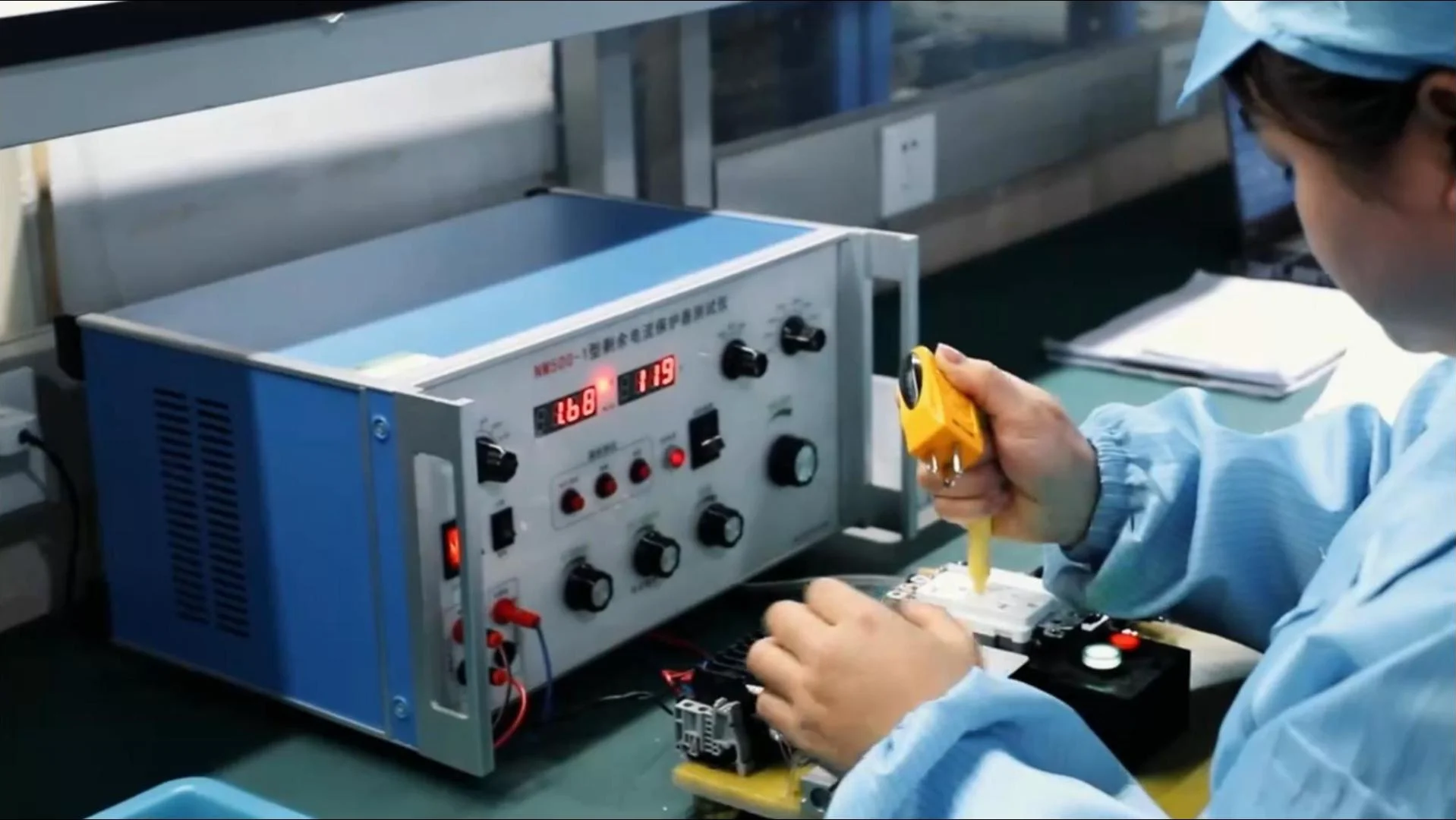
The clip is short — 26 seconds, daytime shift, no narration. You will see wallplate molding, automated terminal screw insertion, the GFCI trip-test sequence on production units, hi-pot dielectric testing, and final inspection going into packaging.
What watching this will not tell you: whether those molds are ours or shared with another product line, the test voltage on the hi-pot stand, the AQL applied at visual inspection, the torque calibration interval on the screw stations, or what happens to the units that fail in-line.
Those answers do not sit in the video. They sit in the documentation, and that is the conversation worth having before a first order — with us or with anyone else you are evaluating.
How to Verify UL on UL Product iQ
A UL file number is the entry point of verification. It does not, by itself, confirm that a specific SKU, voltage rating, or marking variant sits inside the active listing.
The path you can use: open UL Product iQ, create a free account, and search us in our case. The record opens to the Basic Applicant company name, the manufacturing location, the product category code, and the model designations the file covers.
From there, what you are checking is whether the model designations on the record actually include the SKU you have been quoted, and whether the manufacturing address on the file matches the address on the quotation and the country-of-origin marking on the sample.
When something does not line up, that is the next conversation with the supplier. There may be a valid explanation — a series-level model range that includes the SKU under a different designation, an additional manufacturing location added later, or marking variants added through follow-up service. None of those are automatic red flags. But they should get cleared before the PO goes out, not after the first container lands in Long Beach.
If you are sourcing receptacles specifically and want a more detailed pre-shipment checklist for UL 498, see our UL 498 Buyer’s 8-Point Pre-Shipment Checklist, written for the June 20 standard transition.
Six Checks That Reduce Sourcing Friction
When a sourcing conversation starts to slow down before a PO, these are the places we would check first.
1. UL file verification. The brochure copy on a supplier’s website is just a starting point. The record on UL Product iQ is the record buyers should check against the supplier’s document package.
2. SKU-level coverage. The SKU itself has to fall inside the model designations the file covers. This is where amperage variants, voltage variants, and feature variants like TR, WR, and self-test catch people out.
3. Manufacturing location consistency. The manufacturing address on the UL record should match the address on your quotation. Multi-site arrangements are fine, but they have to be visible on the record.
4. Marking authorization. TR, WR, self-test, tamper-resistant, weather-resistant — every marking on the device face has to map to something the listing actually covers for the SKU. A supplier who cannot point to where each marking is authorized is a screening flag.
5. AQL and sample retention. ISO 9001 alone does not tell you what gets tested or how often. Ask which AQL level applies, whether test records are retained per batch, and how rejected units are handled.
6. OEM and private-label handling. The brand on the packaging and the company name on the UL file are not always the same. That one needs more than a single line.
If you have been following CPSC enforcement trends, the reason supplier screening is shifting from price-driven to documentation-driven shows up clearly in what we covered in our analysis of 2026 CPSC recalls in electrical sourcing.
What Should Be in the Documentation Package
The minimum documentation set should help cover distributor onboarding, project submittal, and AHJ inquiries without another round of basic clarification:
A current UL Product iQ record screenshot showing the file number, applicant name, manufacturing location, and covered model designations; a product datasheet for each SKU with electrical ratings and packaging spec; marking and label artwork showing UL Mark placement and any TR / WR / self-test marking required by the standard; an ISO 9001 certificate with valid dates; test reports for the relevant UL standard, such as UL 943, UL 498, UL 20, or UL 514D as applicable; country-of-origin documentation for customs and retailer onboarding; and a packaging spec with UPC and any contractor-pack or retail-specific labeling.
For private-label or OEM orders, add the Multiple Listing Service status — whether your company name will be added as a Multiple Listee on the manufacturer’s file. That last one is the section you will want to read carefully if you are building a private-label program.
If you are putting a distributor account or a project submittal together, asking for these at quotation stage instead of after the PO gives both sides time to align the product, the listing record, the sample, and the packaging file before anything ships.
What the UL File Number Means on OEM and Private-Label Products
This is the part of OEM sourcing that tends to surprise first-time private-label buyers, so we walk through it before the first order goes out.
When we produce an OEM or private-label product for you, the UL file number printed on the device is typically ours — ShengYu’s. That can remain true even if the device carries your brand name, your custom faceplate color, and your private-label SKU. The file number points to whichever company submitted the basic product to UL for testing and signed the Follow-Up Service agreement. In an OEM arrangement, that is the manufacturer.
So when you search the UL file number on Product iQ and see ShengYu’s company name there instead of yours, that is the default OEM structure — not a missing certification. The file covers the SKUs we submitted, regardless of which brand goes on the box.
If you want your own company name searchable in the UL directory, the official path is Multiple Listing Service. Through it, your company becomes a Multiple Listee on our file. Once the registration is completed, your company name and brand information can appear in UL’s online directory under your own entry, while the underlying test data and Follow-Up Service stay with us as the manufacturer.
How this works in practice: when one of our buyers decides they want Multiple Listing, we provide the relevant file documentation and the model designations that need to be added under the buyer’s name. The buyer then contacts UL directly to submit the Multiple Listing application, and we authorize the request through UL’s required process.
The timeline and fee belong to UL, not to the factory. Based on past coordination, buyers should treat Multiple Listing as a multi-week documentation process, not as a last-minute packaging change.
When is this worth doing? When your contractor channel has AHJ reviewers who verify listings under your brand name. When a retailer audits supplier listings under their account. When the project specifies that the listed company on UL Product iQ has to match the company on the spec sheet. For a buyer reselling under a single distribution agreement without those visibility requirements, the OEM file structure may be enough — but confirm that with your customer, compliance reviewer, or channel requirement before assuming it.
The one thing we tell every buyer who is considering Multiple Listing: raise it at quotation stage. Not after artwork is approved. Not after cartons are printed. Not after the first shipment is already moving. At that point, it is no longer a listing question. It is a packaging redo.
Frequently Asked Questions About Wiring Device Supplier Verification
How do you verify a UL file number?
Open UL Product iQ, search by our name ShengYu for our GFCI line as an example — and check that the applicant name, manufacturing location, and model designations on the record match what is on the supplier’s quotation and physical sample.
Does a production-line video prove UL/cUL listing?
No. A video can show visible assembly, testing, and packaging operations on the day it was filmed. UL/cUL listing is established through the certification record, the Follow-Up Service relationship, and the marking on the actual product. The verification document is the listing record on UL Product iQ — the video is just context for it.
What does the UL file number on an OEM or private-label product mean?
It usually refers to the manufacturer who submitted the product for testing and signed the Follow-Up Service agreement, not the private-label buyer. That is the default OEM structure. If you want your own company name searchable in the UL directory under your brand, Multiple Listing Service makes that possible through UL’s formal process.
When should you ask for sample retesting or updated documentation?
Ask when the SKU, color, amperage, voltage, marking variant, packaging format, factory location, or model designation changes from what was covered in the original listing record. Private-label additions and country-of-origin changes also fall under this. The active listing record should match what actually ships.
What documentation should you have before the first order?
A current UL Product iQ record screenshot, datasheets for each SKU, marking and packaging artwork, the ISO 9001 certificate, and test reports for the relevant UL standard. For private-label orders, discuss Multiple Listing before the PO is released if your company name needs to be searchable in UL’s directory.
Related Reading
If you have read our piece on GFI vs GFCI, the same documentation discipline applies here — the term written into the spec controls what gets quoted, listed, and shipped. For NEC compliance specifically, the TR and WR receptacle selection guide covers when each marking is required.
Sources and References
Primary
>Reviewing a Wiring Device Supplier Before Releasing a PO?
Send the UL file number, model list, packaging requirement, and target market. We can help review whether the quoted product, documentation, and packaging expectations line up before sample approval.
The review process is the same: match the file, the SKU, the sample, the packaging, and the marking before the PO moves forward. A small order does not make the documentation less important. It only makes the mistake easier to miss.