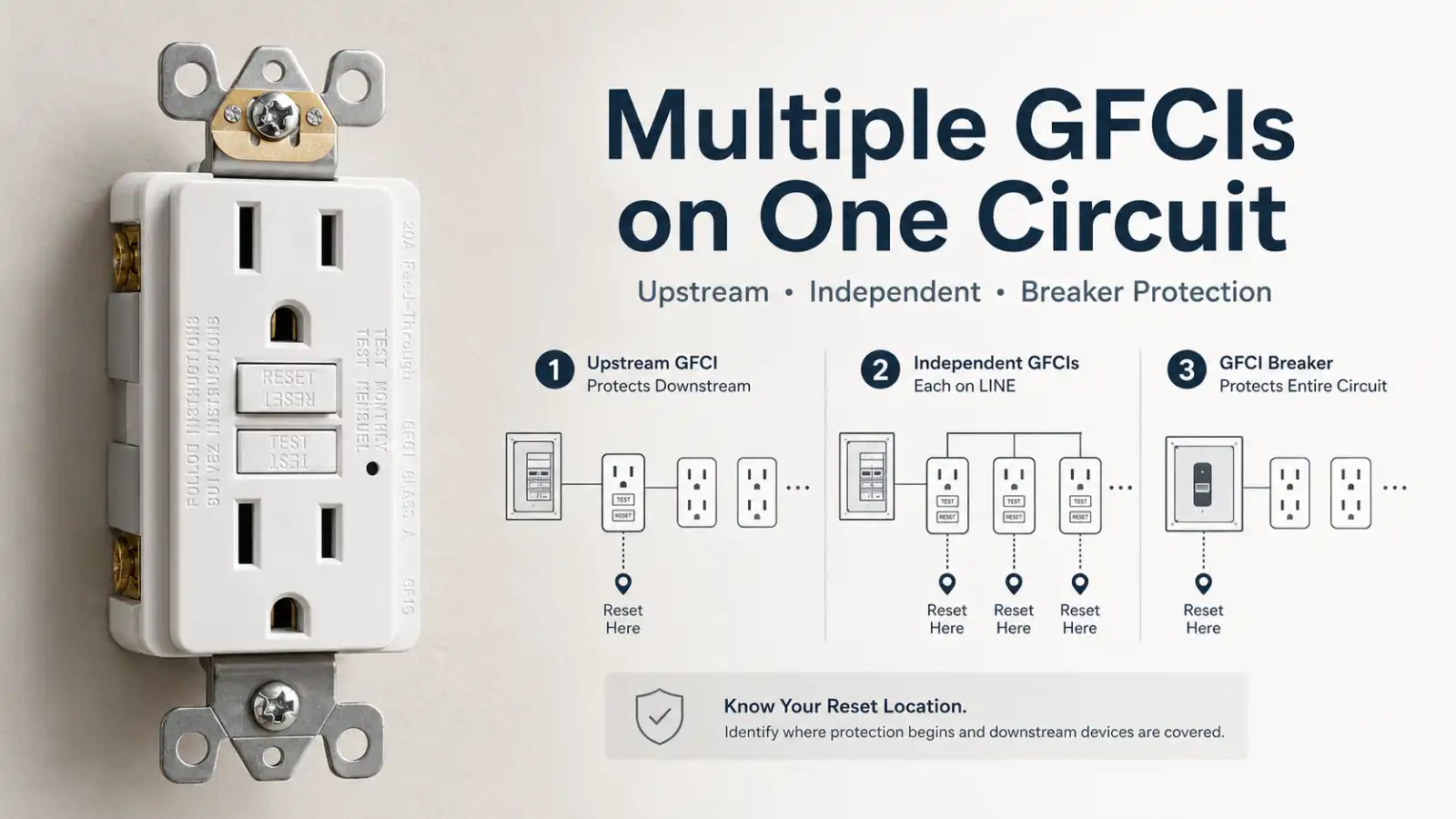
Yes. You can have multiple GFCI outlets on one circuit, and nothing in the code caps the number. That part is settled. The more useful question for anyone ordering devices for a project is which arrangement you actually want — because the three common ones cost different amounts, fail differently, and put the reset button in different places.
| Arrangement | Where it fits | What it costs you when it trips |
|---|---|---|
| One upstream GFCI, standard receptacles downstream | A single residential branch circuit where the device sits somewhere reachable | One fault and the whole downstream run goes dead at once |
| Independent GFCIs, each fed from LINE | Hotels, rentals, commercial kitchens, multi-zone wet areas | Higher device cost; only the faulted location drops |
| GFCI breaker at the panel | Whole-circuit protection, hidden or hard-to-reach outlets | Reset means a walk to the panel |
We sell these devices into multi-unit projects, so what matters here is the part that comes before the wiring: how the count and the placement get decided before anyone picks up a screwdriver. That ‘before the wiring’ decision — protection point, device, documentation — is the same one we walk end to end in the project-level view of where GFCI protection should sit.
The Question Is Rarely “How Many Is Legal”
The code tells you where protection is required, not how to deliver it. NEC 210.8 lists the locations — bathrooms, kitchens, outdoors, garages, and a growing set of others each cycle — and it requires the protective device to be readily accessible so it can be tested and reset. It does not tell you to put a GFCI at every one of those spots. One GFCI feeding standard receptacles downstream meets the same requirement, as long as the protected outlets are labeled. So does a GFCI breaker. So does a device at every location. All three are recognized ways to deliver that protection; which one clears a given inspection comes down to the code edition in force where you’re building and how the device is installed.
So the decision isn’t really a code question. It’s a question about parts cost, about who has to reach the reset, and about how the circuit troubleshoots two years from now when nobody remembers how it was wired.
When One Upstream GFCI Is the Right Call
In September 2021, right after the COVID shutdowns lifted, a contractor flew in from Toronto with a year of work in a folder — five apartment buildings. He didn’t hand us a parts list. He handed us drawings and one instruction: work out how many of each device the layout needs to stay compliant, using the fewest parts possible.
I’m in sales. The first time someone asked us to do a device take-off from a set of prints instead of a purchase order, I didn’t know how to answer him — we spent more than a month with our engineering team learning the residential placement rules before we could give him a number he could build to. He owned the electrical design and the inspection submittal. What we worked out was the device schedule.
The lever that moved the number was this exact arrangement: one GFCI at the head of each circuit, standard tamper-resistant receptacles downstream protected through it, toggle switches and standard devices everywhere a GFCI wasn’t required. Across the five buildings that pulled the GFCI count from about 8,000 to just over 4,500, with the same protection coverage on every outlet the code asked for.
That’s the case for the upstream arrangement. On a straightforward residential branch circuit it protects everything past it for the price of one device, and the rest of the run can be standard receptacles that cost a fraction of a GFCI.
It has one real cost, and you feel it the day something faults. A trip at the head device kills every outlet downstream of it at once. In a house, it’s an annoyance. The other catch is access: bury that upstream GFCI behind a refrigerator or inside a cabinet and it stops being readily accessible, which gets it flagged at inspection. Relocating a device after rough-in is days that weren’t in the schedule. If the protected point has to live somewhere a person can’t reach, that’s the signal to push protection back to the breaker instead.
When Independent GFCIs Earn Their Cost
Move the same circuit into a hotel. One upstream trip and the guest loses the nightstand, the bathroom, and the desk together, often at an hour when the only person who can help doesn’t have panel access and shouldn’t. That single-trip blackout is why I lean the other way for hospitality, rental units, commercial kitchens, and any circuit that crosses several separate wet zones: give each location its own GFCI, each fed from the LINE side, none of them chained to another.
Independent devices cost more up front — you’re paying for a GFCI where a standard receptacle would have done. What that money buys is fault isolation. A fault at one sink drops one sink. The housekeeper or the line cook resets it right there instead of calling maintenance to go hunt for a panel. For an operator who counts service calls instead of parts on the BOM, the math runs the opposite direction from the apartment job.
Wiring a GFCI Behind Another GFCI Is a Troubleshooting Cost
There’s a third thing people do, usually by accident — wire a second GFCI off the LOAD side of the first. The trouble it makes is in the troubleshooting. When the circuit trips you can’t tell by looking which device caught the fault, so whoever resets it works through them one at a time, and if they clear the wrong one while the fault is still live, that’s a callback. Redundant GFCIs don’t add protection; they add reset points to guess at. The specific terminal errors behind this — and the line/load reversals that quietly leave a downstream run unprotected — are their own subject; we walk through them in our piece on GFCI outlet wiring mistakes.
The Breaker Option, Kept Short
A GFCI breaker protects the whole circuit from the panel and solves the access problem outright — nothing in the field has to be reachable, because the reset lives at the panel. That is also its ceiling: the reset lives at the panel. For a tenant or a hotel guest, a walk to a locked electrical room to bring an outlet back isn’t a real option, which is why a breaker tends to suit owner-occupied or staffed buildings more than rentals. We don’t make breakers, so the receptacle-versus-breaker tradeoff stays where we already laid it out, in GFCI breaker vs GFCI outlet.
What This Turns Into on the Spec Sheet
Strip away the wiring talk and the decision lands on a few lines a buyer can actually write down:
- How many circuits, and one GFCI head per circuit versus a device per location — set by the building type, not by habit.
- For every downstream standard receptacle, a “GFCI Protected” label, so the next person doesn’t read a protected outlet as an unprotected one.
- Self-test devices. Under UL 943, the GFCI safety standard, GFCIs built since June 29, 2015 must include auto-monitoring and end-of-life power denial, so a unit that loses its protection locks out rather than sitting there powered and useless. For a building you’ll never revisit, that lockout is the line between a dead-but-safe outlet and a live one that protects nobody.
- The right amperage and the right tamper or weather variant at each spot — 15A or 20A, non-TR, TR, or TR/WR — instead of one blanket SKU stretched across the whole job.
This is where the documentation stops being a formality. Our GFCIs ship with LINE and LOAD marked on the device, the LOAD terminals covered until someone deliberately extends protection downstream, “GFCI Protected” labels in the box, and an instruction sheet that spells out the feed-through wiring. None of that is exciting. All of it heads off the kind of field mistake that comes back as a return.
What we don’t do is design the branch circuits, stamp the drawings, or visit the site. On the Toronto job we did a device take-off from the contractor’s own layout; the engineering and the inspection submittal stayed his. What we can speak to is the production and the parts — which devices, how many, marked how, packed how.
And because we sell B2B, we don’t run homeowner returns. If a project order comes back with a damaged or failed unit, we repair and reship to the importer; for small quantities we send a fair replacement count with the next order rather than turn it into a separate freight event.
Frequently Asked Questions
Can you have multiple GFCI outlets on the same circuit?
Yes — the code doesn’t limit the number. The real choice is whether they’re independent, each fed from LINE, or one GFCI protects the rest downstream.
Does one GFCI outlet protect the others on the circuit?
Only the ones wired to its LOAD side, and only if it’s installed and tested right. Label each protected outlet so nobody downstream assumes it has its own protection.
Is it bad to put a GFCI after another GFCI?
Not unsafe. But a GFCI on the LOAD of another one gives you two reset points for one fault and no way to see which tripped — more troubleshooting, no more protection.
When do multiple independent GFCIs make sense?
When one trip taking out a whole run is something you’ll pay for later: hotels, rentals, commercial kitchens, garage workstations, any circuit that crosses several separate wet zones. Each location gets its own device on LINE, the fault stays local, and the person standing next to it can reset it without finding a panel. You pay more in parts and get it back in service calls you never take.
Why won’t a downstream outlet reset?
Usually the upstream GFCI has tripped, or LINE and LOAD got reversed during install, or there’s simply no power reaching it. Our walkthrough on whether GFCI outlets go bad runs the rest of the check.
Is a GFCI breaker better than multiple outlets?
For staffed or owner-occupied buildings, the breaker is the cleaner choice — the reset sits at the panel and whoever maintains the place can get to it. For rentals and hotels it’s the wrong choice: a tenant can’t reach a locked panel, so the reset belongs at the outlet.
How This Fits With the Rest of What We’ve Written
This article is the decision that comes before the wiring — count and placement. Once those are set, the way the terminals actually get landed, and the reversals that silently kill downstream protection, is the subject of our GFCI outlet wiring mistakes article. The breaker-versus-receptacle question we kept short here on purpose, because the reset-location and cost comparison already lives in the GFCI breaker vs GFCI outlet piece. And the reason a USB or standard outlet downstream stays live or goes dark with the GFCI traces back to the same LINE/LOAD feed-through logic covered in why USB ports stay powered after a GFCI trip.
Sources
- NFPA 70, National Electrical Code — Article 100 accessibility language and Section 210.8 GFCI protection for personnel:
NFPA 70 National Electrical Code - UL 943, Standard for Safety for Ground-Fault Circuit Interrupters — Class A GFCI protection scope:
UL 943 Standard page - UL Solutions — GFCI personal protection devices testing and certification under UL 943 / CSA C22.2 No. 144.1:
GFCI personal protection devices testing and certification - IAEI Magazine, UL Question Corner: Self-testing GFCI Requirements — UL 943 auto-monitoring, end-of-life power denial, and reverse line/load mis-wire protection, effective June 29, 2015:
Self-testing GFCI requirements
Related Reading
Scoping GFCI quantities for a project?
If you want devices with consistent LINE/LOAD marking, protected-outlet labels, and self-test lockout across 15A/20A and TR / TR-WR variants, see our GFCI receptacle category — or send the drawings and we’ll work the device count with you the way we did for the Toronto job.