When an inquiry reaches us with “duplex receptacle” and nothing else, we quote it as a standard duplex — the standard duplex face — because on our desk “duplex” counts the outlets, not the face. Buyers who want the rectangular decorator-style face write that in. That one default, and the reason under it, is what separates a decorator receptacle from a standard one on a purchase order.
The face is what catalogs photograph. The opening is what the plate has to match.
“Duplex” Counts Outlets; It Doesn’t Pick a Face
A duplex receptacle is two outlet positions on one yoke — two places to plug in, one device. That is a count of outlets, not a face. A decorator-style receptacle can be a duplex too: two positions behind a rectangular front. So “standard duplex versus decorator” puts one face against another — the standard duplex face against the rectangular decorator-style one — and both carry the same two outlets.
Decora is Leviton’s brand name for its decorator-style line. The generic word for the rectangular face is decorator-style, and that is the word an RFQ should carry, because “Decora” names a brand while “decorator-style” names a shape.
A line that just says “duplex” gets read here as the standard face. The decorator front is the one a buyer has to call out.
One Opening, One Plate Family
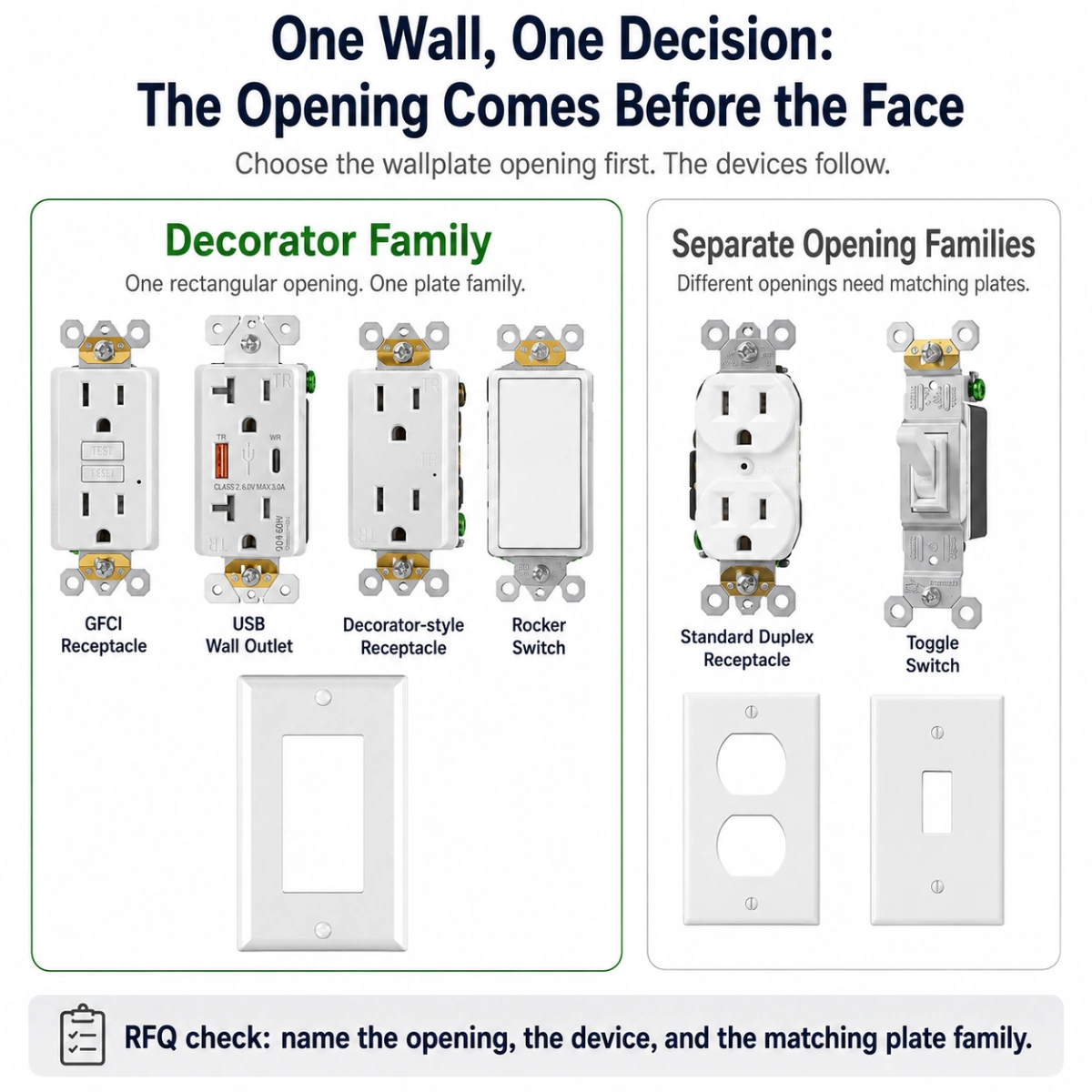
In North American wiring-device packages, the decorator rectangular opening is the common shared opening across many modern device families. A rocker switch, a dimmer, a GFCI receptacle, a USB wall outlet, and a decorator-style receptacle can all sit behind that rectangular opening. The standard duplex face has its own receptacle opening pattern. A toggle has its own narrow opening again.
| Device | Opening family |
|---|---|
| GFCI receptacle | Decorator rectangular opening |
| USB wall outlet | Decorator rectangular opening |
| Decorator-style receptacle | Decorator rectangular opening |
| Rocker switch | Decorator rectangular opening |
| Standard duplex receptacle | Standard duplex opening |
| Toggle switch | Toggle opening |
A wall sorts into openings before it sorts into products. Put a GFCI, a USB charger, and a decorator receptacle down a corridor and one decorator plate family — one finish — closes all of them. Add a standard duplex into the same gang and that box needs a combination plate: a rectangular opening beside a duplex opening on one cover. Those covers exist. They are a separate line item, and skipping them is how a multi-unit job ends with two cover shapes in one color on the same wall.
None of this ranks the devices. A receptacle is listed to UL 498; a wall switch to UL 20, with CSA C22.2 No. 111 behind the Canadian cUL mark. Neither standard sorts by face. The standard duplex face is not a lower safety tier; it is an opening. Grade, amperage, TR, WR, and the listing mark get read on their own line — the way a 15A versus 20A receptacle is settled by the circuit and the listing, not by how the front looks.
Color Is a SKU Question
Color reads like a finish swatch and behaves like a sourcing line. The decorator opening carries the widest color range on our line, because GFCI, USB, receptacle, and rocker all share it, so one matte black or one gray covers the gang. Ask for an uncommon shade in a standard-duplex face, or a weather-resistant 15-amp device in a specific color, and the real question is whether that exact SKU is built at all. Whether it suits the room was never the hard part. Color availability is SKU availability. On our line the color range sits on the decorator family first; matching an unusual shade across a standard-duplex face is the line we confirm before we promise it.
Rocker, Toggle, and the Switch That Follows
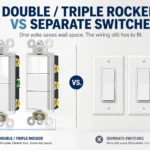
Buyers are clear on this one. They name the switch they want, and they say rocker more than they say anything else. What’s usually still open is the gang around it: does the rest of the wall share the rocker’s opening, or not? A new fit-out where the GFCI, USB, and receptacles are decorator-style takes a rocker so the gang lands on one opening; a toggle there splits the plate package for nothing the project asked for. A replacement run in an older building pulls the other way: if the rooms are standard duplex and toggle, dropping in a rocker means a new device face, a new plate opening, and a finish-match across every box touched.
“It looks newer” does not pay for that rework. “The outlets here are being changed to decorator-style GFCI and USB anyway” does — and then the toggle is what splits the wall.
Whether the switch is single-pole, 3-way, or 4-way is a wiring-function question underneath the face, and it does not change the opening: 3-way vs single-pole switch.
Putting It on a PO Without Splitting the Wall
Three ways to write the line, depending on the wall.
Decorator-family line
Decorator-style duplex receptacle, [15A/20A], [TR], [WR where damp/outdoor], UL 498 / cUL listed, [color], decorator wallplate to match the GFCI / USB / rocker family in the same gang.
Standard-duplex replacement line
Standard duplex receptacle, [15A/20A], [TR], UL 498 / cUL listed, [color], standard duplex wallplate — for rooms where the existing toggle-and-duplex package stays and only the device is swapped.
Mixed-gang line
Where a rectangular device sits next to a standard duplex, name the combination plate and confirm its color and gang count, rather than assuming two single plates will close the box.
Plate size — standard, mid, or jumbo — is a separate call from the opening, made to cover the wall cut sized to the wall cut, which is a different question from the opening: jumbo vs mid vs standard wall plate size. Pull the switch line and the wallplate series from one family so the openings agree before the carton is packed. With the opening named, the face is just the last field on a line that already holds together.
We make the receptacle, the switch, and the plate, and we confirm the opening, the rating, the listing, the color, and the carton label before the order ships. We do not wire the box or sign the inspection. We read a bare “duplex” as standard and flag decorator when it is meant — and the one thing I won’t infer from the word alone is what an export buyer means by a paddle or a modular frame, so I confirm the frame before the quote goes out.
What This Guide Leaves to the Others
This sits with the receptacle and wallplate material that makes up most of what we publish, not the switch side, which stays thin on purpose. It runs on the same separation the 15A-versus-20A guide draws — face and grade are different columns from rating and listing — and stretches it across a whole gang instead of one device. The wallplate is the hinge: the decorator opening is the shared part, so the receptacle defines the family and the switch lands on it last. The plate-size and 3-way pieces take the two calls this article sets aside — sizing the cover, and wiring the function.
FAQ
Is a Decora receptacle the same as a decorator receptacle?
Yes. Decora is Leviton’s brand name; decorator-style is the generic term for the same rectangular face.
If I order a “duplex receptacle,” do I get decorator or standard?
Standard — the standard duplex face — unless decorator-style is written in. Duplex refers to the number of outlets. The face is chosen separately.
Is a decorator receptacle also a duplex?
It can be — two positions behind a rectangular face is a decorator duplex.
Do decorator receptacles need special wallplates?
They use the decorator rectangular opening — the same plate that fits rocker switches, GFCIs, and USB outlets. If the gang is decorator-style, that plate is already right; the standard duplex is the device that needs its own.
Does decorator-style mean higher grade?
No — the face is just the opening. Grade comes from the spec line: residential versus commercial, contact retention, terminal type, all read under UL 498 whether the face is decorator or standard.
What should a receptacle-and-switch PO line include?
Outlet count (duplex or single), amperage, TR and WR as the location requires, the listing and mark (UL 498 for the receptacle, UL 20 for the switch, cUL for Canada), color, and the wallplate opening the gang has to match. The face goes last.
Sources
- UL 498, Attachment Plugs and Receptacles — scope covers attachment plugs, receptacles, cord connectors, inlets, current taps and related devices intended for branch-circuit connection under the National Electrical Code:
UL 498 Scope - UL 20, General-Use Snap Switches — scope covers manually operated, general-use snap switches and modular switch assemblies used under NEC, Canadian Electrical Code, or NOM installation systems:
UL 20 Scope - UL 20 / CSA C22.2 No. 111 — general-use snap switch standard path for the Canadian cUL side:
Intertek Standards Update Notice - DECORA trademark record — DECORA is a trademark of Leviton Manufacturing Co., Inc.; decorator-style is used here as the generic description for the rectangular face style:
DECORA Trademark Record