Walk a finished unit at turnover and you can find two duplex receptacles that look identical. One is just a receptacle. The other is protected by a GFCI sitting somewhere else on the circuit. The entire difference between them can come down to a small sticker on the second one, and that sticker doesn’t make the outlet safe — it records where the safety comes from. The split between a GFCI protected outlet vs GFCI receptacle is the split between a state and a device, and at handover the state is the part that gets lost first.
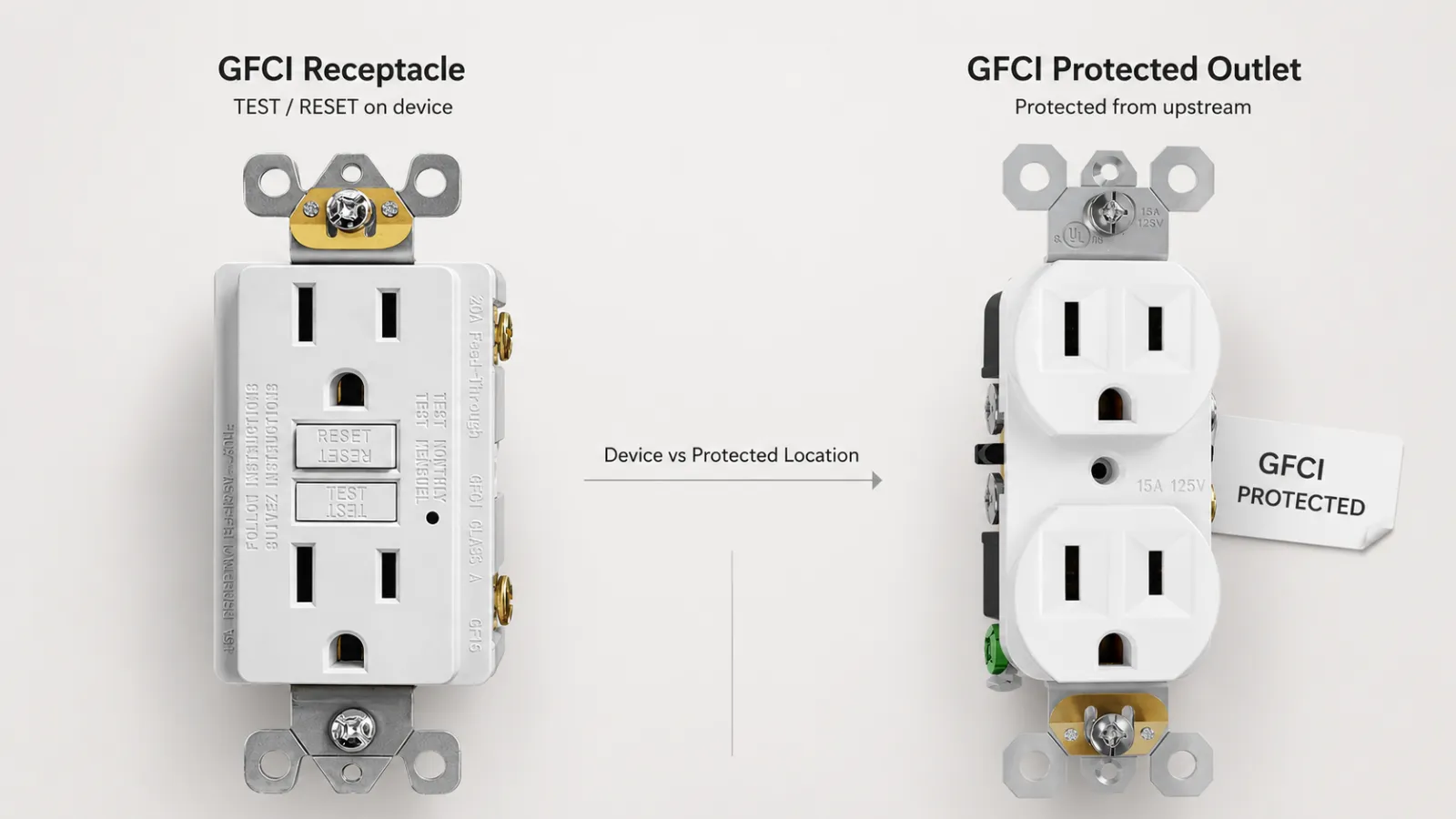
A GFCI receptacle is the device with the TEST and RESET buttons. A GFCI protected outlet is an outlet protected by a GFCI device somewhere upstream — either the LOAD side of a GFCI receptacle or a GFCI breaker at the panel. In downstream layouts, it can be a plain receptacle with no buttons on it at all.
| Point of comparison | GFCI receptacle | GFCI protected outlet |
|---|---|---|
| What it is | A device | A condition — the outlet is protected by something upstream |
| TEST / RESET buttons | On the face | No button on a standard protected receptacle |
| Where you reset it | At the device itself | At the upstream GFCI, or at the GFCI breaker in the panel |
| How you identify it | You can see the buttons | By a label, confirmed with a test |
A Label Is a Map, Not the Protection
The sticker on that second outlet does one job. It tells whoever opens the wall next where the protection is coming from. It doesn’t add any. An outlet is protected because it’s wired to the LOAD side of an upstream GFCI, or fed from a GFCI breaker, and it stays protected whether or not anyone labeled it.
PANEL ──▶ [ GFCI RECEPTACLE ] ── LOAD ──▶ ( standard outlet ) ──▶ ( standard outlet )
              TEST / RESET here              "GFCI Protected"       "GFCI Protected"
              the device                      protected, no buttons   protected, no buttons
              reset is here                   reset is upstream       reset is upstream
Peel the label off and the protection is unchanged; all you lost is the map.
That is also why an unverified label is its own hazard. A “GFCI Protected” sticker means something only after someone has pressed TEST on the upstream device and watched this outlet go dead. If it doesn’t go dead, the label is pointing at protection that isn’t there, and the next person who trusts it skips the test they should have run. A blank plate at least makes that person test before trusting anything; a wrong label talks them out of it.
When the Label Is Code, and When It’s Just Good Paperwork
The clearest place the label isn’t optional is in the code itself. When an old box has no equipment ground, NEC 406.4(D)(2) sets out how a replacement gets marked, and it splits two ways. Replace the two-prong receptacle with a GFCI-type receptacle and the marking is “No Equipment Ground” — the TEST and RESET buttons already show it’s a GFCI, so only the missing ground needs calling out. Replace it instead with an ordinary grounding-type receptacle fed through a GFCI somewhere upstream, and that outlet has to be marked both “GFCI Protected” and “No Equipment Ground,” visible after the cover plate goes on.
The GFCI works fine on that ungrounded circuit either way, since the ground wire takes no part in how it senses a fault. The markings carry what the outlet can no longer show on its own.
That section is the clearest NEC trigger, not the whole list. A local amendment, an AHJ’s reading, a project spec, or a closeout requirement can each call for labeling past what 406.4(D)(2) asks.
Outside that replacement case the picture is looser. A normal grounded receptacle protected by an upstream GFCI isn’t pushed by any blanket code section into wearing a “GFCI Protected” label. Labeling every protected device on a job adds time, and that tradeoff belongs to the installer, not to us. We build the devices and put the labels in the box; we don’t write anyone’s labeling routine, and we won’t pretend a sticker is the law where it isn’t. Whether your AHJ wants the grounded downstream outlets labeled too is a local call, and I can’t make it for you from a factory on the other side of an ocean. The narrow thing we will say: on anything that changes hands later, the label earns its keep.
Why a Sticker Decides Your Next Service Call
A labeled “GFCI Protected” outlet that goes dead points the maintenance route upstream first. Without the label, a dead standard receptacle looks like the failed part. Someone can swap the receptacle and still have a dead outlet because the fault was a tripped GFCI somewhere else on the circuit.
Now the opposite. A downstream-protected receptacle with no label at all, five years on, when someone renovates the kitchen and can’t tell which outlets carry their own protection and which borrow it from upstream. They either test every point on the circuit, which is time, or they assume, which is risk.
When we worked the device take-off for the Toronto apartment job described in our piece on running multiple GFCIs on one circuit, the only way to count the GFCIs was to mark, on the drawing, every endpoint that would be protected through an upstream device rather than carrying its own. That markup was a protection map before a single device shipped. A drawing doesn’t walk the halls of a finished building, though. Unless that protection map made it into the closeout documents, the label on the outlet is the visible copy that still sits with the receptacle when the next person opens the wall. Getting that protection map into the closeout package is one part of the wider handover discipline in how a GFCI order gets documented so it survives the handoff.
What We Put in the Box, and What We Don’t
The part we control stops at the device and the carton. Our GFCI receptacles ship with LINE and LOAD marked on the body, the LOAD terminals covered until someone deliberately extends protection downstream, an instruction sheet that spells out the feed-through wiring, and “GFCI Protected” labels in the box. We don’t include “No Equipment Ground” labels by default. That marking belongs to the ungrounded-replacement case, and we send it only when a customer puts it on the order.
What we don’t do is wire it, test it on the wall, make the inspector’s call, or police how a crew labels its work.
If you’re writing the spec or the PO, the wording that heads off the whole mix-up is the same distinction this article runs on. Keep the device and the state apart:
- “GFCI receptacle” where you want the device with the buttons.
- “Standard receptacle, GFCI protected downstream, ‘GFCI Protected’ label included” where a plain outlet borrows its protection.
- “No Equipment Ground label” only where an ungrounded replacement puts the work under 406.4(D)(2).
- A reset-location note in the closeout packet, so the protection map survives the handoff the drawing won’t make.
Frequently Asked Questions
What does a GFCI protected outlet mean?
It means the outlet is protected by a GFCI somewhere upstream — not that the outlet itself is a GFCI. It can be an ordinary receptacle.
Is a GFCI protected outlet the same as a GFCI outlet?
No. A GFCI outlet, or receptacle, is the device with TEST and RESET. A GFCI protected outlet is an outlet protected by another GFCI device, either upstream on the circuit or at the panel.
Why does my GFCI protected outlet have no reset button?
Because it isn’t the GFCI. The reset sits on the upstream device — another receptacle earlier on the circuit, or a GFCI breaker in the panel. Find that device and you’ve found the reset.
Does every GFCI protected outlet need a sticker?
The NEC case this article focuses on is the ungrounded replacement path under 406.4(D)(2). In that case, a grounding-type receptacle supplied through GFCI protection needs both “GFCI Protected” and “No Equipment Ground” markings visible after installation. Project specs or AHJ review can ask for more labeling, so the safer rule is to separate code-required marking from handover documentation.
What is the difference between “GFCI Protected” and “No Equipment Ground”?
Two separate facts on the same plate. “GFCI Protected” says the protection arrives from upstream. “No Equipment Ground” says there’s no ground wire behind the outlet. The ungrounded-replacement case needs both when a grounding-type receptacle is supplied through GFCI protection.
Can a regular outlet be GFCI protected?
Yes, when it’s wired to the LOAD side of an upstream GFCI or fed by a GFCI breaker. That is what a protected outlet is.
Does a label prove the outlet is protected?
No. A label is a claim. The proof is pressing TEST on the upstream device and watching this outlet lose power. Until then, treat the sticker as a lead, not a guarantee.
How This Fits With the Rest of What We’ve Written
This piece is about telling the protected outlet apart from the device that protects it. How many GFCIs a circuit needs and where they go — the reason a downstream outlet is protected at all — is its own subject, the multiple-GFCIs guide linked above. When a labeled outlet won’t come back to life, the LINE/LOAD reversals and downstream failures behind it are walked through in our GFCI outlet wiring mistakes article. Together the three cover the same circuit from three sides: sizing the protection, wiring it, and keeping the label readable for whoever comes next.
Sources
- NFPA 70, National Electrical Code — Section 406.4(D)(2), replacement of non-grounding-type receptacles, with marking requirements split between GFCI-type replacements and grounding-type receptacles supplied through a GFCI:
NFPA 70 National Electrical Code - NC Office of the State Fire Marshal, 406.4(D)(2) — GFCI Stickers — interpretation separating a GFCI-type replacement marked “No Equipment Ground” from a non-GFCI grounding-type receptacle protected by a GFCI device and marked “GFCI Protected” and “No Equipment Ground”:
GFCI Stickers interpretation - EC&M, NEC Requirements for Receptacles — 406.4(D)(2)(c) and the point that GFCI protection works on a two-wire circuit because the equipment grounding conductor takes no part in GFCI operation:
NEC Requirements for Receptacles
Related Reading
Specifying GFCIs and protected outlets for a project?
If you want devices that ship with clear LINE/LOAD marking, covered LOAD terminals, and “GFCI Protected” labels in the box — with “No Equipment Ground” labels available on request — see our GFCI receptacle category, or send the drawings and we’ll mark the protected endpoints with you the way we did on the Toronto job.