A supplier sends over a UL file number — something like E###### — and it reads like the certification question is settled. Verification actually starts there; it doesn’t close there. For a supplier who makes several different product lines, that one number tells you less than it looks like it does.
The position before the rest: treat the file number as a search key. Before you act on it, the product category, the exact model, and even which body issued the certification all have to line up with the SKU you’re buying. A number on its own approves nothing.
-
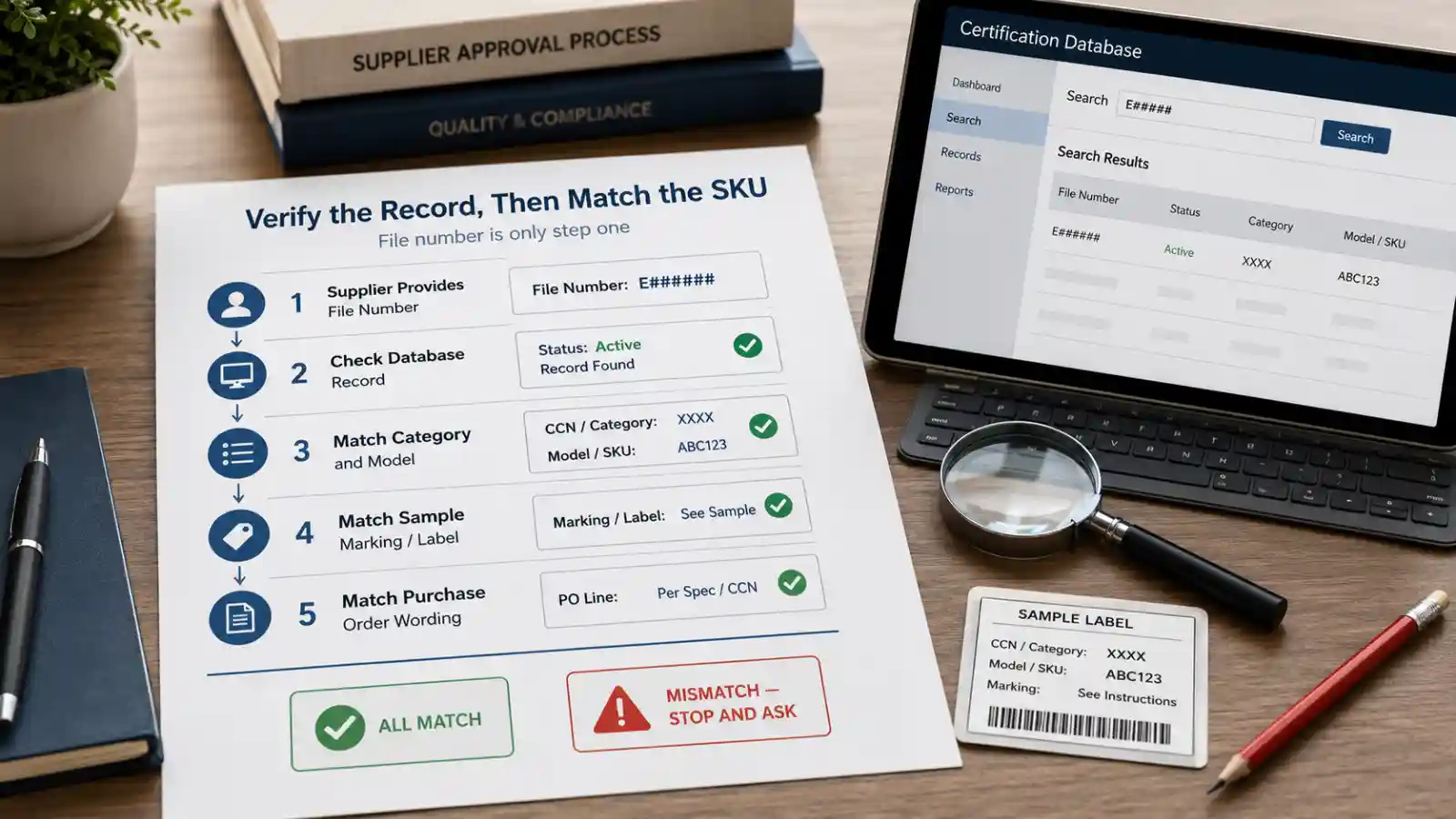
STEP 1Supplier gives a UL file number (for example, E######)
-
STEP 2Search that number in the free UL Product iQ database
-
STEP 3Open the record: confirm company name, product category (CCN), and that your model/SKU is in scope
-
STEP 4Match the marking, rating and label on the sample to that same record
What a File Number Actually Points To
A UL file number is assigned to a company and a product category — it’s the record for that manufacturer’s evaluated products in that category, and the same firm can hold more than one. Search it in Product iQ, UL’s free database, and you pull up the company, the category code (CCN), and the models on file. So the number answers one question: does this maker have an evaluated record in this category. Worth knowing. It does not, on its own, tell you the item in your quote is the item on that record.
The common miss is reading “here is an E-number” as “here is a certified product.” The number is the start of a lookup. The lookup is the verification.
One Supplier, Several Lines — Not One Blanket Certificate
This is where wiring devices catch buyers out.
A supplier might make GFCIs, USB outlets, receptacles, switches, and wallplates — different product families under different standards. On our side, each of those sits under its own UL/cUL record, organized by category. So “we’re UL listed” is true and still incomplete, because the honest follow-up is: listed for which line? The GFCI record doesn’t cover the switches, and the wallplate sits somewhere else again. A file number that checks out for one category tells you nothing certain about a product in another.
There’s a second wrinkle, and it’s about which body did the testing. When we bring out a new product, we sometimes certify it with ETL first, then add UL as well when customers’ projects call for it. Both are full certifications to the same product standard, and which marks a product carries follows what its buyers need; neither is a step toward the other. Our GFCI-with-USB unit, new for 2026, started with ETL, and we add UL on the lines where buyers ask for it. The practical catch for verification: a buyer who confirmed our GFCI line in Product iQ and assumed the newest combo unit was in there too would be searching the wrong database. For that unit, the record lives with Intertek.
An ETL listing to a UL standard is a real third-party certification, issued by a Nationally Recognized Testing Laboratory. What it isn’t is automatically interchangeable on paper: some project specs name UL specifically and won’t accept ETL in its place. So the project spec is what decides whether a given mark clears, even when the certification itself is sound.
So before treating a line as covered, a buyer has to know not just the file number, but which laboratory holds the record for that exact product, and whether the project will accept it.
“Listed To” and “Conforms To” Are Different Claims
Two things a spec sheet runs together. One is the standard a product was tested against — “listed to UL 943,” for instance, which an NRTL like UL or Intertek/ETL can certify against. The other is who holds the listing and which mark the product carries.
“Conforms to UL 943,” “meets UL requirements,” or “UL pending” is a softer claim — often self-declared, with no NRTL listing behind it and frequently nothing in any directory to find. The standard tells you what the product was measured against; the listing record and the mark tell you who certified it and whether you can confirm it.
A File Number Can Be Copied: A 2018 Case
A file number can also be printed by someone who has no right to it.
Back in 2018 another factory — I won’t name them — printed our self-test UL file number on their own GFCIs. It surfaced at a customs inspection: asked to produce the UL authorization tied to that file, they couldn’t, because the file was ours. The shipment was held. We only learned about it when UL contacted us to say our number was turning up on goods we hadn’t made. UL does work with customs to flag certification claims that don’t hold up, though I can’t tell you how routine that kind of check is — ours came to light because someone looked.
The takeaway for a buyer is plain. A file number on a label is a claim, not proof that the shipper is the company holding it. The record in Product iQ names the actual certificate holder; confirm the name on it is the supplier you’re paying.
What an Approval Should Confirm
A check that holds up looks at more than the number:
- the category (CCN) covers the product you’re buying, not only some other line the supplier also makes;
- the exact model or catalog number appears on that record;
- which body issued it — UL, cUL, or ETL/Intertek — so you search the right directory;
- the marking, rating, and label on the sample match the record;
- the wording reads “listed to,” rather than “conforms to” or “meets requirements.”
What we hand a buyer is the file number itself, and we point them at Product iQ to read it for themselves — the certificate PDF and the database record say the same thing, so we’d rather you check it at the source. Some buyers want the PDF as well, which is fine. Then a sample ships, with the UL or ETL mark printed or molded right on the device, and the buyer tests it and checks it against the list above. The lines and their certifications are on our GFCI and wiring-device category page.
We can stand behind our own records, our markings, and the sample in your hand. We can’t vouch for a number on someone else’s label, and we don’t decide whether a given certification is the right one for your market — that part belongs to you and your local authority.
Matching the Certification to the Market
American-style wiring devices going into North America are generally expected to carry UL, cUL, or an equivalent ETL/Intertek listing — in our experience selling into the region. Different markets run different certification systems, and the job is to match the device to the one in force where it ships, then confirm the record exists under that system before the order moves.
Frequently Asked Questions
What is a UL file number?
It’s the identifier UL assigns to a company for an evaluated product category — the key you use to pull that manufacturer’s record in the Product iQ database. One company can hold several, by category.
Can you verify UL certification with just the file number?
You can start. Enter the file number in Product iQ and you’ll see the company, the category, and the models on file. To finish the verification you still have to confirm the specific model you’re buying is on that record, that the category matches the product, and that the marking on the sample agrees with the listing. The number opens the record; the verification is what you do after.
Does “conforms to UL” mean a product is UL listed?
Not necessarily. “Listed to UL 943” means an NRTL — UL or another, such as Intertek/ETL — evaluated samples against that standard and the product carries a listing mark you can look up. “Conforms to” is often a self-declaration, with no listing behind it.
What does it mean if the model number isn’t found in Product iQ?
It can mean a few things, and not all of them are sinister: a search using the maker’s internal model code instead of the UL identifier often returns nothing, and some products are certified by a different body. It can also mean the specific SKU was never listed. The move is the same either way — ask the supplier for the file or directory path that returns the exact model, and hold the approval until it does.
Is an ETL listing as good as a UL listing?
For certification status, ETL (Intertek) is a Nationally Recognized Testing Laboratory, so an ETL listing is a real third-party certification. The practical difference for verification is where you look — an ETL-listed product is confirmed in Intertek’s directory, not UL Product iQ. And project specs or the AHJ still decide whether a given mark is accepted for a specific job.
How This Article Connects to the Rest of the ShengYu Library
Confirming the record points at the exact SKU is the same discipline we wrote about for outdoor receptacles, where the device, the listing, and the order all have to name the same configuration. The return side of a listed device — what a “won’t reset” claim can and can’t prove — runs through our piece on whether GFCIs go bad. And the paperwork that should travel with a certified order before it ships is the subject of our UL 498 buyer’s checklist.
Verifying Us Before You Order
If you’re vetting us as a supplier, send the SKU you’re looking at and the market it’s going to. We’ll give you the UL or ETL file number and the directory path to pull the record yourself, so you can confirm the category, the model, and the mark before anything moves. Contact ShengYu.
Sources
- UL Product iQ — UL Solutions’ certification database. The guided search accepts a file number, category control number (CCN), company name, or model number, and a listing record is identified by the CCN-plus-file-number combination:
UL Product iQ - UL Solutions / IAEI Question Corner — overview of Product iQ and how a UL file number maps to a manufacturer and a product category rather than to every product the company makes:
Introducing the UL Product iQ Database - Intertek ETL Listed Mark Directory — the verification path for products certified by ETL (Intertek) to a UL or other standard; an ETL listing is confirmed here rather than in UL’s database:
ETL Listed Mark Directory - Compliance Gate, “UL Listed Products” — distinguishes a UL Listed mark from softer wording such as “conforms to,” “meets UL requirements,” or “UL pending”:
UL Listed Products
Confirm any record against the current entry in the relevant NRTL’s directory; a printed number or a certificate copy is a claim until the directory record is matched to the exact model.