Two questions come up regularly from buyers picking between 15 amp and 20 amp receptacles. “Is the 20 amp one better than the 15 amp?” And “my project runs on 20 amp circuits, do all the receptacles need to be 20 amp?”Both are reasonable questions. Both are asked from the wrong angle.
15 amp and 20 amp receptacles, at least on our line, are not on a better-or-worse axis. They are not stronger-or-weaker either — well, technically the slot configuration is different, but within the same grade family on our production line, the brass contacts, screws, and terminals are shared between the 15A and 20A SKU. The face mold changes from parallel slots to a T-slot. That is the production-side difference. What the front of the device tells the eye is not the same thing as what the inside of the device is doing.
For repeated general-use locations on a properly specified 20A multi-outlet branch circuit, the clean answer is often a 15A duplex receptacle. The 20A receptacle earns its place when the location actually needs the NEMA 5-20R face — usually because the equipment has a 5-20P plug, or because the project spec calls it out by name.
This guide is for project buyers — small contractors, distributors, property managers, anyone ordering receptacles for a job rather than for a homeowner replacement — who want to know which one to order and why. The answer is usually less dramatic than the search results make it sound.
What actually changes between a 15A and 20A receptacle
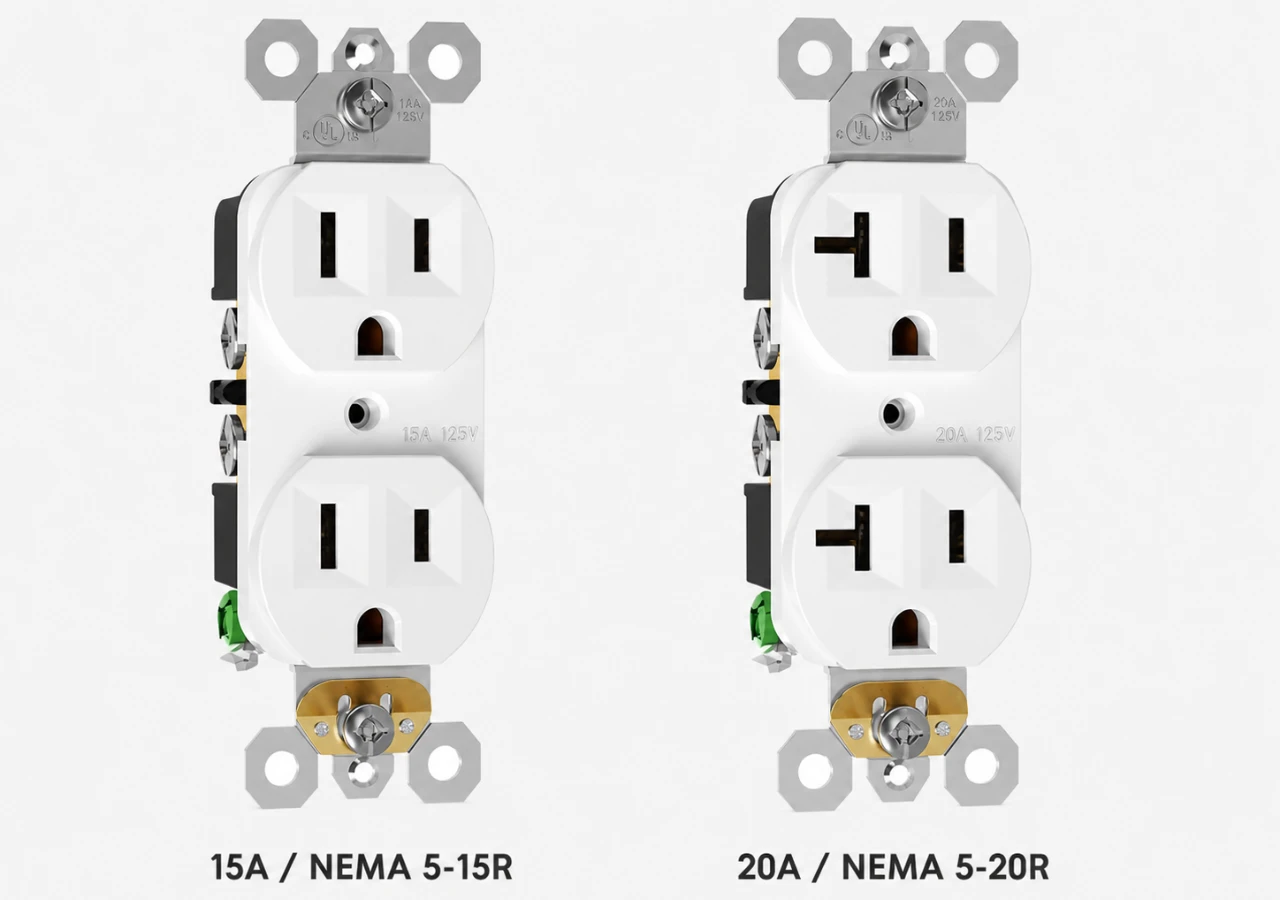
A NEMA 5-15R has two vertical slots — one hot, one neutral — plus a ground pin opening. Rated 15 amps at 125 volts. The only plug shape it accepts is the 5-15P (two vertical blades).
A NEMA 5-20R has one vertical slot and one horizontal slot, forming a “T” on the neutral side. Rated 20 amps at 125 volts. The T-slot accepts both the 5-15P (two vertical blades) and the 5-20P (one vertical + one horizontal blade). That backward compatibility is intentional — a 20A receptacle on a 20A circuit can still take a normal 5-15P plug.
A 5-20P plug cannot fit into a 5-15R receptacle. The horizontal blade has nowhere to go.
What stays the same is the inside of the device. On our production line, a 15A duplex and a 20A duplex within the same grade tier (residential, commercial, or industrial) share the same brass contacts, the same hot and neutral terminals, the same screw assembly. The face mold is what changes. Same factory tooling family, different face inserts.
Cost difference between the two SKUs on our line is marginal — a few cents per unit at most. 15A volumes are larger, so 15A unit cost runs slightly below 20A at the same grade, but the gap is small enough that it almost never drives the procurement decision.
When customers ask us to manufacture a 15A receptacle “but built to 20A standards,” what we usually do is send them a short side-by-side video of the inside of both SKUs. The brass is the same. The contact points are the same. The materials are the same. Once they see it, the question usually changes.
There is also a published reason this matters at the listing level. This also connects to the kind of UL 498 review buyers should complete before shipment. The UL Guide Information for the receptacle category (UL category RTRT) states that 15 and 20 amp single and duplex receptacles provided with more than one set of terminals for line and neutral conductors “have been investigated to feed branch-circuit conductors connected to other outlets on a multi-outlet branch circuit.” In plain terms: the device’s internal current path is evaluated for the case where a 15A duplex sits on a 20A multi-outlet circuit and the full circuit current passes through the device to feed the next outlet. That listing logic is consistent with what we see on our own production line — the internal current-carrying parts are sized the same way between 15A and 20A within a grade tier, because the device is expected to handle the same pass-through current either way.
Grade matters more than amperage
Receptacles in the North American B2B catalog come in three grade tiers. Grade is where the actual durability and material differences live.
Residential grade. Our baseline. Brass contacts and materials sized for residential plug-in cycle counts and thermal cycling. This is what ships for most general-use applications — apartments, dwelling units, hotel guest rooms, office walls. Most of our 15A and 20A receptacle volume goes out at this tier.
Commercial grade. Heavier brass on the contacts, stronger contact spring force, longer plug-insertion cycle life. Specified for hotels with high turnover, education facilities, healthcare common areas, office spaces with constant plug cycling. The face is identical to residential at the same NEMA configuration — the differences are inside.
Industrial grade. Heaviest brass. Higher flame-retardant rating on the housing material. Larger contact surface area, tighter contact grip. Specified for workshops, light industrial, equipment rooms, and any location where the receptacle takes mechanical stress from plugs being pulled hard or at angles.
We do not make hospital grade. Hospital-grade receptacles (marked with a green dot) carry specific UL requirements for grip retention and ground reliability that government healthcare and clinical procurement typically sources direct from major branded suppliers in the US — that channel is set up for hospital-grade certification, and we do not compete in it. If a project asks us for hospital grade, we say so up front.
The reframe matters because when a buyer asks “is 20A better than 15A?”, the underlying question is usually “is 20A more durable?” Durability is not driven by amperage. Durability is driven by grade. A 15A commercial receptacle outlives a 20A residential receptacle on the same wall, because commercial means thicker brass and stronger contact force regardless of which face mold sits on top of it.
A 15A industrial outlives most 20A residentials by a clear margin. If the project goal is durability, the lever is grade — not the amperage label on the face.
When the 5-20R is the right SKU
A few conditions where a 5-20R receptacle is the correct choice:
The equipment plug is a 5-20P. This shows up on certain commercial kitchen equipment (large microwaves, commercial mixers, certain pieces of warming and refrigeration gear), older window AC units, some portable industrial equipment such as floor scrubbers and large vacuums, certain HVAC accessories, and a small set of office equipment like dedicated commercial printers and large UPS units. If the plug coming into that outlet has a horizontal blade, the receptacle needs a T-slot.
The project specification — written by the engineer of record or the architect — calls out NEMA 5-20R at a specific location. The spec drives the SKU. We pull the part the spec asks for; we do not substitute.
The circuit conductor and breaker are both confirmed at 20A. This is an electrical engineering decision that happens upstream of the receptacle decision, not something the receptacle factory weighs in on.
If none of the loads at a given location have a 5-20P plug, and the spec does not call for 5-20R, the T-slot has no functional purpose at that location. It is a face mold that does nothing for the use case.
Most of the equipment plugged into receptacles in residential, hospitality, and office settings carries a 5-15P plug — lamps, phone chargers, laptops, televisions, refrigerators, microwaves, vacuum cleaners. The 5-20P plug appears more often in commercial kitchens, light industrial, and certain dedicated equipment circuits, but it is not the typical plug shape on general-use walls.
Why 15A receptacles are commonly used on 20A circuits
This is the part of the topic that generates the most forum debate.
NEC 210.21(B)(3) allows 15A duplex receptacles on a 20A branch circuit, as long as the circuit supplies two or more receptacles. A duplex receptacle counts as two receptacles for the purposes of this rule, not one. So a standard 20A general-purpose circuit running through a wall with multiple duplex receptacles is allowed to have 15A duplex receptacles installed.
A single receptacle on an individual branch circuit follows a different rule — NEC 210.21(B)(1) — which requires the receptacle ampere rating to be at least the circuit rating. That is why a 50A range receptacle sits on a 40A or 50A range circuit, and why a single-outlet branch circuit needs the receptacle and the circuit rating to line up more closely. Two different rules for two different scenarios.
Why is the duplex-on-20A configuration allowed at all? Two reasons that work together. Load on a multi-outlet circuit distributes across multiple receptacles, so no single 15A device is expected to carry the full 20A. And the UL Guide Information cited above confirms that 15A duplex receptacles with more than one set of terminals are evaluated for feeding downstream outlets on a multi-outlet branch circuit — the internal current path is investigated for that use case.
One nuance worth flagging. The 2023 NEC changed the wording in 210.21(B)(3) from “shall conform to” the values in Table 210.21(B)(3) to “shall not be less than” those values. The literal reading of the new wording arguably allows a 20A receptacle on a 15A multi-outlet circuit (because 20 is “not less than” 15). This conflicts with NEC 210.24’s summary table, and the ambiguity remains in code commentary — it is being debated by code professionals, and the final read on any specific job sits with the engineer of record and the local AHJ. We can describe what our devices are listed for. We do not interpret code on the project’s behalf.
Why ordering 20A everywhere is usually over-specification
The over-specification trap.
We sometimes see PO language along the lines of “upgrade all receptacles to 20A for project consistency.” The reasoning behind it is understandable. 20A sounds higher, more robust, more future-proof. From a specification angle, though, defaulting to 20A across general-use locations is usually over-specification rather than upgrade.
For repeated general-use receptacle locations on a 20A branch circuit — apartment rooms, hotel guest rooms, office general walls, education facility classrooms — ordering 15A duplex tends to be the lower-risk specification.
No functional gain. A 20A T-slot at a living-room wall serving a table lamp and a phone charger is not doing anything useful at that location. The plugs that go into it are 5-15P. The T-slot is decorative.
Signal mismatch. A 5-20R receptacle is a visible signal that the location can accept a 20A plug load. If the branch circuit, breaker, or downstream load capacity does not actually support a 20A appliance being plugged in at that location, the receptacle face is telling an inaccurate story to the future occupant or maintenance crew. The wrong signal can lead to the wrong plug-in decision a year or two later.
The durability lever is grade, not amperage. If the project goal is “more durable receptacles in this hotel,” the correct adjustment is commercial-grade 15A, not residential-grade 20A. A 15A commercial outlasts a 20A residential on the same circuit. Going up in amperage when the actual need is durability is solving for the wrong variable.
The exception is real. When the project location genuinely needs 5-20P plug compatibility — a dedicated equipment circuit, a commercial kitchen pull, a workshop bench, a known piece of equipment with a 20A plug — 5-20R is the correct SKU. The point is to match the SKU to the location’s actual load, not to default to 20A as a category-wide upgrade.
So the decision usually narrows to a handful of things worth confirming at quote stage. What is the location type — general-use or dedicated equipment? What is the plug shape on the equipment that will live there? Is the circuit conductor confirmed by the engineer? Does the project trigger TR (NEC 406.12), WR (NEC 406.9), or GFCI (NEC 210.8) on the same line item? Which grade tier matches the usage intensity? And for any unit shipping to Canada, is cUL on the device? Most of these get resolved in a single round of replies at quote stage.
What we do not try to cover
A few judgments stay outside the manufacturer’s lane on this topic.
Code interpretation. The 2023 NEC wording change in 210.21(B)(3), the conflict with 210.24, and how a particular AHJ chooses to read it — that question belongs with the engineer of record and the local inspector. We can describe what our devices are tested and listed for. We cannot tell a project what the inspector across the street will sign off on.
Branch circuit design. Conductor sizing, breaker selection, panel schedule — electrical engineering decisions that happen before the receptacle ever lands on a BOM.
Article 680 — pools, spas, fountains. Receptacle requirements inside these environments layer on top of 210.8 and 406.9, with bonding and distance rules that belong with a pool installer and the EOR.
Hospital grade receptacles. We do not produce them. Government healthcare and clinical procurement sources hospital grade direct from major branded suppliers in the US — that is the correct path, and we say so when asked.
Field installation. We are a factory. We do not visit job sites, and we do not install. Our engineering team can supply application notes or wiring diagrams on request, but the install runs through a qualified electrician under local rules.
Frequently Asked Questions
Can I use a 15 amp receptacle on a 20 amp circuit?
Yes, if the circuit supplies two or more receptacles. NEC 210.21(B)(3) Table allows 15A receptacles on a 20A multi-outlet branch circuit, and a duplex receptacle counts as two receptacles for this rule. UL Guide Information confirms 15A duplex receptacles with multiple terminals are evaluated for feeding downstream outlets on a multi-outlet branch circuit. A single 15A receptacle on an individual 20A branch circuit is not allowed under 210.21(B)(1) — that rule requires the single-receptacle rating to be at least the circuit rating.
Can I install a 20 amp receptacle on a 15 amp circuit?
Conventionally, no. A 5-20R on a 15A circuit gives a visual signal that the location supports a 20A plug, which the circuit cannot safely supply. The 2023 NEC’s wording change in 210.21(B)(3) created some literal ambiguity for multi-receptacle situations, but the resolution on any specific job belongs with the engineer of record and the local AHJ.
Does a 20 amp circuit require a 20 amp receptacle?
No. A 20A branch circuit serving multiple receptacles can use 15A or 20A duplex devices. Many 20A general-use branch circuits — kitchen counters, bathroom branch circuits, garage circuits — are installed with 15A duplex receptacles, because the appliances plugged in carry 5-15P plugs.
What is the difference between NEMA 5-15R and NEMA 5-20R?
The face. NEMA 5-15R has two parallel vertical slots and accepts only the 5-15P plug. NEMA 5-20R has a vertical slot and a horizontal slot forming a T on the neutral side, and accepts both 5-15P and 5-20P plugs. Both are 125V single-phase. On our line, the internal current-carrying parts of a 15A and 20A duplex at the same grade tier are the same.
Is a duplex receptacle considered one receptacle or two?
Two. NEC defines each device contact configuration as a single receptacle, so a duplex carries two receptacles on one yoke. This matters for NEC 210.21(B)(1) versus (B)(3) — the duplex falls under the “two or more receptacles” rule, not the single-receptacle rule.
Should project buyers order commercial grade 15A or 20A receptacles?
It depends on the project usage, not on the amperage. For repeated general-use locations in hotels, education, assisted living, or commercial offices, commercial-grade 15A is typically the right balance of durability and SKU simplicity. For dedicated equipment locations that need a 5-20P plug, commercial-grade 20A. Grade and amperage are independent decisions — pick each one for what it actually controls.
Sources
- NFPA 70, National Electrical Code (2023 edition) — Articles 210.21(B)(1), 210.21(B)(3), 210.24, 406.3(B). Free read-only access via NFPA: NFPA 70
- ANSI/UL 498, Attachment Plugs and Receptacles — ULSE Standards Catalog: UL 498
- UL Guide Information for Receptacles for Plugs and Attachment Plugs (UL category RTRT) — as published in the UL White Book and discussed in IAEI Magazine: IAEI Magazine
- ANSI/NEMA WD 6, Wiring Devices — Dimensional Specifications
- Mike Holt Code Forum, ongoing discussion on 210.21(B)(3) 2023 wording change: Mike Holt Code Forum
- UL Product iQ certification database: UL Product iQ
Author & Review
Prepared by the ShengYu Engineering Team — the five-engineer product and compliance group behind ShengYu’s UL- and cUL-listed wiring devices since 2006. The team covers UL/cUL submittal review, NEC compliance, product design, and QC, and reviewed this article against NFPA 70 and UL 498 source text before publication.
Related Reading
Working on a project where 15A or 20A receptacles need to be matched to actual usage?
Send the location schedule, the equipment plug types if known, and the certification scope (US-only or US + Canada). Our engineering team can confirm whether the quoted device should be 15A or 20A, which grade tier to specify, and whether TR, WR, or GFCI characteristics should be combined on the same SKU.