Last updated: May 2026 · By the ShengYu Engineering Team
A customer asked me USB Wall Outlet vs Wall Charger over WhatsApp back in 2018. He had already been buying from us for a while — at that point his orders were the 4.2A dual-USB outlets — and he wanted help with something that wasn’t really a product question. His own end customers kept pushing back on him: everyone already owns a charger, so why pay for an outlet with USB built in?
It’s a fair question. I’ve heard versions of it many times since.
My answer then was that the USB outlet was never competing with the charger. It adds a charging point to a wall that already exists. It doesn’t ask anyone to throw a charger away, and it was never going to.
That framing is still how I’d answer it today. What follows is the longer version — where the USB outlet genuinely earns its place, where I’d still tell someone to reach for the charger, and which of the common objections actually hold up.
What the USB outlet is actually for
The case for a USB outlet gets clearer the more devices a person owns.
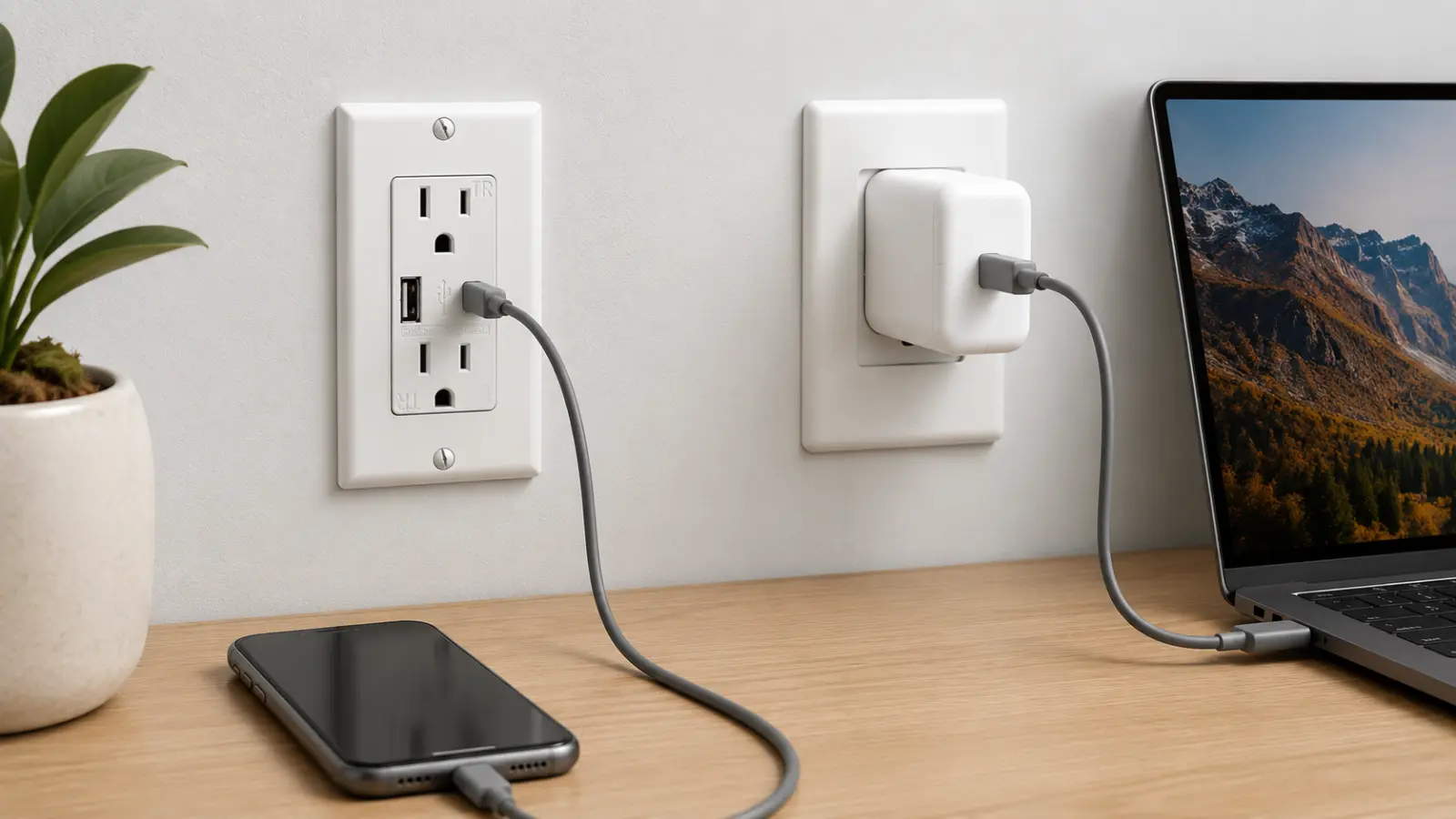
One phone, charged once a day, at home — the outlet and the charger are close to a tie. Nobody needs to be convinced either way. The difference shows up when there are three or four devices in rotation: a phone, a tablet, earbuds, a watch. With chargers, that is a small pile of bricks competing for wall space. With a USB outlet, it is a few cables going straight into the wall, and the two AC slots on the same device still open for everything else.
Travel is the other place it gets obvious. Packing a cable is easier than packing a cable plus a brick — and the brick is the part that gets left behind in a hotel nightstand drawer. A built-in USB outlet at the destination removes that whole problem, which is part of why hotels and serviced apartments have been specifying them as a standard room feature.
So the honest description is narrow: the USB outlet is a convenience layer on top of wiring that is already in the wall, most worth it for people charging several devices in the same spot and least worth it for a single device in a single location.
When I’d still point someone to the charger
There is a real boundary here, and as someone who sells the outlets, I would rather say it plainly than have a buyer find out later.
When the goal is the fastest possible charge, the charger wins. As far as I know, some Android phones — OnePlus and Xiaomi have had 120W adapters — ship or pair with chargers well above what a built-in USB outlet delivers. Laptops come with 140W bricks. Those numbers exist because the device is built around that specific charging profile. For someone who needs a near-empty laptop back to full before a meeting, the original charger is the answer, and a USB outlet is not going to change that.
This is also the cleanest way to hold the two side by side. The charger is the high-output, device-specific tool. The USB outlet is the always-there, good-enough-for-most-things convenience. We make the outlet, not the charger — and the honest position is that both still have a job.
The objections worth taking seriously
A few of the common pushbacks come up often enough that they are worth going through.
One is that a USB outlet costs you an AC slot. It does not — at least not ours. A USB outlet and a standard duplex receptacle both give you two AC outlets; the USB ports are added to the device, not swapped in for an AC slot. The “running out of outlets” complaint usually traces back to a different product style, where USB ports replace one of the AC halves. That design exists, but it is a choice, not a rule.
Charging speed is the objection that used to be fair. When we started building USB outlets in 2014, a dual-USB unit put out about 3.6A total — fine for phones of that era, slow for anything larger, with early ports in the 5V / 2.4A range. That gap is most of why the “USB outlets charge slow” reputation exists. It is also mostly closed now: our current USB-C PD outlets reach 65W, which covers fast charging for most phones and a good share of tablets and lighter laptops. The reputation lagged the hardware — though charging speed still depends on the device and the cable as much as the outlet, which is its own separate topic.
Then there is the worry that USB-A is on its way out, so anything installed now is half-obsolete. There is something to that — USB-C is clearly where devices are heading. But A-to-C and C-to-C cables are both still everywhere, and USB-A cables in particular stay easy to find and cheap to replace. That is the practical reason the A+C combination is still the highest-volume configuration in our USB outlet line: one port for the large installed base of USB-A cables, one port for the fast-charging C devices. We make dual-A and dual-C as well, but A+C is what most buyers order. Where the standard goes after this, I will not pretend to know — there are proprietary fast-charging protocols we already cannot build for, and possibly never will. A USB outlet is a sensible bet on the next several years, not a permanent fixture.
The customer who converted his home and office
In 2021, one of our long-term customers was at the factory for an incoming inspection visit. We had worked together for years by then, mostly over email and WhatsApp, but he came through for inspection fairly regularly.
During one of those visits we were just talking, and he mentioned he had gone and replaced the outlets in his own home and his own office with USB outlets — everywhere except the spots that needed GFCI. His line, half a joke, was that he would never need the charger again in his office and home. He had lost track of where his chargers even were.
I do not take that as proof everyone should do the same. He is one customer, it is his own preference, and he had easy access to the product. But it is a real version of the high end of the use case — someone with a lot of devices, charging in fixed locations, who valued the convenience enough to convert everything. The one downside he raised was honest: a USB outlet costs noticeably more than a plain duplex receptacle. He considered that acceptable for what he got. Another buyer might weigh it differently, and that is a reasonable place to land too.
Where this leaves the question
The USB outlet and the wall charger were never really competing for the same job. The charger is the high-wattage, device-specific tool you reach for when speed matters most. The USB outlet is the convenience built into the wall, and it pays off for the person charging several devices in one place far more than for someone with a single device and a charger that already works fine.
Quick decision rule: when the charging need keeps shifting, when a device has to reach its fastest charging profile, or when whatever is on the wall might need swapping out in a hurry, the plug-in wall charger is the lower-risk choice. The USB wall outlet earns its place where the charging location is fixed — hotel desks, serviced apartments, student housing, offices, a regular charging spot at home — and where the value is convenience: fewer loose adapters, less to misplace, and both AC receptacles left open.
If you are sourcing USB receptacles for a project and want to talk through which configuration fits — A+C, dual-A, or dual-C — our USB outlet range is here.
Technical notes
A few primary sources are worth bookmarking if you want to verify the technical background here. The USB Implementers Forum maintains the USB Power Delivery specification, which now defines power levels up to 240W — far above what a phone or an in-wall outlet actually draws, but the reason a dedicated charger has headroom a built-in outlet does not. On the code side, IAEI Magazine’s breakdown of 2017 NEC 406.3(F) and 406.6(D) explains the distinction between a receptacle with an integral USB charger and a faceplate-style USB charger — two different products that often get discussed as if they were the same thing. And the listing standard itself, UL 498 Supplement SE, covers receptacles with an integral power supply and Class 2 output connectors, which is the evaluation a legitimate USB receptacle is built and tested against.