Last updated: May 2026 · By the ShengYu Engineering Team
As a manufacturer of UL-listed GFCI receptacles, we do not run service trucks. The GFCI outlet wiring patterns we pay attention to do not come from service calls. They come from public troubleshooting threads, electrician discussions, installation comments, and the repeated questions that appear whenever someone replaces a GFCI outlet and the new device will not reset, keeps tripping with nothing plugged in, or appears to have power but is not working.
The instinct is to call the device defective and replace it again.
Usually it is not the device.
Here are the wiring issues that actually create these symptoms: line/load reversal, lost downstream protection, shared-neutral confusion, loose terminations, misleading plug-tester readings, and USB combo outlet behavior that makes a tripped GFCI look like it is still working.
Why a GFCI That Powers On Isn’t Necessarily Wired Right
A GFCI receptacle works by comparing the current flowing out on the hot conductor to the current returning on the neutral. As long as those two values stay within the required trip threshold, the device remains in its reset position. The ground-fault sensing function is built around current balance. It is not a full wiring inspection.
That is the technical reason a “GFCI outlet not working but has power” report is so common. The face may glow green, a plug tester may read “wired correctly,” and the device may still cycle through its own TEST and RESET buttons. None of that proves the GFCI outlet wiring around it is correct, and none of it proves that downstream receptacles are actually protected.
A newer lockout-equipped GFCI may refuse to reset when LINE and LOAD are reversed. A newer self-test GFCI outlet also periodically auto-monitors its ability to provide ground-fault protection. That self-test function is separate from the earlier reverse line-load lockout requirement, but both features can make newer devices behave differently from older units still found in renovation work.
That generation difference matters. A powered face does not always mean correct wiring. A device that refuses to reset is not automatically defective. And a normal-looking downstream outlet may not be protected at all. For terminology background, “GFI” and “GFCI” refer to the same protection category in everyday use, even though GFCI is the better term for specifications and UL references.
Mistake #1: Line and Load Reversed
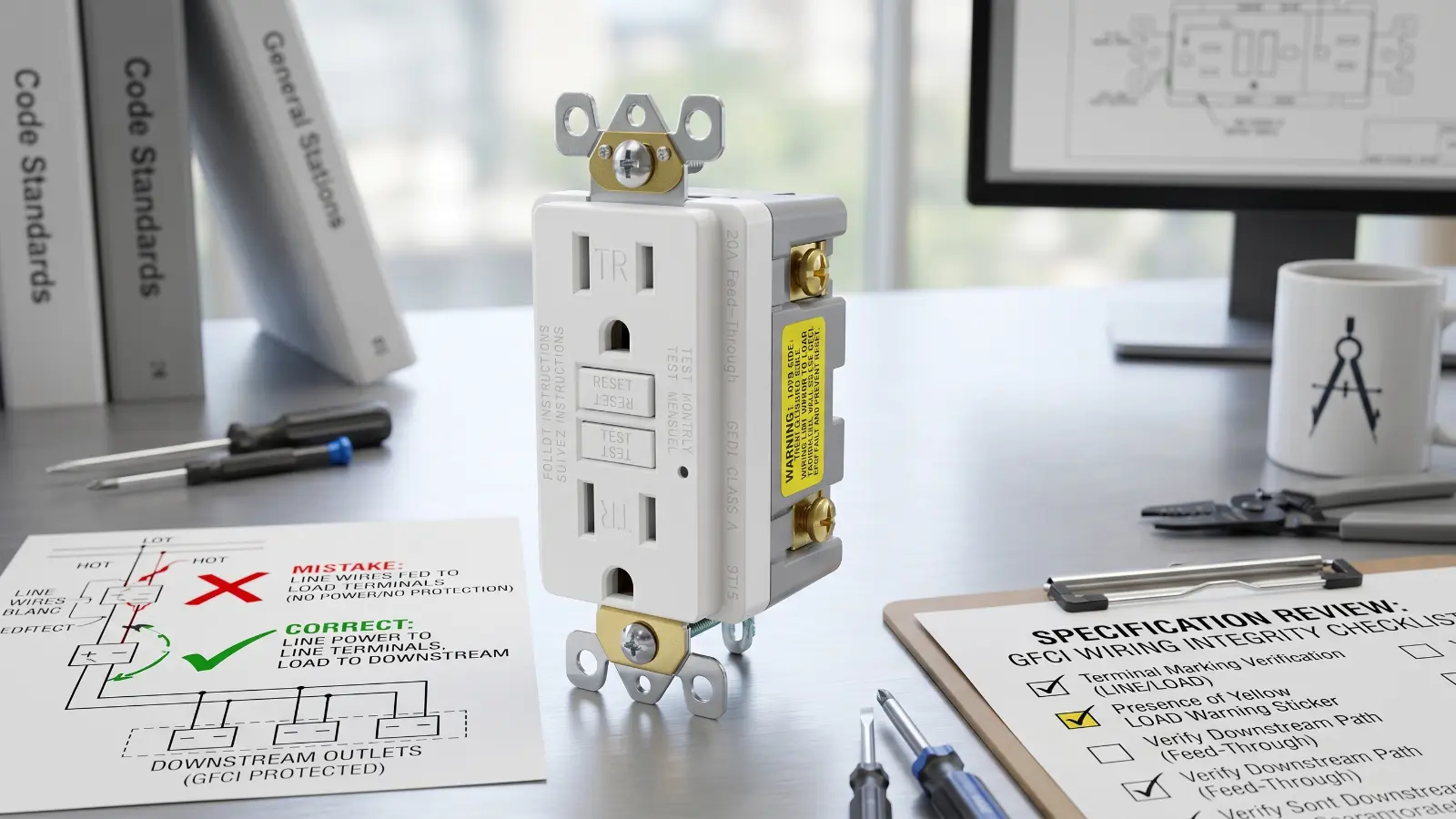
The first set of terminals on the back of a GFCI receptacle is labeled LINE. That is where the supply from the panel connects. The second set is labeled LOAD. That is where downstream receptacles connect if the installer wants those downstream points protected by the same GFCI.
Reversing those two is one of the wiring errors that appears repeatedly in public troubleshooting threads. The GFCI line vs load distinction matters more than it first appears because the symptom changes depending on the device generation.
On older GFCIs made before later UL 943 reverse-miswire requirements, a reversed LINE/LOAD installation could appear more normal than it should. The face may energize. The TEST button may trip it. The RESET button may put it back. What the device cannot do correctly is protect the downstream outlets, because the sensing path is not arranged the way the installation expects. Anyone who relies only on the green light has a false sense of protection on every receptacle past that point.
Later lockout-equipped devices are designed to deny reset or deny power when the supply is connected to the wrong terminal set. The symptom may be described simply as “the GFCI outlet won’t reset.” In that case, refusal to reset is not automatically a defect. It may be the device preventing a miswired installation from being treated as safe.
For a qualified electrician, distinguishing LINE from LOAD starts with de-energizing the circuit and verifying absence of voltage with an appropriate tester before the device is pulled from the box. The cable feeding from the panel belongs on LINE. Any cable intended to protect downstream receptacles belongs on LOAD.
Older units that “still work” when reversed are the more dangerous of the two. The device tells you nothing is wrong.
What We Can Verify Before the GFCI Leaves the Factory
A manufacturer cannot verify how a GFCI will be wired in the field. It belongs to the installer and, the location where inspection is involved, the AHJ. What we can verify is the device and the documentation package before it leaves the factory.
- Device marking: LINE and LOAD terminal areas are clearly identified on the device body.
- LOAD terminal warning: the LOAD side is covered before installation so it is not used as a continuation point by mistake.
- Package documentation: the box includes wiring instructions, a diagram, and “GFCI Protected” labels.
- Function check: TEST and RESET behavior was checked during production inspection according to the product test process.
- Traceability: the product is tied to a UL/cUL file and the correct product category.
Those checks do not replace field verification. We can only reduce the chance that a wiring mistake starts with unclear product marking or missing documents.
Mistake #2: Assuming Downstream Receptacles Are Protected
A single GFCI receptacle at the first position of a branch circuit can protect standard outlets downstream. But only if the downstream cables are connected to the LOAD terminals of that GFCI. The protection is not inherent to the location of the device. It depends on which terminal set the downstream conductors landed on.
This is where many homeowners get caught. A standard outlet two rooms over looks identical whether it is a GFCI protected outlet through feed-through wiring or completely outside any GFCI’s reach. The NEC requires “GFCI Protected” and “No Equipment Ground” marking in one specific replacement condition: when a non-grounding receptacle is replaced with a grounding-type receptacle supplied through GFCI protection in older wiring without an equipment ground.
Outside that specific NEC replacement condition, a “GFCI Protected” label is not always a code trigger, but it is still useful project documentation when downstream protection depends on an upstream GFCI. Without that label, the next renovation cycle often loses the protection map.
When this matters: home inspections, real estate transactions, rental-unit turnover, and AHJ review. Pressing the TEST button on the upstream GFCI and confirming which downstream outlets lose power is the practical way to map protection. Visual inspection alone catches nothing. A GFCI protected outlet has no reset button of its own, so it appears identical to an unprotected one.
Two failure modes look almost the same from the outside. First, the downstream receptacles were never connected to LOAD. Second, LINE and LOAD were reversed on the upstream GFCI, so downstream outlets continue to deliver power without the intended protection. Both can sit unnoticed because the face of the GFCI looks normal.
Mistake #3: When a GFCI Shares a Neutral with Another Circuit
In some older homes — and in some kitchen or laundry layouts — two 120-volt circuits may share a single neutral conductor back to the panel. Electricians call this arrangement a multi-wire branch circuit, or MWBC. The GFCI receptacle does not know why the neutral is shared. It only sees whether the current returning through its sensing path matches the current it sent out.
The problem is not that a GFCI can never be supplied by a multi-wire branch circuit. The problem appears when a shared neutral is carried through the LOAD side, or when downstream neutrals from more than one circuit are tied together after the GFCI. Then the current returning through the GFCI no longer matches the current it sent out, so the device trips.
From the user’s side, the symptom is simple: the GFCI outlet keeps tripping with nothing plugged in.
A kitchen is one place where this confusion can show up. A garbage disposal switch and a small-appliance receptacle may share a 2-gang box. If neutral paths are mixed after a GFCI device, the GFCI can trip every time the other load operates. The device is not defective. It is reporting a current imbalance created by the wiring path.
The same issue can appear anywhere downstream neutrals are mixed after the GFCI, especially in older boxes where more than one circuit passes through the same enclosure.
The repair path belongs to a qualified electrician and, where inspection is involved, the AHJ. The point for troubleshooting is simpler: if the trip only appears after downstream wiring is connected, another receptacle replacement is usually the wrong first move. The wiring path has to be isolated.
In MWBC work, electricians may evaluate a 2-pole GFCI breaker at the panel or a layout that keeps shared neutrals off the GFCI LOAD side. Which path is acceptable depends on the actual circuit and local inspection requirements. For full kitchen retrofits where the wiring cannot be easily separated, a 2-pole GFCI breaker may be the more practical direction. Another nuisance-trip pattern with a different mechanism appears on HVAC circuits with high-frequency motor loads, which is worth separating from wiring-path mistakes because the symptom can look similar from the user’s side.
Mistake #4: Hot and Neutral Reversed — Not the Same as Line/Load
The terms get confused, but these are two different mistakes. Line/load reversal swaps which terminal set receives supply power. Hot/neutral reversal swaps which conductor — black or white — lands on which screw within the correct terminal set. The wiring can look superficially similar to someone who has not learned the distinction.
A GFCI with hot and neutral reversed may still trip and reset normally because the ground-fault sensing function compares current between the two conductors. What changes is the wiring condition around the device. A plug-in tester may flag “hot/neutral reversed.” Some equipment may behave unpredictably. A related upstream condition, such as an open neutral or open ground, can also produce a confusing tester reading at a downstream receptacle that appears correct at its own terminals.
The diagnostic value is real. If a newly installed GFCI sometimes trips and sometimes will not reset, with no clear pattern, polarity reversal is one wiring condition to rule out before assuming the device has failed. A qualified electrician can separate hot/neutral reversal from line/load reversal by checking voltage relationships between hot-neutral, hot-ground, and neutral-ground.
Mistake #5: Loose Connections Behind the GFCI
The wires connecting to a GFCI can fail mechanically in ways the electrical test buttons do not catch. Most North American receptacles, including many GFCIs, support more than one termination method. One is the side-wire screw, where the conductor wraps around a screw and is clamped under the screw head. Another is a back-wire entry, where the conductor enters a hole on the back of the device.
The back-wire category itself splits into two mechanisms that are easy to confuse. The first is clamp-style back wiring, where a metal plate inside the device is pulled down against the conductor by tightening the side screw. The second is spring-only push-in termination, where a thin spring clip retains the wire without screw tightening. Both use a hole on the back of the receptacle. Only one uses a screw to maintain mechanical pressure.
The failure mode shows up over time. Heating and cooling cycles, plug insertion and removal, and vibration in walls can loosen weak terminations. The contact area shrinks. Resistance climbs. Heat builds at the connection point. Then the symptoms appear: outlets that feel warm, downstream outlets that lose power randomly, GFCIs that trip after months of normal operation, or a device that tests fine on the bench because the failure is in the conductor termination rather than the receptacle electronics.
GFCIs with back and side wire support give the installer a choice. Clamp-style back wiring can provide a positive mechanical pull-down when the conductor gauge fits the device specification. Side wiring gives a direct screw-clamp path. Either is a more controlled termination method than relying on a spring-only push-in connection on a circuit that sees regular use.
Mistake #6: When the Plug Tester Lies
The three-light plug-in tester is a useful first-pass diagnostic, but it carries a known limit. It uses three indicator lamps lit in different combinations to flag conditions such as “open ground,” “hot-neutral reversed,” or “hot-ground reversed.” Several distinct fault conditions can produce the same light pattern, and a GFCI plug tester gives no way to distinguish which condition is actually present.
One false positive worth knowing: a high-resistance neutral splice somewhere upstream of the receptacle being tested. The tester may read voltage between hot and ground but see an unusual neutral voltage, then light up as “hot-ground reversed” even though the conductors at the tested receptacle are correctly placed.
Replacing the GFCI in response to that reading fixes nothing. The actual fault may be at a wire-nut splice in a junction box one or two outlets back. The new GFCI then shows the same tester reading and gets replaced again. The receptacle was not the problem and is not the solution.
The diagnostic upgrade is a multimeter and a wiring-path check. Direct voltage measurements between hot-neutral, hot-ground, and neutral-ground at the receptacle terminals can separate a wiring fault at the device from a splice fault upstream. The plug tester is a starting point, not an endpoint.
Mistake #7: USB Combo Outlets and the “It’s Still Working” Confusion
A combination GFCI with USB charging ports is increasingly common in kitchens, hotels, bathrooms, and hospitality renovation projects. The wiring point many installers and homeowners miss is internal: how the USB module gets its power affects what the device looks like when the GFCI portion trips.
In some new designs, such as a GFCI with USB module, the USB ports are tapped from the LINE side of the GFCI. That means the USB ports can keep delivering power even when the GFCI has tripped and the AC outlets on the same face are dead. The user sees a phone charging through USB and assumes the device is working, sometimes not realizing the GFCI has been tripped for hours.
In other designs, the USB module is fed through the LOAD side, and USB power cuts when the GFCI trips. Different manufacturers make different choices for different reasons — charging continuity in one case, simpler internal layout in another.
For diagnostics, never use the USB ports as a signal of GFCI status. Press TEST and watch the AC outlets specifically.
A Safer Field Check Sequence Before Replacing the GFCI
Before assuming the receptacle is defective, the wiring side should be checked first. The following sequence is what a qualified electrician would verify, ordered so the lower-risk checks come before the ones that require pulling conductors out of the box.
- Step 1: If the GFCI outlet will not reset on first energization, LINE/LOAD reversal at the device is one of the first wiring conditions to verify. A GFCI outlet not resetting after installation is often a wiring symptom rather than proof of a defective device.
- Step 2: With the circuit de-energized and verified, the cable returning to the panel should land on LINE; any cable continuing to downstream receptacles should land on LOAD. These positions should be checked against the markings printed on the device back.
- Step 3: Each conductor termination should be inspected. Side-wire screws should be tightened down on cleanly stripped copper. Back-wire clamp connections should hold the conductor firmly when the screw is fully tightened. No loose strands, no over-stripped insulation.
- Step 4: Multimeter measurements between hot-neutral, hot-ground, and neutral-ground at the device terminals should fall within expected ranges. A plug-in tester alone is not enough to rule out an upstream splice fault.
- Step 5: After re-energization, pressing TEST and then RESET should produce a clean cycle. If the GFCI outlet keeps tripping after reset with nothing plugged in, the next place to look is the shared-neutral or splice scenarios described above — not the device.
If all five steps pass and the device still misbehaves, device replacement becomes the reasonable next step. If the problem appears only after LOAD wiring is reconnected, the next step is usually circuit isolation rather than another replacement device.
| Symptom | Likely Wiring Area to Check | Why Replacing the GFCI May Not Help |
|---|---|---|
| New GFCI will not reset | LINE/LOAD position, supply power, lockout behavior | A newer device refuse reset because the wiring path is wrong. |
| Downstream outlet has power but no known protection | LOAD-side feed-through and protection labeling | The upstream GFCI may not actually be feeding the downstream outlet through LOAD. |
| GFCI trips when another load operates | Shared neutral or mixed downstream neutrals | The device is reacting to current imbalance, not failing internally. |
| Plug tester gives a confusing reading | Upstream splice, open neutral, open ground, polarity | The tester cannot see the whole wiring path behind the device. |
Frequently Asked Questions About GFCI Outlet Wiring Mistakes
What happens if LINE and LOAD are reversed on a GFCI outlet?
On a modern lockout-equipped GFCI, the device may refuse to reset or may deny power when the supply is connected to the LOAD terminals. On some older devices, the face may appear to work even though downstream receptacles are not protected as intended. That is why GFCI line vs load is more than a label issue.
Why will a new GFCI outlet not reset?
A new GFCI outlet that will not reset is not automatically defective. Common causes include missing supply power, LINE/LOAD reversal, a downstream fault connected to LOAD, or lockout behavior on a newer device. The wiring path should be verified before the receptacle is replaced again.
Can one GFCI protect outlets downstream?
Yes, one GFCI receptacle can protect downstream receptacles when the downstream cable is connected to the GFCI LOAD terminals. If the downstream cable is connected to LINE, or if LINE and LOAD are reversed, downstream protection may not exist even though the outlets still have power.
Why does my GFCI keep tripping with nothing plugged in?
If the GFCI keeps tripping with nothing plugged into the face, the problem may be downstream. Shared neutrals, mixed downstream neutrals, moisture, damaged cable, or a splice fault can all create an imbalance that the GFCI detects. Removing the load from the face does not remove every load from the protected wiring path.
Can a plug tester prove a GFCI is wired correctly?
No. A plug tester is useful for first-pass checks, but it cannot fully verify the wiring path behind the device or downstream protection. Different wiring faults can produce similar light patterns. A multimeter check and a wiring-path inspection are needed when the symptoms do not match the tester reading.
Should USB ports still work after a GFCI trips?
It depends on how the GFCI/USB combo device is internally designed. If the USB module is powered from the LINE side, USB charging may continue after the GFCI has tripped. If it is powered through the protected side, USB power may shut off with the AC outlets. USB charging should not be used as proof that the GFCI is reset or protecting the receptacle face.
What This Tells You About Replacing vs Rewiring a GFCI Outlet
The GFCI device is the loudest part of the circuit. It has the buttons, the indicator light, and the test sequence. So it gets the blame when something goes wrong.
On a newly installed receptacle that shows these symptoms immediately after replacement, the device may be doing exactly what it was designed to do. The wiring around it deserves the first check.
When the diagnostic order starts at the wiring — LINE/LOAD position, shared neutrals, terminal tightness, splice integrity — and only then considers replacing the receptacle, repeated replacement usually becomes unnecessary. The useful question is not “which GFCI should I buy next?” It is “what condition is this GFCI responding to?”
Need UL/cUL Listed GFCI Receptacles for North American Projects?
ShengYu supplies GFCI receptacles in 15A, 20A, WR, TR, slim body, self-test, and GFCI with USB configurations for project sourcing and distributor programs.
Related articles on this site
- GFI vs GFCI: Same Thing or Different? Why Electricians Use Both Terms
- GFCI Breaker vs GFCI Outlet: How Contractors and Property Managers Should Choose
- Why USB Ports Stay Powered After a GFCI Trip: Line-Side vs Load-Side Combo Outlet Design
- HVAC GFCI Nuisance Tripping in 2026: HF GFCIs, Class C SPGFCIs, and the NEC 210.8(F) Deadline
Related product links
Sources and references
Primary
- U.S. Consumer Product Safety Commission: GFCI Fact Sheet
- OSHA: Ground-Fault Circuit Interrupters
- UL Solutions: GFCI Personal Protection Devices Testing and Certification
- IAEI UL Question Corner: Self-Testing GFCI Requirements
- UL Code Authorities: GFCI Reverse Line-Load Miswire Requirements
- NFPA 70: National Electrical Code, 2026 Edition
Supporting