In April 2026, a buyer reached us on WhatsApp with a short request: “15A receptacle.” That was enough for us to start a quote. On our line, a bare 15A request means a normal receptacle without TR or WR. If no color is stated, we quote white. Decorator style has to be requested.
The buyer then sent a product photo and asked what WR meant. He also asked whether a WR receptacle would include TR. Nothing in that first message had answered either question. “15A receptacle” had identified the rating, but it had not identified the whole SKU.
For a standard duplex receptacle, we prefer to lock the specification by separate fields. Ampere rating, grade, TR/WR, face style and terminal type do different jobs. When those fields are merged into one short product label, quote differences surface later in samples, submittals or packing.
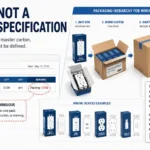
Our defaults help us quote, but they are not a universal specification
A factory needs defaults or every short inquiry turns into a long questionnaire. Our default for an unspecified 15A receptacle is simple: normal face, no TR, no WR and white color. A 20A request means a 5-20R configuration on our line. A decorator face is quoted only when the buyer asks for it.
Those are ShengYu quoting rules rather than NEC language, NEMA definitions or a rule another supplier has to follow. Two suppliers can therefore answer the same short RFQ with two different products while both feel they answered correctly.
We do not infer grade from a hotel, office, apartment or other project label. If the order requires our commercial/spec line, the buyer needs to state that grade. The same rule applies to terminal type when the RFQ needs a particular connection method.
From a short RFQ, we cannot determine which code edition the project location has adopted. We specify and manufacture receptacles; we do not decide field installation or AHJ acceptance.
| Short RFQ | Our default quote | What is still open |
|---|---|---|
| 15A receptacle | 15A normal receptacle, non-TR, non-WR, white | Grade, face style, terminal type, WR/TR requirement, final model |
| 20A receptacle | 20A receptacle with 5-20R face configuration | Grade, face style, terminal type, TR/WR, color, final model |
The face gives useful clues, then the specification moves inside
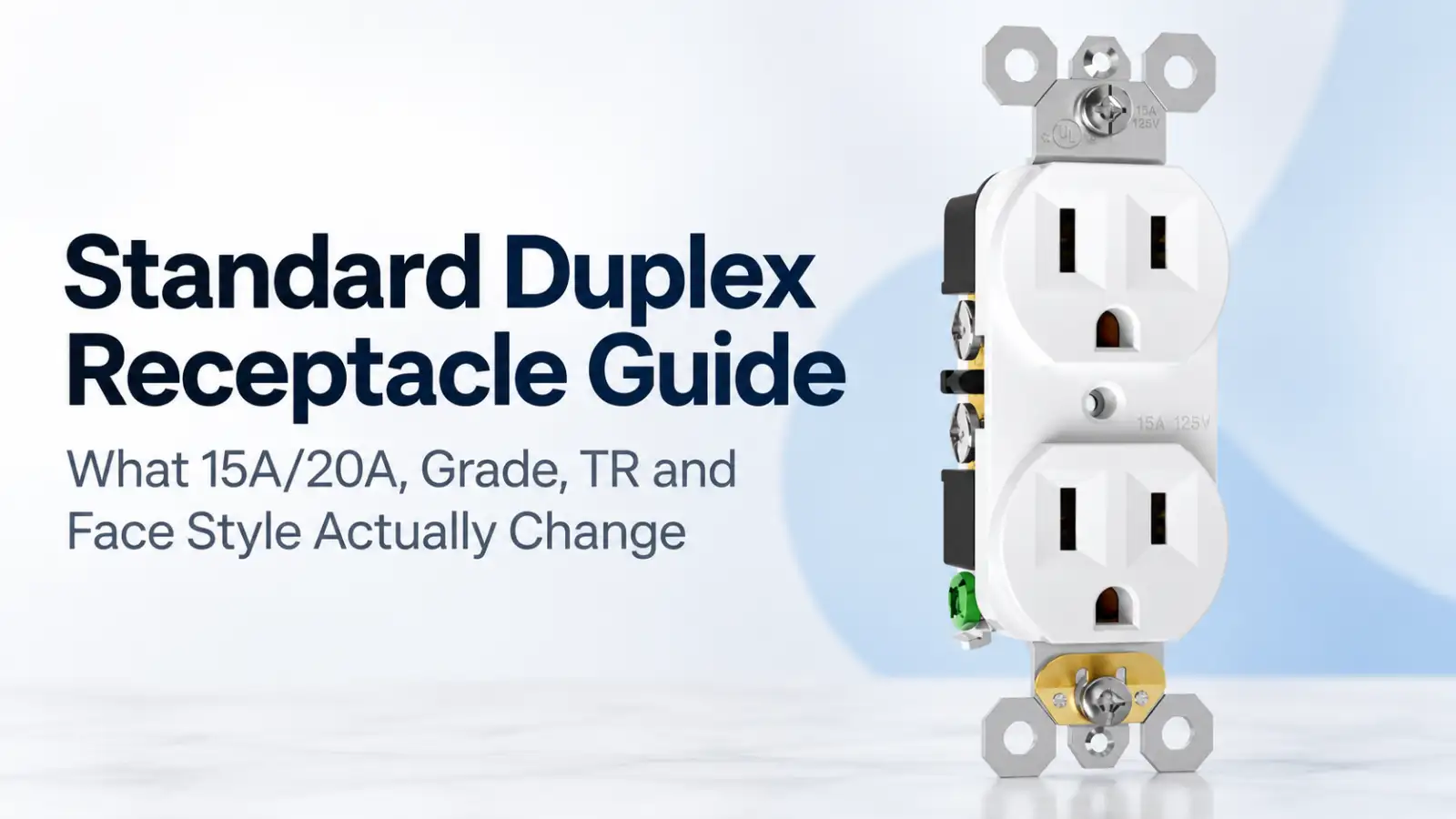
The front of a receptacle settles some questions quickly. A 5-20R face is easy to recognize by the T-slot. A 5-15R face does not have that 20A slot pattern. NEMA WD 6 provides the dimensional framework behind those configurations.
On our standard duplex line, the 15A and 20A products use the same main mold family. The face is different because the 20A version needs the T-slot. Apart from that face change, the terminals, screws, grounding strap and yoke are basically shared.
We also use the same copper thickness for the 15A and 20A internal current path. That is a ShengYu construction choice, not a claim about every receptacle on the market.
The face does not identify grade. It does not tell a buyer which terminal architecture is inside. It also does not settle whether a standard-looking unit is TR unless the applicable marking and model information are visible.
A 15A face and a 20A pass-through path answer different questions
The 15A-on-a-20A-circuit question becomes confusing when the face rating and the terminal path are treated as one number. NEMA WD 11-2023 separates them.
NEMA states that 15A receptacles are tested and UL Listed to carry 20A from terminal to terminal. This supports pass-through use on a 20A branch circuit. The part that interfaces with the plug remains evaluated for a 15A plug.
A visible 5-15R face therefore describes the plug interface. It does not describe every current path behind the device.
On our line, that public rule aligns with a practical design choice. Our 15A and 20A standard duplex receptacles use the same copper thickness in the internal path. The supporting hardware described above is shared as well. The 20A unit changes the face to the 5-20R T-slot configuration.
A standard duplex receptacle is really a stack of separate specification fields
A product title can make these fields look like one ladder, even though the SKU structure keeps them separate.
| Field | What it changes | What it does not settle | ShengYu note |
|---|---|---|---|
| 15A / 20A | Rating and NEMA face configuration | Grade, TR/WR, face style family, terminal type | 20A means 5-20R on our line |
| Grade | Product line, material and test requirement level | Amp rating, TR/WR, face style, terminal type | Separate basic/residential and commercial/spec lines |
| TR / WR | Protective feature set | Amp rating, grade, terminal type | WR variants on our line are supplied with TR |
| Standard / Decorator face | Face format and matching wallplate opening | Amp rating, grade, TR/WR, terminal type | Internal electrical mechanism is the same on our line |
| Terminal type | Installation method and SKU | Amp rating, grade and face style | Side-wire, back-wire clamp and push-in/backstab are separate SKUs |
Public manufacturer catalogs show the same separation. Product pages from Leviton and Eaton list amperage, grade, tamper resistance, style and wiring method as separate specifications rather than as one merged label.
“Commercial grade” still needs a manufacturer-specific definition
Grade needs extra caution in a quote. NEMA WD 11-2023 says NEMA does not classify “specification grade,” “construction grade” or “commercial grade” receptacles. It also says those terms do not have technically standardized definitions across manufacturers.
That wording changes how we handle the phrase. A buyer asking for “commercial grade” has given us a product-line requirement, but not a universal construction recipe.
ShengYu has a residential/basic line and a commercial/spec line. The commercial/spec line uses higher material requirements and higher test requirements. We quote it as a separate line rather than upgrading an ordinary 15A or 20A item by assumption.
Cost follows the construction and order requirements behind that line. Copper thickness is a major material cost driver for us. Certification scope, test requirements, plastic requirements and packaging can also change cost. Individual blister packaging, for example, carries a different packing cost from a simpler bulk format.
Leaving grade undefined can create a mismatch when the buyer and supplier attach different construction requirements to the same label.
TR adds a shutter assembly; it does not rebuild the electrical core on our line
Our TR shutter components are injection-molded and assembled in-house. A spring-linked mechanism requires both sides to be engaged before the shutters open. Adding TR gives the receptacle one extra mechanical assembly step.
The electrical mechanism behind that shutter does not change on our line. Device depth does not change because TR was added. The rating also stays a separate field, so a 15A TR receptacle is still a 15A receptacle.
We perform a manual insertion check after assembly. The check confirms that the shutter opens as intended when both sides are engaged. We do not use a separate numeric shutter-force rejection value in this process.
We have not had a customer complaint that a ShengYu TR receptacle could not accept a plug. That point is only our own service record; it is not a market-wide claim.
WR and TR are separate ideas, but our WR SKU already includes TR
In that April WhatsApp thread, the WR question came after the 15A quote. The ampere rating alone had not settled the orderable combination.
On our receptacle line, WR versions are supplied with TR. We therefore quote the combination as TR+WR rather than a WR-only version. This is a ShengYu portfolio rule, so we do not present it as a universal naming rule for every manufacturer.
The project still needs the correct ampere rating, face style, grade and terminal choice. Adding WR does not select those fields.
Standard and decorator faces can share the same electrical core
On our line, the standard duplex and decorator-style versions use the same internal electrical mechanism. The face changes. The rectangular decorator format also changes the matching wallplate opening.
A buyer who writes “15A decorator receptacle” has specified more than “15A receptacle,” but the line still lacks TR/WR, grade and terminal information. The face narrows the SKU tree; it does not finish it.
Terminal type can change the SKU even when the front looks identical
We offer side-wire, back-wire clamp and push-in/backstab terminal options across the receptacle line. They are handled as different SKUs.
Two white 15A TR receptacles can look identical from the front and still be different SKUs because the termination method is different.
For projects that have already fixed the installation method, we prefer to state the terminal type in the order line. It removes one more place where two visually similar products can diverge.
The exact SKU has to survive production and packing
Once the specification is complete, the same fields have to remain intact through production. Our device marking carries the ampere rating, 125V rating, TR marking where applicable, UL number and model number.
We run one SKU on one production line. The packing check includes a second look for a wrong variant mixed into that run. That extra check matters when 15A and 20A bodies share many parts, or when TR and non-TR versions look similar from the front.
The carton label adds another layer. It includes quantity, the customer SKU and gross and net weight. The goal is to keep the commercial order line tied to the physical device and the shipping carton.
| Control point | What is checked |
|---|---|
| Device marking | 15A/20A, 125V, TR where applicable, UL number, model number |
| Production line | One SKU per line |
| Packing check | Wrong variant mixed into the run |
| Carton label | Quantity, customer SKU, gross weight, net weight |
Rebuilding the April WhatsApp request
The original request was simply “15A receptacle.” Under our default quoting practice, that led to a normal white 15A receptacle without TR or WR. The buyer’s later WR question showed which part of the specification still needed explanation.
If the same request had to become a complete order line, we would confirm the visible rating and face. Then we would add the fields that change the SKU. The sequence would cover NEMA configuration, standard or decorator face, TR/WR, grade, terminal type, color and the final model.
A finished line could therefore look like this:
15A, 125V, NEMA 5-15R duplex receptacle, commercial/spec line, TR, standard face, back-wire clamp, white, model _____
That is the point where a standard duplex receptacle becomes usable procurement data rather than a broad product name.
FAQ
Can a 15A receptacle be used as a pass-through device on a 20A branch circuit?
Yes. NEMA WD 11-2023 states that 15A receptacles are tested and UL Listed to carry 20A from terminal to terminal for pass-through use. The plug interface remains a 15A interface.
Does “commercial grade” always describe the same construction?
No. NEMA says “commercial grade,” “construction grade” and “specification grade” are not technically standardized definitions across manufacturers. Buyers have to read the grade together with the manufacturer’s actual product line and model data.
Does WR include TR?
On our receptacle line, yes. Our WR variants are supplied with TR.
Is a decorator receptacle electrically different from a standard duplex receptacle?
On ShengYu’s line, the internal electrical mechanism is the same. The face format changes, and the matching wallplate opening changes with it.
Sources and Internal Basis
External Sources
- NEMA WD 11-2023, Wiring Devices: Frequently Asked Questions. Used for 15A terminal-to-terminal 20A pass-through, the non-standardized meaning of commercial/specification/construction grade, and configuration/marking guidance:
NEMA WD 11-2023 PDF - NEMA, Electrical Standards & Products Guide. Used as the public source pointing to ANSI/NEMA WD 6 for plug, receptacle and wallplate dimensional standards:
NEMA Electrical Standards & Products Guide PDF - UL Solutions, Attachment Plug and Receptacle Safety Evaluations. Used for the UL 498 product-safety evaluation scope:
UL Attachment Plug and Receptacle Safety Evaluations - Leviton product pages DTC15 and DTC20. Used as public catalog evidence that amperage, NEMA configuration, grade, TR and style are listed as separate specification fields:
Leviton DTC15 |
Leviton DTC20 - Eaton TR6252CDW product page. Used as public catalog evidence for separate fields such as amperage rating, device grade, features, wiring method, style type and NEMA configuration:
Eaton TR6252CDW
Internal Basis
- ShengYu quoting defaults — 15A receptacle defaults to normal non-TR, non-WR and white; 20A defaults to 5-20R; decorator face must be requested.
- ShengYu standard duplex construction — 15A and 20A versions share the main mold family and most supporting hardware; the 20A version changes the face to the T-slot configuration.
- ShengYu current-path construction — 15A and 20A standard duplex receptacles use the same copper thickness in the internal path.
- ShengYu product-line boundary — residential/basic and commercial/spec are separate product lines with different material and test requirements.
- ShengYu TR construction — shutter components are injection-molded and assembled in-house; TR adds one shutter assembly step and does not change the internal electrical core on our line.
- ShengYu WR portfolio rule — WR variants are supplied with TR.
- ShengYu face-style construction — standard duplex and decorator versions share the same internal electrical mechanism on our line.
- ShengYu terminal options — side-wire, back-wire clamp and push-in/backstab are handled as separate SKUs.
- ShengYu production and packing control — one SKU per line, with device marking and carton-label checks used to prevent the wrong variant from being mixed into a shipment.
Need the exact receptacle combination, not just the product family?
ShengYu supplies UL and cUL listed receptacles, GFCIs, USB outlets, switches and wallplates for North American buyers. If your RFQ already includes rating, grade, TR/WR and terminal requirements, we can review it model by model. →
Contact ShengYu