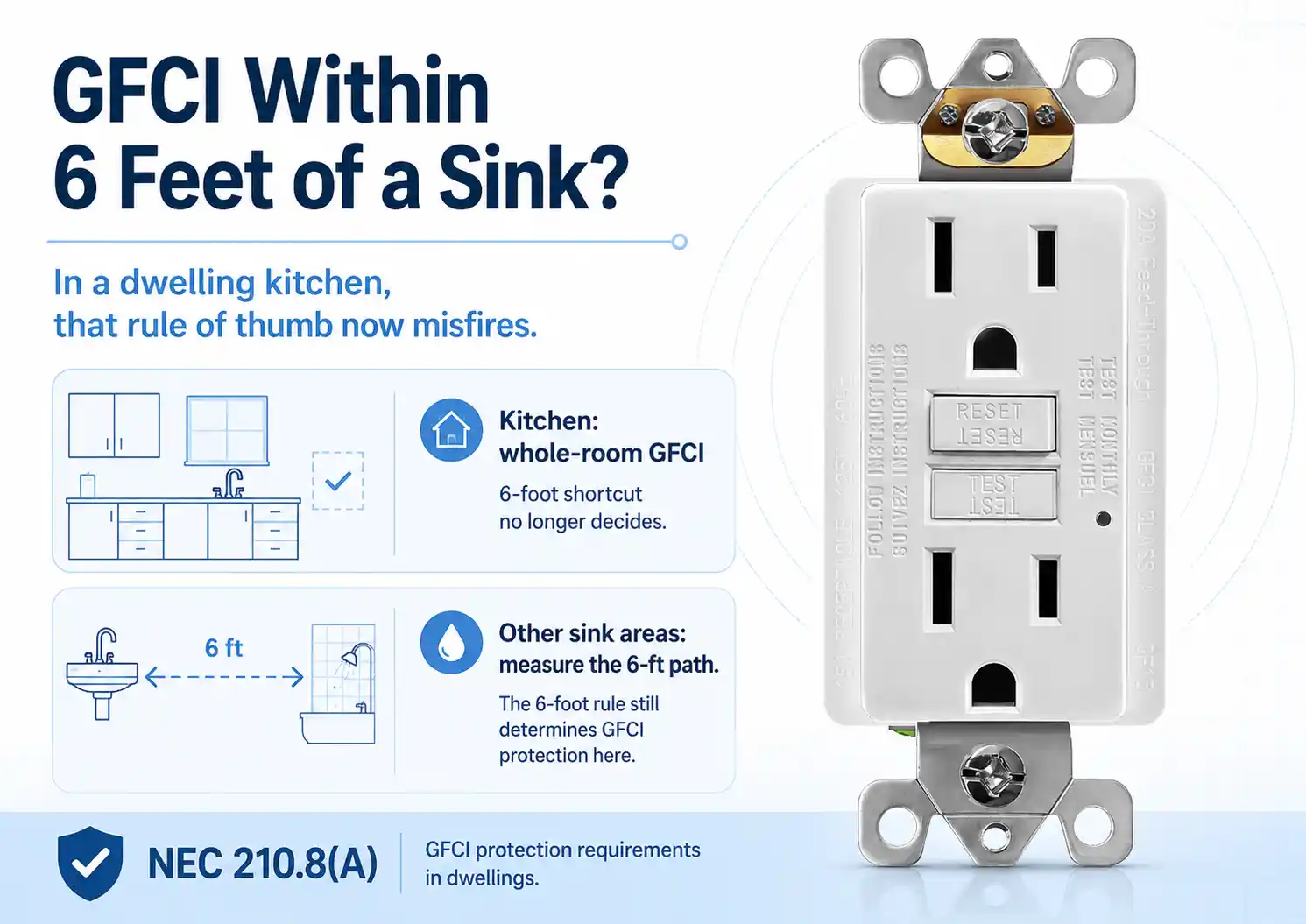
Three facts up front, because the rest of this hangs on them. Under an adopted 2023 NEC reading, a dwelling kitchen needs GFCI on every 125–250V receptacle within the 210.8(A) scope and distance from the sink no longer exempts anything in that room. The six-foot rule still exists, but it only triggers where a sink, a bathtub, or a shower is involved — it was never a general outlet rule. And that six feet is measured along the shortest path a cord would travel, stopped by any wall, doorway, or fixed barrier, starting from the top inside edge of the sink bowl.
I sell receptacles to wholesalers, builders, and retailers. I don’t measure anyone’s sink and I don’t wire anyone’s wall. The reason I’m writing this from the buyer’s chair is that a wrong reading of “six feet” doesn’t start or stop with me — it gets handed down a line, and I’m the layer in the middle that either catches it or passes it along. Here’s the whole handoff.
The line starts with a rule of thumb
The phrase I hear behind a lot of orders is some version of: “it’s more than six feet from the sink, so it doesn’t need GFCI.” For years that was a usable shortcut in a kitchen. It isn’t anymore.
The 2023 NEC deleted the words “where the receptacles are installed to serve the countertop surfaces” from 210.8(A)(6). With that phrase gone, every receptacle in a dwelling kitchen needs GFCI protection — countertop or not, six inches from the sink or sixteen feet from it. The tape measure stopped deciding anything inside that room. The trouble is that the old shortcut still gets spoken out loud at the planning stage, and it rides the order upstream to me.
What “six feet” actually governs, once it leaves the kitchen
This is the part most outlet guides skip, and it’s the part that decides a schedule. The six-foot measurement is not a property of an outlet and it is not a general rule. It only comes into play when a sink, a bathtub, or a shower is in the picture. Take those away and six feet governs nothing.
So the same number reads differently the moment the room name changes:
| Location | Does the 6-foot tape decide? | How it’s actually judged | What goes on the spec line |
|---|---|---|---|
| Dwelling kitchen | No | Whole room — every 125–250V receptacle is GFCI | GFCI (often TR) on every kitchen device |
| Bathroom | No | All receptacles GFCI | GFCI, TR |
| Wet bar, laundry sink, basement bar, vanity | Yes | Within 6 ft of the sink bowl | GFCI where the 6-foot path reaches the outlet |
| Garage, outdoors | No | By location, not distance | GFCI, and WR outdoors |
A buyer who treats “six feet” as the master switch gets two rooms wrong at once: the kitchen, where the distance no longer matters, and the garage or outdoor run, where it never did. The number only earns its keep in that third row — a sink or tub present, no whole-room rule overriding it.
How the six feet is measured, when it does apply
When the six-foot rule is in play, it isn’t a straight tape line through the cabinetry. The code measures it as the shortest path the cord would follow without piercing a floor, wall, ceiling, or fixed barrier, and without passing through a doorway or window. The clock starts at the top inside edge of the sink bowl — for a bathtub or shower, at the outside edge — and “within six feet” includes six feet exactly.
What that means in practice: a receptacle that’s four feet from the bowl in a straight line, but on the far side of a full-height wall the cord would have to route around, can fall outside the six feet. A fixed barrier breaks the path. I can’t make that call from a purchase order, and neither can the factory — it’s a site judgment that belongs to whoever’s standing in the room with the plans. What I can do is not pretend the spec line answers it.
The appliance outlets that ride the mistake
The shortcut does the most damage on appliances, because that’s where “it’s a dedicated circuit, it’s exempt” stacks on top of “it’s far from the sink.” Inside a 2023 kitchen, neither excuse survives. The refrigerator receptacle behind the fridge, the dishwasher and disposal receptacles under the counter, the microwave outlet — all of them need GFCI now, regardless of distance, and the fridge outlet is the one inspectors catch most. Dishwasher receptacles have needed GFCI since the 2014 cycle; the 2023 change swept in the rest.
Outside the kitchen, those same appliances go back to the location test: GFCI if they’re within the six-foot path of a sink, or in a garage or basement that calls for it on its own. So “does the fridge outlet need GFCI” has no single answer — it depends entirely on which room the fridge is standing in. A buyer pricing a multi-unit job has to split the appliance line by room, not by appliance.
The code asks for protection; the PO has to name the method
One more place the order can go sideways: 210.8 requires GFCI protection, not a GFCI receptacle at every point. The protection can come from a GFCI receptacle at the outlet, or from one GFCI feeding the receptacles wired downstream of it on its LOAD side. A single device can cover several ordinary outlets behind it when it’s wired that way — which is the line-side versus load-side architecture that decides what’s actually protected, and the downstream-count question that decides how many GFCI faces a circuit really needs. There are breaker-based ways to provide the same protection at the panel; those are an installer and AHJ call, not something I’d quote into a receptacle line.
By the time it reaches me, the spec is the spec
Here’s the end of the line, my end. When an order lands, I quote and ship what the spec says — “15A self-test TR GFCI,” or “15A self-test TR-WR GFCI,” at whatever quantity. I don’t reinterpret the room behind the line. If the schedule named a standard receptacle for a kitchen device because someone counted past six feet, the carton I send out matches the line, clears my dock, and gets red-tagged at the wall — then comes back to my shelf as the wrong stock, electrically fine and useless for the job.
That’s the honest boundary of what a supplier controls. We supply the listed GFCI device the spec names and we mark it correctly; we don’t decide whether a wall counts as inside six feet, and we don’t decide which NEC edition the local jurisdiction enforces. Adoption varies, and a kitchen quoted against the 2020 edition reads differently than the same kitchen under 2023. So the field where this gets fixed isn’t my dock and it isn’t the jobsite — it’s the spec line, before the order is placed. The factory can only execute a wrong field faithfully.
Break the line at the schedule
The cheapest place to stop a bad reading is the schedule, before a single carton is built. Walk it room by room, not outlet by outlet. Is this a kitchen or bathroom — then it’s whole-room GFCI, and the tape measure doesn’t enter into it. Is there a sink, tub, or shower and no whole-room rule — then the six-foot path decides, measured from the bowl’s top inside edge. Garage or outdoor — GFCI by location, WR outdoors. Then write the device fields the location earned: GFCI, TR where the room requires it, WR outdoors, the amperage, the face. And name the adopted edition on the schedule, because that one note is the difference between two correct answers. This is the same room-by-room discipline that runs through a full GFCI receptacle sourcing decision map; the location names the requirement, and the requirement belongs on the line before it ever reaches a supplier.
FAQ
Do outlets within 6 feet of a sink need GFCI?
Where a sink, bathtub, or shower is involved, yes — a receptacle within six feet of the sink bowl’s top inside edge needs GFCI protection. But “within six feet” is only one of the triggers in 210.8. In a dwelling kitchen the whole room needs GFCI regardless of distance, and in a garage or outdoors the requirement is by location, not by the six-foot measurement.
Is the 6-foot rule still how a kitchen is judged under the 2023 NEC?
No. The 2023 edition removed the countertop limitation from 210.8(A)(6), so every 125–250V receptacle in a dwelling kitchen needs GFCI protection regardless of its distance from the sink. The six-foot measurement still applies to sinks outside the kitchen rule — wet bars, laundry sinks, bathroom vanities — but not to the kitchen itself.
Does a refrigerator or dishwasher outlet need GFCI?
In a dwelling kitchen under the 2023 NEC, yes — refrigerator, dishwasher, disposal, and microwave receptacles all need GFCI regardless of distance from the sink. Outside a kitchen, it goes back to whether the outlet is within six feet of a sink or in a location like a garage that requires it on its own.
How is the 6 feet measured?
Along the shortest path a cord would travel without piercing a wall, floor, ceiling, or fixed barrier and without passing through a doorway — not a straight tape line. It starts at the top inside edge of the sink bowl, or the outside edge of a bathtub or shower, and six feet exactly still counts as within six feet.
Does the GFCI have to be at the receptacle?
No. The code requires GFCI protection, which can be provided by a GFCI receptacle at that point or by an upstream GFCI protecting the outlets wired downstream of it. The method is a wiring decision; the requirement is what the location sets.
Sources
- NFPA 70, National Electrical Code — official NEC standard reference for Article 210 and dwelling-unit GFCI requirements. Use the adopted edition and AHJ interpretation for project enforcement:
NFPA 70, National Electrical Code - NEC 210.8 public code summary — ground-fault circuit-interrupter protection for personnel, including dwelling-unit location categories and the requirement for GFCI protection in specified areas:
NEC 210.8 Ground-Fault Circuit-Interrupter Protection for Personnel - NEC 210.8(A)(6) / 2023 NEC context — dwelling-unit kitchen GFCI language; the 2023 kitchen reading should be verified against the full NFPA 70 text and the adopted local edition:
NFPA 70 2023 NEC Access - NEC 210.8 measurement language — six-foot distance measured as the shortest cord path without piercing a floor, wall, ceiling, or fixed barrier and without passing through a doorway; sink measurement starts from the top inside edge of the bowl, and bathtub / shower measurement starts from the outside edge:
NEC 210.8 GFCI Protection Summary - NEC 210.8(D) — GFCI protection for specific appliances such as dishwashers, microwave ovens, ranges, wall-mounted ovens, and disposals, subject to the adopted edition and equipment ratings:
NEC 210.8(D) Specific Appliances - Local AHJ and adopted edition — final enforcement depends on the NEC edition adopted in the project jurisdiction and the authority having jurisdiction at the jobsite.
Related reading
Before the kitchen schedule reaches the supplier
Browse the GFCI receptacle line for self-test, TR, and WR options.