In 2018 a North American distributor we’d worked with for years asked us to add a jumbo line to the standard and mid-size plates we already made. We built it, we’ve shipped it since, and the question that comes up most on those orders is not the size — it’s what the buyer expects the extra coverage to do. The mismatch starts there: the buyer expects the larger rim to solve a wall condition that still belongs to the box or the wall repair.
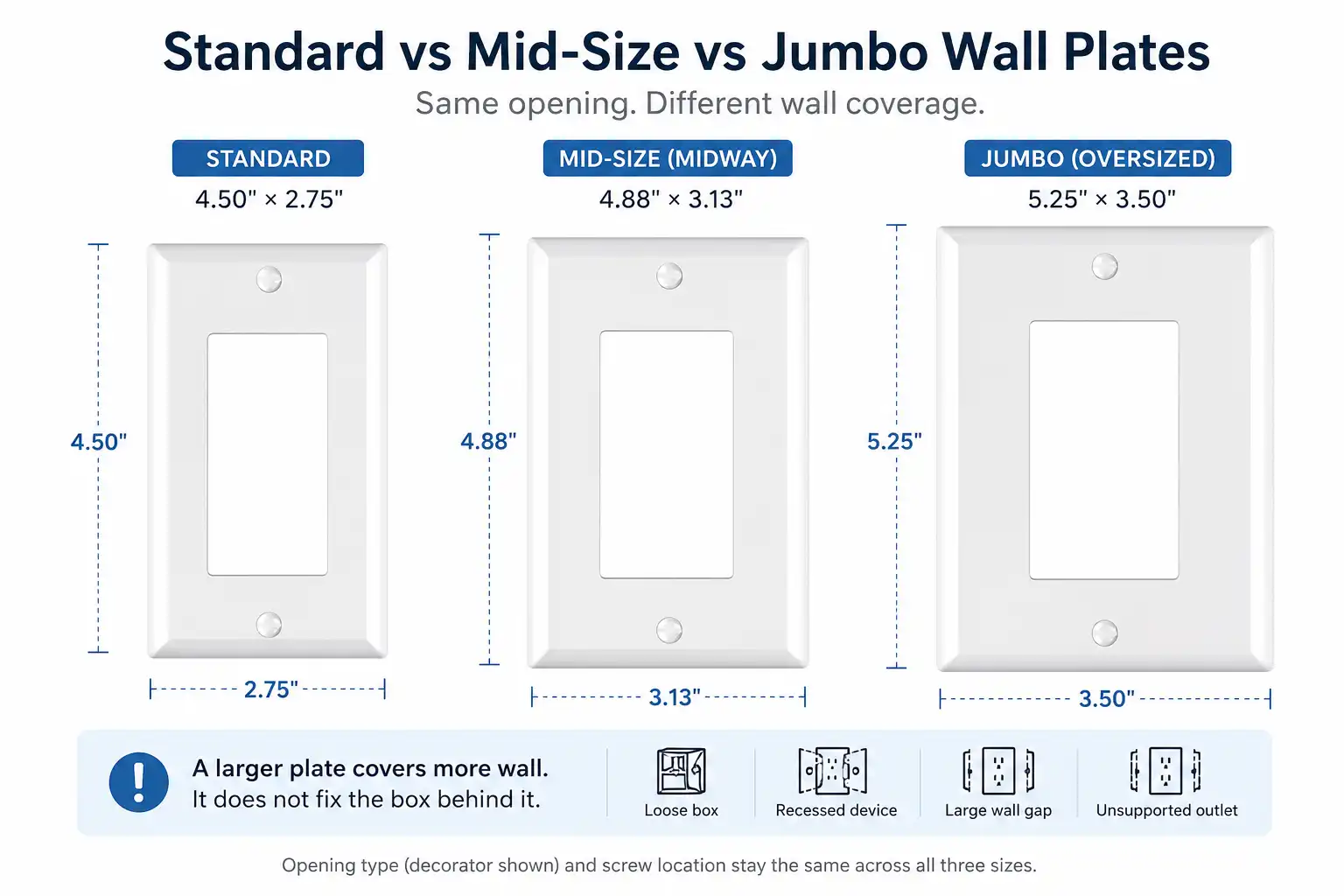
A jumbo plate adds roughly three-quarters of an inch on each dimension over standard. That is all it adds. It does not move the screw holes, it does not change the device opening, and it does not make the wall behind it any more finished than it was.
The Opening Stays Put; Only the Rim Grows
Across standard, mid-size, and jumbo, the device opening and the screw locations are the same. A jumbo decorator plate and a standard decorator plate seat on the identical device; the jumbo just reaches farther out onto the wall. Size class and opening type are two separate columns on a spec — the opening fits the device, the size covers the wall — and the opening side of that is its own decision, worked through in decorator vs standard receptacle.
That single fact — same opening, bigger rim — is the whole reason size gets misused.
What Each Size Is Actually For
| Size class | Typical 1-gang outer size | What the extra rim does | What it does not do |
|---|---|---|---|
| Standard | 4.5 × 2.75 in | The clean default — sits close to the device, least wall covered | — |
| Mid-size (midway) |
about +0.375 in each way | Covers a thin paint line or a slightly chipped drywall edge | Hide a real gap or a recessed box |
| Jumbo (oversized) |
about +0.75 in each way | Reaches over a wider paint shadow or rough cut from a device swap | Make an oversized hole or unsupported box compliant |
Exact outside dimensions vary by manufacturer. The North American shorthand is usually standard, mid-size / midway, and jumbo / oversized.
Standard is what moves in volume, because most plates ship to dress a receptacle or switch that went in clean. Mid-size earns its place on repaints and device swaps, where the old plate left a witness line the new device doesn’t quite reach. Jumbo is the deliberate one — useful for a specific renovation edge, and a poor default everywhere else.
A Bigger Plate Is Not a Code Fix
This is the line that matters on a project. A plate covers the wall to the eye; the code reads the box, not the plate.
NEC 314.21 requires that a broken or incomplete noncombustible surface — drywall, plaster, plasterboard — around a flush-cover box be repaired so that no gap or open space at the edge of the box is greater than 1/8 inch (3 mm). A jumbo plate hiding a half-inch gap does not satisfy that; the gap still has to be repaired, the plate just stops anyone from seeing it.
So the list of things a larger plate cannot fix is short and worth stating plainly: a loose box, a recessed device, an unsupported receptacle, a box set back too far, or a wall gap past an eighth of an inch. Size covers a finish irregularity. It does not stand in for box support, an extension ring, or drywall repair.
When Jumbo Reads as the Repair
There is a cost to reaching for jumbo by reflex. On a clean wall, an oversized plate is a tell. A service electrician or a finish trade reads it as a goof plate — the cover that went on because something behind it was rough — and on a high-end or hospitality corridor that signal is the opposite of the finish the project paid for. Mixing standard plates through most of a run and a jumbo at one box makes the one box the thing the eye lands on.
The plate that disappears is usually the smallest one that still covers the cut. Bigger is a fix for a real edge, not an upgrade.
The Material Line Nobody Asks About Up Front
One thing size has nothing to do with: color hold. A white plate yellows over years — that is how the white polymers used in cover plates age, and direct sun speeds it. A better base resin slows the shift; it does not stop it. The point for a schedule is that color is a material-and-time question, not a size one, so a wall standardized on one white today can drift unevenly later if half the plates are swapped down the line. Buy the run in one material and one lot where the finish has to stay matched.
Putting Size on the PO
A plate order that names the opening but not the size lands as standard on our desk, because standard is what dresses a clean install and that is what most plates do. Size class only needs calling out when the wall asks for it.
Standard line
1-gang decorator wall plate, standard size, [color], UL 514D / cUL listed, to match the GFCI / USB / receptacle / switch family in the gang.
Mid-size replacement line
1-gang decorator wall plate, mid-size, [color], for paint-line or drywall-edge coverage on a device swap, same decorator opening.
Jumbo renovation line
1-gang decorator wall plate, jumbo, [color], for a specific wall-finish edge — confirm the box gap and support are corrected, since the plate covers the finish, not the box.
We make the plate in all three sizes and the full color range, we label the color and size class on the carton and inner box, and we default to standard when an order gives us the opening and no size. We do not rule on whether a wall gap is legal, whether a box is supported, or what the AHJ will accept — those sit with the people at the wall.
Before the plate line is set
Tell us the opening and we’ll match the plate family; if a wall edge needs mid-size or jumbo, say where, and we’ll confirm color, material, and carton labeling across the run. Browse the wall plate line, or send the schedule to the team.
The Other Columns on a Plate Spec
The opening side of a plate spec — decorator rectangular versus standard duplex versus toggle — is the other column, separated in decorator vs standard receptacle. When the device behind the plate is a switch, whether it’s single-pole or three-way is a function call that doesn’t touch plate size, covered in 3-way switch vs single pole. And the take-off habit underneath all of these — read each spec column on its own line instead of off the device — runs through the GFCI receptacle sourcing decision map.
FAQ
What is the difference between standard, mid-size, and jumbo wall plates?
Outer coverage. Standard is the smallest and the default; mid-size adds about 0.375 inch each way; jumbo adds about 0.75 inch. The device opening and screw locations are identical across all three — only the rim that reaches onto the wall changes.
Are mid-size and midway wall plates the same?
Yes. “Midway” is a common manufacturer name for the mid-size class.
Can a jumbo wall plate cover a drywall gap?
It can hide one from view, but it does not make it right. NEC 314.21 still requires the gap at the box edge to be closed to within 1/8 inch on drywall or plaster. Repairing the gap and dressing it with a plate are two different steps.
Does a jumbo wall plate fit the same switch or outlet?
Yes. Same opening, same screws — a jumbo seats on the identical device a standard plate does. The only difference is how far it reaches onto the wall.
Is a jumbo plate better than a standard one?
Not by default. It’s the right call for a specific wider wall edge and the wrong one on a clean wall, where an oversized plate reads as a cover for a problem rather than a finished look.
What should a wall plate PO line include?
The opening type (decorator, duplex, toggle), the size class (standard, mid-size, jumbo), gang count, color, material, and the listing and mark (UL 514D / cUL). If the order names the opening and no size, expect standard.
Sources
- UL 514D, Cover Plates for Flush-Mounted Wiring Devices — scope covers metallic and nonmetallic cover plates and associated gaskets for flush-mounted wiring devices under the NEC and Canadian Electrical Code:
UL 514D Scope - CSA C22.2 No. 42.1 — Canadian companion standard for cover plates for flush-mounted wiring devices:
CSA C22.2 No. 42.1 - NEC 314.21 — noncombustible surfaces broken or incomplete around a flush-cover box must be repaired to no gap greater than 1/8 in (3 mm) at the box edge:
NEC 314.21 Public Code Discussion - NEC 314.20 — the box, plaster ring, extension ring, or listed extender front edge must not be set back of the finished surface more than 1/4 in:
NEC 314.20 Reference - Plate size references for standard, mid-size, and jumbo outer dimensions:
Lowe’s Wall Plate Buying Guide,
Leviton Wallplate Size Guide,
Kyle Switch Plates Size Reference