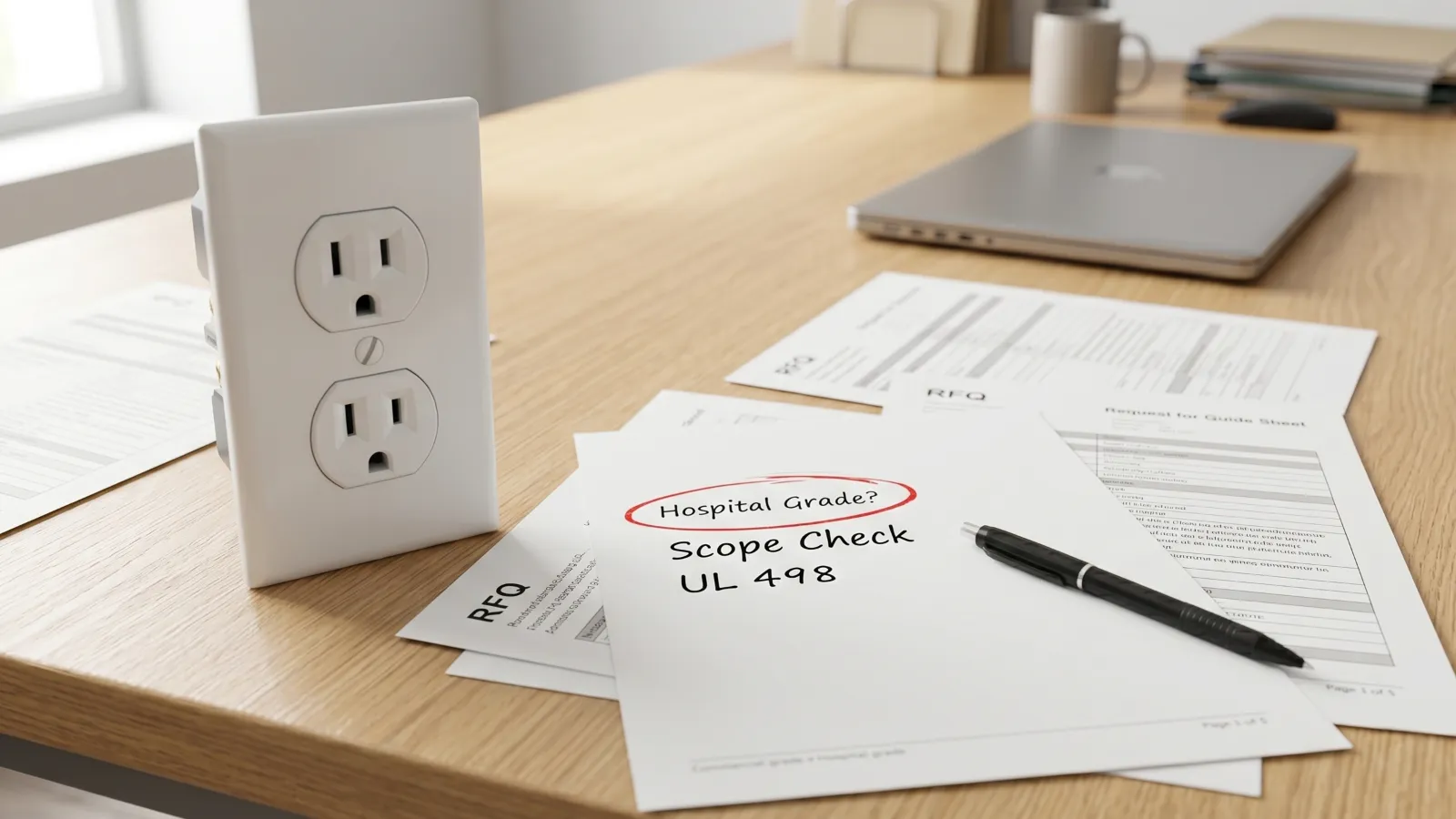
In late April 2023, during the Canton Fair, a buyer from Texas came to our booth asking about GFCI receptacles and duplex receptacles. He was trying to break into a market segment his current sourcing did not cover. Then he asked: could we supply hospital-grade?
Our first question back was: where are they going.
What that question sorts out, and why we ask it before answering “yes” or “no” to hospital-grade inquiries, is what this article is about.
The Right Answer Is Sometimes “We Do Not Make That”
We do not list, mark, or sell hospital-grade receptacles.
The hospital-grade procurement channel is dominated by established healthcare wiring-device brands with decades of submittal history, project references, and healthcare-channel documentation. We made a deliberate decision not to compete there.
The reason is not a single material feature. Hospital-grade is a separate listed scope: testing, marking, documentation, submittal history, and healthcare procurement expectations all have to line up. Our current line is not positioned for that scope.
A few B2B suppliers say yes to every product question by default. The reasoning is understandable — a new account is a new account. But hospital-grade procurement is one of the categories where saying yes when the answer should be “not on this line” creates problems downstream: at submittal review, at AHJ inspection, at the moment a project’s electrical engineer asks the supplier to produce the UL 498 Supplement SC hospital-grade listing documentation that backs a Hospital Grade marking.
Saying it up front protects the buyer’s project timeline. Saying it up front also keeps the part of our business that supplies commercial-grade and industrial-grade product clean — we are not running two parallel stories about what our line does.
That is the boundary.
The Texas Inquiry, and How It Resolved
Back to the buyer at the Canton Fair.
His actual need turned out not to be Hospital Grade-listed receptacles for a large hospital project. He was looking for product he could use in small healthcare or clinic-support environments where the engineer of record and AHJ did not require Hospital Grade-listed receptacles. He wanted product more robust than standard commercial-grade.
We supplied him reinforced commercial-grade — UL-listed commercial product from a line we already run, with attention to plug retention and assembly integrity that holds up under higher-use conditions. We did not put Hospital Grade markings on the product. We did not recommend he position it as a Hospital Grade alternative when talking to his own customers. He understood the distinction. The order shipped.
The same Canton Fair week, two other buyers asked the same question. One was a U.S. distributor wanting to add hospital-grade to his catalog as a marketing tier above commercial — we told him our line is not the right source for that. The other was a project sourcing agent for a large hospital expansion — we suggested looking at a product line already built and documented for hospital-grade healthcare procurement, and we did not quote.
Three conversations. Three different answers. The question “where are they going” is what produces three different answers instead of one default yes.
Hospital Grade Is Not the Next Tier After Commercial Grade
Residential. Commercial. Industrial. Hospital-grade.
These are not four steps on a ladder. The first three are a continuum of durability and material specification — heavier brass, longer contact life, higher flame-retardant rating as the tier climbs. The same grade-tier logic applies to amperage decisions on general-use circuits — durability lives in the grade, not the amperage label. Hospital-grade sits on a different axis. It is a listed product scope evaluated under UL 498 Supplement SC and applied under NEC Article 517 for specific clinical environments.
The Supplement SC test scope includes:
- An abrupt plug-removal test — a 10-pound weight dropped from 24 inches pulls a steel-bodied test plug out of the receptacle, repeated 8 times with the receptacle rotated through different positions; after that, the grounding contact must retain a 4-ounce grounding pin for one minute with the receptacle facing down
- Grounding contact temperature and resistance testing
- Fault current testing
- Assembly integrity requirements
- A green dot marking visible on the face after the cover plate is installed
Those requirements are not answered by one thicker contact or one different plastic housing. The product has to be built, tested, listed, marked, and documented for that scope. A commercial-grade receptacle with stronger materials remains commercial-grade unless the listed hospital-grade test and marking chain exists behind it.
Our commercial-grade and industrial-grade lines use flame-retardant polycarbonate across the device housing, and our higher-tier line is built for stronger plug retention and longer insertion-cycle endurance than the residential baseline. That is the correct conversation when a buyer needs durability for a non-hospital-grade application — the kind of conversation that comes up when buyers default to “20A everywhere as an upgrade” instead of asking about grade tier.
But those material choices do not make the product hospital-grade. The difference is the listed scope. The green dot is not the source of the certification — it is the visible end of a test, marking, and documentation chain that has to exist before the marking appears on the face.
The obstacle is not one component. It is the scope. Hospital-grade procurement for large healthcare facilities runs through submittal packages, listing documentation, project references, and channel expectations that established healthcare wiring-device product lines have built over many years. Our current line is not that line, and we are not going to manufacture that impression through label adjustment.
What the Green Dot Marks
The green dot on a receptacle face means one thing: this device is listed Hospital Grade under UL 498 Supplement SC.
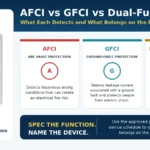
It does not mean isolated ground. It does not mean emergency or backup power. It does not mean tamper-resistant — TR is a separate NEC 406.12 listing requirement. It does not mean GFCI. These are independent markings with independent listings and independent applications.
| Marking buyers sometimes confuse with green dot | What that marking actually means |
|---|---|
| Orange triangle | Isolated ground receptacle |
| Red device body | Facility convention for emergency or critical branch circuit |
| “TR” marking | Tamper-resistant per NEC 406.12 |
| GFCI TEST / RESET buttons | Ground-fault circuit interrupter per UL 943 |
A hospital-grade receptacle can also be tamper-resistant. It can also be GFCI. But the green dot alone settles only one question. If a project specification needs the others, they have to be specified separately on the PO line.
What We Do, What We Do Not
We supply UL- and cUL-listed general-use receptacles, GFCI receptacles, USB outlets, switches, and wall plates. We supply commercial-grade and industrial-grade product for high-durability applications, with grounding configuration and project documentation reviewed against the buyer’s stated specification.
We do not put hospital-grade markings on product that was not listed and tested under UL 498 Supplement SC. We do not enter large-hospital procurement channels where established healthcare wiring-device product lines have been the spec-of-record for decades. We do not interpret patient-care space classification on a buyer’s behalf — that is the engineer of record’s call.
Frequently Asked Questions
What does the green dot on a receptacle mean?
It means the receptacle is listed Hospital Grade under UL 498 Supplement SC. The green dot is the face-side identification, visible after the cover plate is installed. Without the listing behind it, a green dot on a face is not a hospital-grade marking — it is a sticker.
Is hospital-grade the same as isolated ground?
No. Hospital-grade is a UL 498 Supplement SC listed product scope identified by the green dot. Isolated ground is a separate construction with a separate marking, usually an orange triangle on the face. A receptacle can be hospital-grade, or isolated ground, or both at the same time, or neither.
Are hospital-grade receptacles required in every medical building?
No. NEC Article 517.18 and 517.19 require hospital-grade receptacles in specific patient bed locations within General Care (Category 2) and Critical Care (Category 1) spaces. Doctor offices, exam rooms, waiting areas, and outpatient facilities that do not meet the patient bed location definition are not automatically required to use hospital-grade receptacles. The classification belongs to the engineer of record and the local AHJ.
Can I use hospital-grade receptacles in a home or office?
Yes, physically. They are interchangeable with general-use receptacles at the NEMA 5-15R / 5-20R level. Whether it is the right purchase is a different question — for most residential and office use, commercial-grade is the appropriate match to the actual load and use profile, and the hospital-grade premium does not buy you anything you will use.
Is hospital-grade just a stronger commercial-grade receptacle?
No. Hospital-grade is a listed product scope with specific UL 498 Supplement SC test requirements — abrupt plug removal, grounding contact temperature, fault current, assembly integrity — and specific markings. A commercial-grade receptacle with thicker brass is not hospital-grade. The marking has to be backed by the Supplement SC listing, not the other way around.
Why does ShengYu not offer hospital-grade receptacles?
The hospital-grade procurement channel for large healthcare facilities is dominated by product lines with decades of submittal history, healthcare-channel documentation, and spec-of-record presence. We made a deliberate decision not to compete there. We supply commercial-grade and industrial-grade product, and we do not put Hospital Grade markings on product that was not listed for that scope.
Sources
- NFPA 70, National Electrical Code (2026 edition) — Article 517.18, 517.19, 517.16. Free read-only access via NFPA: NFPA 70
- NFPA 99, Health Care Facilities Code — patient care space categories (Category 1 and Category 2): NFPA 99
- ANSI/UL 498, Attachment Plugs and Receptacles, Supplement SC — Hospital Grade Devices. ULSE Standards Catalog: UL 498
- UL Solutions, “Attachment Plug and Receptacle Safety Evaluations”: UL Solutions
- IAEI Magazine, “Receptacle Grades: What Do They Mean?”: IAEI Magazine
- StayOnline, “NEMA Hospital Grade Plugs and Receptacles” technical reference
Author & Review
Prepared by the ShengYu Engineering Team — the five-engineer product and compliance group behind ShengYu’s UL-listed and cUL-listed wiring devices since 2006. The team covers UL 498 submittal review, NEC compliance, product design, and QC. This article was reviewed against NFPA 70 (2026 edition), NFPA 99 patient care space classifications, and UL 498 Supplement SC hospital-grade test requirements before publication.
Related Reading
Working on a project where the receptacle scope sits between commercial-grade and hospital-grade, and you are not sure which side to source from?
Send us the application — building type, space classification if you have it, expected use intensity, and certification scope. We will tell you whether ShengYu is the right supplier for that destination, or whether the project belongs in a different channel. We say that at quote stage, not after the PO is signed.