UL’s circuit-breaker marking guide uses “Combination AFCI” for one device category. A breaker carrying both Class A GFCI and combination-type AFCI functions receives the longer identifier “CB/GFCI/Combination AFCI.”[1]
An RFQ shortened to “AFCI/GFCI outlet” removes the words that identify the product.
The slash can hide a breaker, a dual-function receptacle, or two devices installed at different points on one circuit. Before pricing starts, the protection requirement has to pass through the panel schedule, device schedule, takeoff, and PO without changing meaning.
From Protection Requirement to Product Line
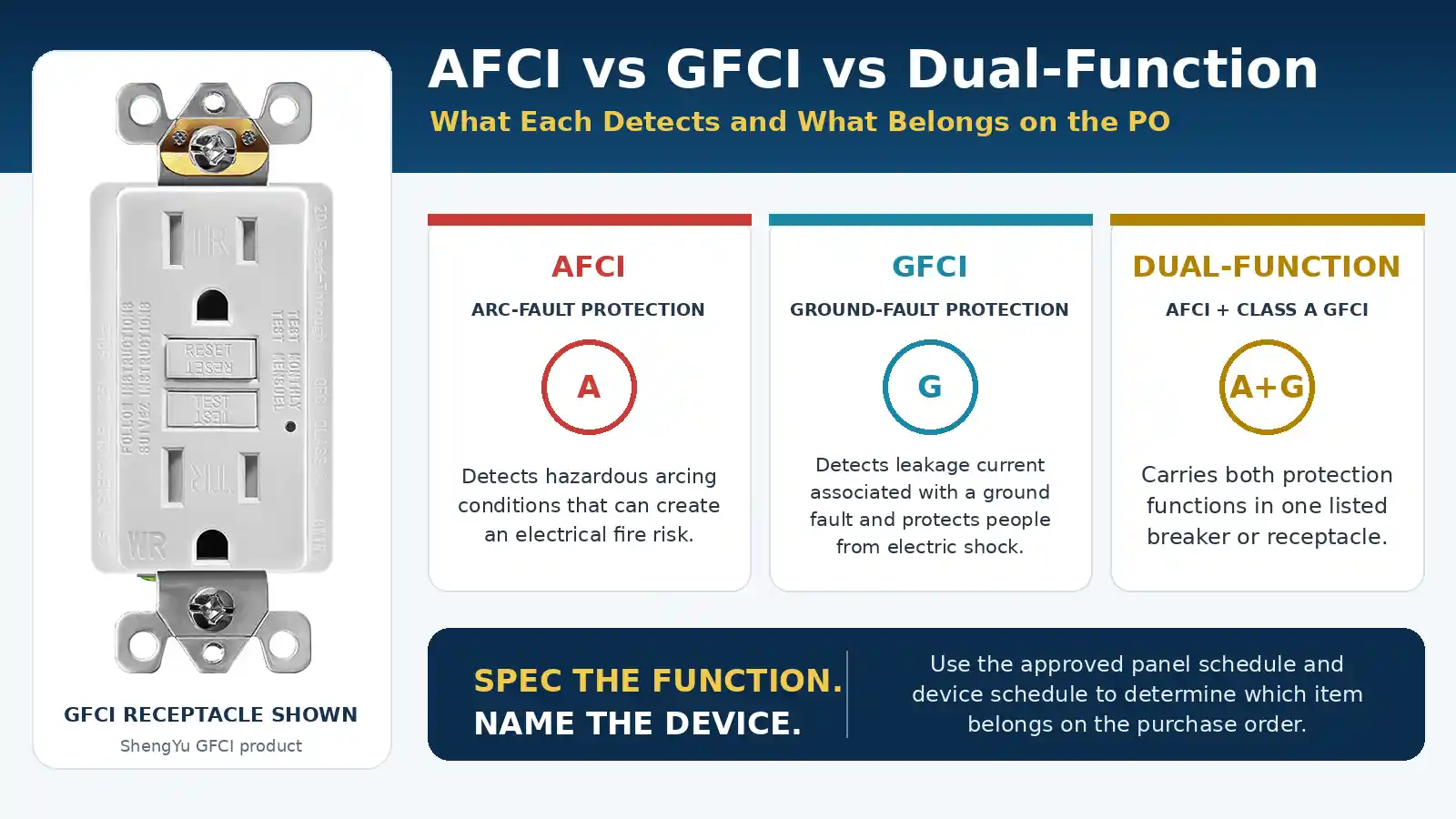
A GFCI monitors current leaving and returning through the intended circuit path. It opens the circuit when the detected imbalance indicates leakage. The protection is aimed at electric-shock hazards from ground faults.[2]
An AFCI monitors for arcing conditions that can create a fire-ignition risk. UL 1699 covers several AFCI forms. UL 1699A adds requirements for outlet branch-circuit AFCIs used with UL 1699.[4][5]
A dual-function device carries AFCI and Class A GFCI functions in one product. Breaker and receptacle versions both exist. The product form still has to be named.[6][7]
| Wording in the project file | Detection function stated | Product form stated | PO status |
|---|---|---|---|
| AFCI protection | Arc-fault protection | No | Incomplete |
| GFCI protection | Ground-fault protection | No | Incomplete |
| Dual-function protection | AFCI and Class A GFCI | No | Incomplete |
| Dual-function breaker | Both functions | Breaker | Panel details still required |
| Dual-function receptacle | Both functions | Receptacle | Rating and certification still required |
| AFCI breaker + GFCI receptacle | Functions split across two devices | Breaker and receptacle | Two purchasing lines required |
One Word Changes the Product Category
Combination AFCI does not mean AFCI plus GFCI.
In AFCI terminology, “combination” identifies protection against both series and parallel arcing conditions. UL’s marking guide keeps that category separate from a breaker carrying Class A GFCI protection. The latter uses “CB/GFCI/Combination AFCI” or the full equivalent wording.[1][7]
| Original wording | Problem inside the wording | Revised purchasing description |
|---|---|---|
| Combination AFCI breaker | GFCI function has not been stated | Keep as an AFCI breaker unless the approved schedule adds GFCI |
| Dual-function AFCI/GFCI breaker | Product form is clear | Add panel compatibility, rating, pole count, model, and certification |
| Dual-function AFCI/GFCI receptacle | Product form is clear | Add rating, receptacle configuration, model, and certification scope |
| Combination AFCI/GFCI outlet | Combination and dual-function terminology have been mixed | Return to the approved schedule before quotation |
| AFCI breaker + GFCI receptacle | Two products carry separate functions | Issue separate panel and wiring-device lines |
For a buyer, the first correction is small: preserve the formal device term before adding amperage, color, certification, or packaging. Those later fields cannot repair the wrong category.
Follow the Circuit Through the Project File
The electrical note records the protection requirement. “Provide AFCI and GFCI protection” identifies two functions. It leaves the product location open.
The panel schedule records the breaker. A breaker line needs the approved type, pole configuration, rating, panel family, and model path. Panel compatibility belongs here because the breaker has to match the equipment named in the schedule.
The device schedule records the wall device. It can call for a standard receptacle, GFCI receptacle, AFCI receptacle, or dual-function receptacle. Amperage, face configuration, TR, WR, grade, and color enter the file at this point.
The takeoff converts those records into quantities.
A count of protected locations cannot move directly into the GFCI quantity column. One protective device can serve downstream outlets when the listed device and installation method provide LOAD-side protection.
An official dual-function receptacle product page, for example, identifies 20A feed-through protection for its listed devices. This is a product-specific detail rather than a rule for every dual-function receptacle.[6]
The PO preserves the selected path. It names the breaker on the panel order and the receptacle on the wiring-device order.
When the Breaker Carries Both Functions
When one dual-function breaker serves a circuit with several receptacle outlets, the panel schedule and device schedule produce different quantities.
| Count retained in the takeoff | Source document |
|---|---|
| Circuits requiring AFCI protection | Electrical notes and panel schedule |
| Circuits requiring GFCI protection | Electrical notes and panel schedule |
| Dual-function breakers | Approved panel schedule |
| GFCI receptacles | Approved device schedule |
| Standard receptacles | Approved device schedule |
A location can receive both forms of protection while using a standard receptacle face. The breaker carries the detection functions in that design.
A different project can place GFCI protection at a receptacle. The resulting device count then comes from the wiring-device schedule, including any downstream outlets served through its LOAD terminals.
Those projects can share the same phrase in a general electrical note and still produce different orders.
Reset access and trip diagnosis change when several protective devices share one circuit, but the takeoff here keeps protected locations separate from protective-device quantities. Here the protected-location total and the protective-device total remain separate.
Split Protection Creates Two Purchase Packages
An approved circuit can use an AFCI breaker with a GFCI receptacle downstream. A manufacturer’s official technical FAQ confirms that a GFI receptacle can operate downstream of a CAFI or AFI breaker.[8]
The panel order carries:
- AFCI category
- Ampere rating
- Pole configuration
- Panel or load-center family
- Exact breaker model
- Required U.S. or Canadian certification
- Trip identification when the project specifies it
The wiring-device order carries:
- GFCI receptacle
- 15A or 20A
- 125V device rating
- TR, WR, or Hospital Grade configuration
- Self-test requirement
- Feed-through requirement
- Color
- Quantity
- Certification evidence
- Instructions and OEM packaging files
We manufacture GFCI receptacles and standard receptacles. We do not manufacture AFCI devices, dual-function AFCI/GFCI devices, or panel breakers. Branch-circuit design and breaker selection remain outside our supply scope.
A request reading “20A AFCI/GFCI outlet, white, UL/cUL” pauses before quotation. The buyer or design team has to identify the approved protection point.
Once the AFCI function is assigned to the breaker, our line can be narrowed to a 20A, 125V GFCI receptacle. TR, WR, self-test, grade, color, and packaging then become order fields.
The Protection Starting Point Changes the Evidence
A dual-function breaker places both protection functions in the panel package. The receptacle PO follows the wall-device schedule.
An AFCI breaker with a GFCI receptacle splits the evidence. The breaker record supports the AFCI function. The GFCI certificate, product marking, and quoted model support the receptacle line.
An outlet branch-circuit AFCI places the AFCI device at an outlet. UL 1699A covers this form and is used with UL 1699. Its scope covers outlet branch-circuit AFCIs rated up to 20A for 120V AC circuits.[4][5]
A dual-function receptacle adds another layer. One manufacturer’s listed products cite UL 1699A for AFCI, UL 943 for GFCI, and UL 498 for the receptacle function.
A buyer should request the evidence attached to the quoted model rather than copying those standards onto an unrelated product.[6]
The position of an outlet device also affects the protection path. Product instructions and the approved design define the line-side and LOAD-side coverage.
U.S. and Canada Need Separate Evidence Lines
UL lists UL 943 and CSA C22.2 No. 144.1 for Class A GFCIs. Its AFCI certification page lists UL 1699 for the United States and CSA C22.2 No. 270 for Canada.
Outlet branch-circuit AFCIs require the added product-form review described in UL 1699A.[3][4][5]
| Quoted function and form | U.S. evidence line | Canadian evidence line |
|---|---|---|
| GFCI receptacle | UL 943 plus applicable receptacle requirements | CSA C22.2 No. 144.1 plus applicable receptacle requirements |
| Combination AFCI breaker | UL 1699 plus breaker requirements | CSA C22.2 No. 270 plus applicable breaker requirements |
| OBC AFCI receptacle | UL 1699A used with UL 1699 | Applicable Canadian AFCI and receptacle certification scope |
| Dual-function breaker | AFCI, Class A GFCI, and breaker functions in the same listed model | Canadian scope covering the same functions |
| Dual-function receptacle | AFCI, Class A GFCI, and receptacle functions in the same listed model | Canadian scope covering the same functions |
The mark on the product remains part of the proof. UL states that Product iQ can verify a unique identifier or file number. [9]
For our quoted North American GFCI series, we provide the applicable certificate or certification reference during discussion. The quotation, PI, product rating, ordered configuration, and certification record have to describe the same series.
The circuit is called 120V in normal project language. The rating printed on our North American GFCI face is 125V. Our 220V GFCI belongs to other markets and stays outside this order path.
Canadian packaging needs another check. UL’s Canada Safety Scheme includes assessment of dual-language safety labeling. Customer artwork can also add French to the box, instructions, warnings, electrical information, and carton marks.
Required safety wording follows the certification documents before printing.[10]
A GFCI Name Becomes a Manufacturable Line
The inquiries reaching our sales desk use “GFCI outlet,” “GFCI receptacle,” or occasionally “GFI outlet.”
I do not know whether the same wording pattern extends across the wider market.
For our quotation process, the destination country comes first. Voltage and self-test status are confirmed separately for orders outside North America.
A North American GFCI line then moves through amperage, TR, WR, self-test, grade, and color.
Our available configurations include 15A and 20A self-test models, TR models, and TR/WR models. The WR GFCIs on our line also carry TR.
Hospital Grade GFCI versions are available in 15A and 20A, with the confirmed TR, WR, and self-test configurations.
The face is rated 125V. A 20A version uses the T-shaped slot.
LINE and LOAD appear on the back. GFCI identification appears on the side. Class A, TR, WR, and the electrical rating appear on the face when they apply. UL/cUL information is carried on the side label.
Self-Test is part of the specified configuration, though the words are not printed on the device body by default.
The model is carried through the quotation, PI, catalog or specification material, and certification records. Product and packaging markings follow the approved configuration and the customer’s OEM files. Internal batch coding remains available for factory traceability.
The indicator logic is also part of the product review:
| Condition on the quoted GFCI models | Indicator status |
|---|---|
| Normal powered operation | Green |
| Tripped | Off |
| LINE/LOAD reversed | Off; reset is blocked |
| End-of-life condition | Red; the device must be replaced |
We use these facts only for our GFCI quotation and product review. They provide no basis for claims about an AFCI breaker or a dual-function receptacle.
The July 30 Inquiry
On the evening of July 30, 2026, a buyer from Costa Rica contacted us through WhatsApp. The first request covered company information and the catalog.
We sent the catalog and the UL certification reference. The catalog also displayed the UL number.
The buyer required a UL-certified GFCI, moving the discussion to our self-test series. TR and WR had not been specified, so those fields stayed open while samples were prepared.
The exchange stayed within GFCI.
The order had already gained several facts before a sample was selected: destination market, certification request, self-test configuration, and the series connected to the certification reference.
Amperage, TR/WR, final packaging, and carton marks still needed confirmation.
A bare “GFCI outlet” line would have lost that sequence.
Two PO Corrections
A project using a dual-function breaker can separate the orders like this:
Panel order
Dual-function combination AFCI/Class A GFCI circuit breaker. Rating, pole configuration, compatible panel family, exact model, and certification shall follow the approved panel schedule.
Wiring-device order
Receptacles according to the approved device schedule. State amperage, 125V rating, TR/WR, grade, color, certification, and quantity.
The wiring-device line follows the specified face devices. Dual-function receptacles enter the order only when the device schedule names them.
A project using an AFCI breaker with a GFCI receptacle needs a different split:
Panel order
Combination-type AFCI breaker. State rating, pole count, panel compatibility, model, and certification according to the approved schedule.
Wiring-device order
Self-test Class A GFCI receptacle, 15A or 20A, 125V. State TR or TR/WR, grade, color, certification scope, packaging, and quantity.
A dual-function receptacle follows a third product route, but ShengYu cannot supply that category. The inquiry should remain with a manufacturer whose quoted model carries the required AFCI, GFCI, and receptacle certification scope.
FAQ
Is a combination AFCI the same as a dual-function AFCI/GFCI?
Combination AFCI identifies series and parallel arc-fault protection. Dual function adds Class A GFCI protection to the AFCI function.[1][7]
Does a dual-function breaker make every downstream receptacle a dual-function receptacle?
The breaker carries both detection functions in that architecture. The device schedule still determines the receptacle type and quantity.
Can an AFCI breaker and a GFCI receptacle share one circuit?
Yes. A GFCI receptacle can operate downstream of an approved AFCI breaker. The two products remain separate order lines.[8]
What information should a buyer send to a GFCI receptacle factory?
Send the destination market, amperage, 125V rating, self-test requirement, TR/WR or Hospital Grade configuration, color, quantity, certification request, and packaging files.
Include the approved device schedule when the project also uses AFCI protection.
Is a UL number enough for a U.S. and Canadian order?
Check the product mark against the applicable certificate and Product iQ record. Keep the quoted series, product category, geographic scope, ratings, and ordered configuration consistent across those records.[9]
Sources and Internal Basis
External Sources
- UL Solutions, “Molded Case Circuit Breaker – Marking and Application Guide”. Public marking guide separating “Combination AFCI” from “CB/GFCI/Combination AFCI” and identifying the Class A GFCI marking used on the dual-function breaker category.
- Occupational Safety and Health Administration, “Ground-Fault Circuit Interrupters (GFCI)”. Public explanation of GFCI current comparison, ground-fault interruption and personnel-shock protection.
- UL Solutions, “GFCI Personal Protection Devices Testing and Certification”. Public scope for Class A GFCIs under UL 943 and CSA C22.2 No. 144.1, including receptacle and circuit-breaker forms.
- UL Solutions, “Arc Fault Circuit Interrupter (AFCI) Device Testing and Certification”. Public AFCI definition, U.S. UL 1699 and Canadian CSA C22.2 No. 270 anchors, common product forms and noncord rating scope.
- UL Standards & Engagement, “UL 1699A — Outlet Branch Circuit Arc-Fault Circuit-Interrupters”. Official standard-detail page for outlet branch-circuit AFCI product-form requirements used with UL 1699.
- Leviton, “Dual Function AFCI/GFCI”. Manufacturer public anchor for dual-function receptacle form, LOAD-side feed-through, and the UL 1699A, UL 943 and UL 498 evaluations stated for its listed models.
- Schneider Electric, “What Is the Difference Between a CAFI and a DF Breaker?”. Manufacturer technical definition separating combination arc-fault protection from dual-function combination AFCI plus Class A ground-fault protection.
- Schneider Electric, “Is It OK for a GFI Receptacle to Be Used Downstream of a CAFI or AFI Arc-Fault Circuit Breaker?”. Manufacturer technical confirmation that the two devices can operate on the same circuit without interfering with each other.
- UL Solutions, “FAQ — Enhanced and Smart UL Certification Mark”. Public explanation of country codes, file numbers or unique identifiers, and Product iQ verification of certification information.
- UL Solutions, “Follow-Up Services”. Public Canadian certification resource stating that UL verifies required bilingual safety, warning and caution markings for products certified for Canada.
Internal Basis
- ShengYu GFCI product range and order fields for 15A and 20A, 125V, TR, WR, self-test and Hospital Grade configurations.
- ShengYu GFCI product-marking positions, indicator-status logic, internal traceability and OEM packaging workflow.
- ShengYu July 30, 2026 Costa Rica WhatsApp inquiry record covering catalog, UL certification reference, self-test series selection and sample preparation.