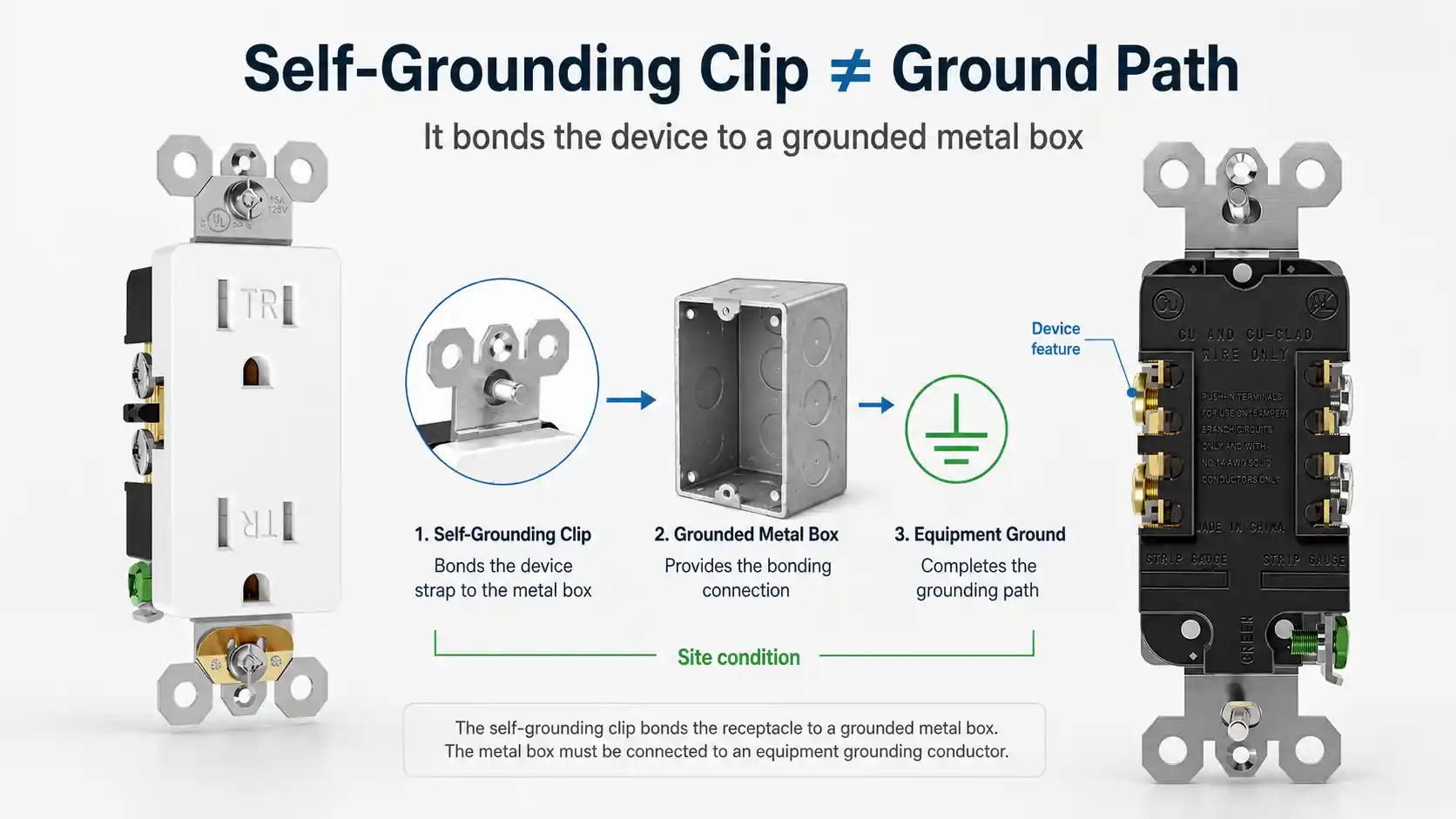
A self-grounding clip is the last inch of a ground path, and on its own it grounds the receptacle to nothing. Every receptacle we build carries one — spec, commercial, heavy-duty, and residential alike — so the clip is not the variable. Whether the box behind it is grounded is.
In May 2026, while we were running social outreach, five small wholesalers sent RFQs over WhatsApp and asked, mid-conversation, whether a self-grounding receptacle just needs a hot and a neutral. We get the other version of that question all the time: is the clip enough, do I still need a ground wire. And we’ve had the report that gives the game away — the outlet went in, the tester lit green, and the circuit turned out to have an open ground.
We build UL/cUL-listed receptacles and switches for North America. We can tell a buyer exactly what that clip on the spec sheet replaces. It can’t tell you what the box is connected to.
The clip is the last inch of a ground path
The receptacle’s ground pin connects to the device yoke. The yoke connects, through the self-grounding clip and the mounting screws, to the metal box. The box connects back through an equipment grounding conductor, or metal conduit, to the system grounded point — the path that has to carry fault current back to the source so the breaker trips. The clip sits at the very end of that run. It closes the short gap between the receptacle and the box, and nothing more.
An electrician on a code forum put it the way a spec sheet never will: the screw bonds the receptacle, not the box.
That is the role NEC 250.146(B) gives it — a listed self-grounding yoke and its screws standing in for the bonding jumper that would otherwise run to a grounded flush-mounted metal box. The box still has to be grounded first. The code is just as direct that a wire-type equipment grounding conductor has to be tied to the box by its own screw or a listed grounding device. A self-grounding receptacle does not do that job.
The self-grounding clip is a spring grounding strap riding on the mounting screw — “self-grounding” and “grounding strap” name the same copper piece, not two competing options.
Where the copper does nothing
The clip earns its keep only when the box is already part of a live ground path. Pull that assumption and the same copper strap does nothing.
A plastic box is the plainest case. There is no metal for the clip to touch, so the ground reaches the device only through the conductor landing on the ground screw.
An old metal box is the one that fools people. A box from a mid-century house, fed by cloth wiring or an aging BX run, can have no continuous path back to the panel. The clip bonds the receptacle to that box perfectly, and the box leads nowhere — its own bond to the system was never there or has corroded away. Metal you can touch is not the same as metal that is bonded.
A raised or exposed-work cover changes the answer again. Whether the device grounds through it depends on the cover-and-box combination being listed for that continuity; where it isn’t, a bonding jumper is still needed.
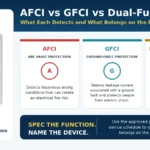
Then the GFCI swap. A GFCI protects people on a circuit with no ground at all, which is why it goes into old houses — but it does not create an equipment ground. A self-grounding GFCI on an ungrounded box gives you protection and no ground.
| Box behind the clip | What the clip does |
|---|---|
| Grounded flush metal box | bonds the receptacle to a live path — its job |
| Plastic box | nothing; the ground rides the conductor to the screw |
| Ungrounded old metal box | bonds to dead metal; no ground reaches the face |
| Raised / exposed-work cover | depends on a listed combination; a jumper can still be required |
“Grounded” on a tester is not “bonded back to the panel”
The report we hear is always some version of the same thing. It went in, the three-light tester read correct, and a later look found an open ground.
The clip wasn’t faulty. The box it bonded to was never tied back to the panel. A three-light tester can’t confirm the impedance or continuity of the whole grounding path, the bonding upstream, or the state of every box, and a miswire can fool it outright. The reading is one device at one moment, not proof that every box on the order has a ground path. That verification lives with the installer and the inspector, on site.
What the spec sheet says, and what it leaves out
Open most self-grounding spec sheets and you get one line: “automatic self-grounding clip.” Sometimes a note that it bonds the strap to the metal box. The precondition is never printed — that the box has to be grounded for any of it to mean anything.
What we can speak to on our own line: every receptacle we ship carries the clip, across spec, commercial, heavy-duty, and residential grades, and it is a copper spring strap riding on the mounting screw. Our switches use the same idea with an extended copper clip. We check ground continuity by sampling — five to ten percent of a batch, not every piece.
The state of a wall we will never see is the part no sheet can carry. The clip is a device feature; a grounding path is a site condition. Those two collapse into the single word “self-grounding,” and that is where the RFQ questions and the open-ground surprises come from.
Specifying it without overselling it
“Self-grounding receptacle” on a purchase order names the feature and stops. It hasn’t said what the installer is grounding to. A line that closes the gap tends to carry:
- the grade and rating — spec or commercial, 15A or 20A, TR, the way a 15A vs 20A receptacle spec is written out
- the terminal, named plainly — screw-pressure-plate back-wire or side-wire, the distinction worked through in back-wire vs side-wire vs backstab
- the self-grounding clip and the separate ground screw, both, so a jumper is available when a raised cover or local practice calls for one
- a note that the device is for grounded metal box applications, with the grounding path verified on site
The last line is the one no supplier can fill for you. We build the receptacle, fit the copper clip, and sample-check the continuity the device controls. We don’t wire the box, run the conductor, or decide whether a wall is grounded. When a job hangs on whether an old box is bonded, that is the installer’s and the AHJ’s call, and we point to the listing rather than rule on it. An isolated-ground requirement is a separate category, not something the self-grounding clip addresses — the same line between grades drawn in hospital-grade receptacles and what we don’t build.
FAQ
Do self-grounding outlets need a ground wire?
The circuit still needs a grounding path. On a grounded metal box, the clip can replace the bonding jumper from the receptacle to the box, so a separate pigtail to the device may not be required. The equipment grounding conductor still has to reach and bond the box. On a plastic box, the ground wire lands on the device’s ground screw — the clip has no metal to bond to.
Does a self-grounding outlet need a metal box?
It needs a grounded one to do anything. The clip bonds the receptacle to a metal box; with a plastic box there is nothing for it to grab.
Is a metal box automatically grounded?
No. A metal box is grounded only if it is bonded back to the panel through an equipment grounding conductor or qualifying metal raceway. Older boxes can be metal and ungrounded at once.
Is the self-grounding clip enough by itself?
It is enough to bond the receptacle to a box that is already grounded. It is not a substitute for a grounding path that isn’t there.
Can a GFCI replace a ground?
A GFCI protects people on an ungrounded circuit, which is why it’s allowed as a retrofit, but it does not create an equipment ground. A self-grounding GFCI on an ungrounded box still has no ground.
Sources
- NEC 250.146 summary via UpCodes — equipment bonding jumper required from the receptacle grounding terminal to a grounded metal box, except per 250.146(A)–(D):
NEC 250.146 Summary - EEPower, NEC Basics: Equipment Grounding Conductors in Receptacles and Boxes — listed self-grounding yoke with a spring-type grounding strap and the effective ground-fault current path between receptacle and box:
EEPower Equipment Grounding Conductors in Receptacles and Boxes - EC&M, Rules for Connecting a Receptacle Grounding Terminal to an EGC — surface-box, self-grounding yoke, floor-box, and isolated-ground exceptions to the bonding-jumper rule:
EC&M Receptacle Grounding Terminal to EGC - EC&M, Attachment of Equipment Grounding Conductor to Box — 250.148(C): a wire-type EGC must connect to the metal box with a grounding screw, listed fitting, or listed grounding device:
EC&M Attachment of EGC to Box - Electrical License Renewal, NEC 406.4(D)(2) Non-Grounding-Type Receptacles — public code summary explaining GFCI replacement on non-grounding-type receptacles and the “No Equipment Ground” marking:
NEC 406.4(D)(2) GFCI Replacement Summary - Leviton GFCI product category — product feature note stating that the standard self-ground clip grounds the device in grounded metal box installations:
Leviton GFCI Self-Ground Clip Feature - Leviton DR15S-GW product page — commercial-grade, tamper-resistant, self-grounding receptacle product data showing ground clips, grounding screw, and self-grounding specification language:
Leviton DR15S-GW Self-Grounding Receptacle - Hubbell Wiring Device-Kellems IG5262 specification PDF — automatic self-grounding clip described as assuring ground continuity between mounting strap and metal wall box:
Hubbell IG5262 Self-Grounding Clip Specification - Mike Holt forum, Self-grounding receptacles — practitioner reading that the screw bonds the receptacle, not the box, and that many jobs still land a ground at the device:
Mike Holt Self-Grounding Receptacles Discussion - Mike Holt forum, Does self-grounding receptacle meet 250.148(C)? — discussion separating device bonding from metal box bonding, including raised-cover cases:
Mike Holt 250.148(C) Self-Grounding Discussion
Related reading
Before the spec is sent
Browse the duplex receptacle category.
Questions on what a self-grounding spec line actually covers? Talk to us.